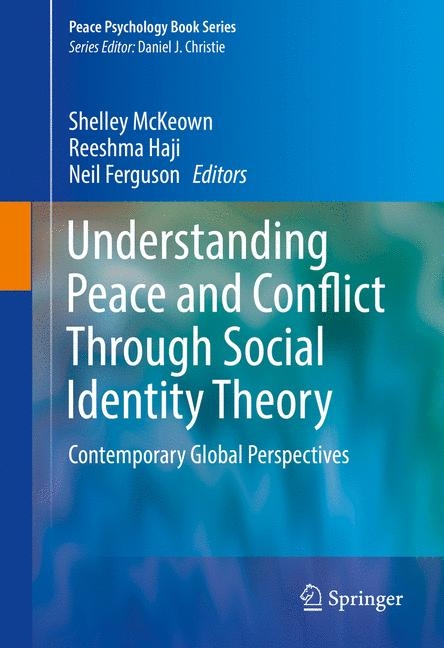
Understanding Peace and Conflict Through Social Identity Theory (eBook)
XX, 387 Seiten
Springer International Publishing (Verlag)
9783319298696 (ISBN)
It is evident that any account of peace requires an intricate understanding of identity both as a cause and consequence of conflict, as well as a potential resource to be harnessed in the promotion and maintenance of peace. Understanding Peace and Conflict Through Social Identity Theory: Contemporary Global Perspectives aims to help achieve such an understanding and as such is a valuable resource to those studying peace and conflict, psychologists, sociologists, anthropologists, public policy makers, and all those interested in the ways in which social identity impacts our world.
Shelley McKeown Jones is lecturer in the psychology of education at the University of Bristol. She teaches social psychology and research methods on the MSc Psychology of Education programme. Her research focuses on how social psychological theories, such as intergroup contact theory and social identity theory, can be used to understand and improve intergroup relations. Shelley has published a number of journal articles and a book on identity, segregation and peacebuilding in Northern Ireland.
Reeshma Haji (PhD. York University) is an assistant professor in psychology at Laurentian University. She teaches courses in social psychology and research design and also supervises undergraduate and graduate research. Her research focuses on intergroup relations of religious groups and minority group identities in diverse societies. Dr. Haji has published journal articles and book chapters that have applied social psychological perspectives to religious identity and interfaith relations.
Neil Ferguson (D.Phil., Ulster, 1998) is Professor of Political Psychology at Liverpool Hope University. His research and writings deal with moral development and a number of topics located within political psychology. Professor Ferguson is currently the President of the MOSAIC - Moral and Social Action Interdisciplinary Colloquium and is a member of the Governing Council for the International Society of Political Psychology (ISPP). He also serves on the editorial boards of the Journal of Moral Education and the Journal of Social and Political Psychology and is a trustee of the Journal of Moral Education Trust.
Shelley McKeown Jones is lecturer in the psychology of education at the University of Bristol. She teaches social psychology and research methods on the MSc Psychology of Education programme. Her research focuses on how social psychological theories, such as intergroup contact theory and social identity theory, can be used to understand and improve intergroup relations. Shelley has published a number of journal articles and a book on identity, segregation and peacebuilding in Northern Ireland.Reeshma Haji (PhD. York University) is an assistant professor in psychology at Laurentian University. She teaches courses in social psychology and research design and also supervises undergraduate and graduate research. Her research focuses on intergroup relations of religious groups and minority group identities in diverse societies. Dr. Haji has published journal articles and book chapters that have applied social psychological perspectives to religious identity and interfaith relations. Neil Ferguson (D.Phil., Ulster, 1998) is Professor of Political Psychology at Liverpool Hope University. His research and writings deal with moral development and a number of topics located within political psychology. Professor Ferguson is currently the President of the MOSAIC - Moral and Social Action Interdisciplinary Colloquium and is a member of the Governing Council for the International Society of Political Psychology (ISPP). He also serves on the editorial boards of the Journal of Moral Education and the Journal of Social and Political Psychology and is a trustee of the Journal of Moral Education Trust.
Social identity and peace psychology: An IntroductionReeshma Haji, Shelley McKeown Jones and Neil Ferguson Section 1 Theoretical and Contemporary Issues.Part I: History and development of social identity theory1. Social identity theoryMichael A. Hogg2. Towards a Clearer Understanding of Social Identity Theory’s Self-Esteem HypothesisSarah E. Martiny and Mark Rubin3. Between the lines of us and them: Identity threat, anxious uncertainty, and reactive ingroup affirmation – how can antisocial outcomes be prevented?Adrian Lüders, Eva Jonas, Immo Fritsche and Dimitrij AgroskinPart II: Social identity as a source of conflict and peace4. Identity and Acculturation Processes in Multicultural SocietiesSofia Stathi and Claudia Roscini5. Tyranny and leadershipStephen Reicher, S. Alexander Haslam, Michael Platow and Nik Steffens6. Crowd behaviour and collective actionStephen T. La Macchia and Winnifred R. Louis7. The Role of Social Identity in the Recruitment and Reintegration of Child Soldiers Michael G. Wessells Part IV: Contemporary issues8. Symbolic reminders of identityRebekah A. Phillips DeZalia and Scott L. Moeschberger9. Identity and psychological healthOrla T. Muldoon, Robert D. Lowe and Katharina Schmid10. Global Climate Change: A Social Identity Perspective on Informational and Structural InterventionsMark A. Ferguson, Rachel I. McDonald and Nyla R. Branscombe Section 2 Worldwide PerspectivesPart I: Africa11. Social Identity Theory as a Theory of Change: The Case of South Africa Ines Meyer, Kevin Durrheim and Don Foster12. Social Identity and Conflict in Northern UgandaGrace Lapwoch and Kennedy Amone- P’Olak13. Representations of Social Identities in RwandaSigrun Marie Moss Part II: Europe14. Social Identity Theory and Intergroup Conflict in Northern IrelandNeil Ferguson and Shelley McKeown Jones15. Social Identity in a divided CyprusCharis Psaltis and Huseyin Cakal16. Building national identity in newborn Kosovo: Challenges of Integrating National Identity with Ethnic Identity among Kosovar Albanians and Kosovar SerbsEdona Maloku, Belle Derks, Colette van Laar and Naomi EllemersPart III: North and South America17. Canada, a fertile ground for intergroup relations and social identity theoryRichard N. Lalonde, Jorida Cila and Maya Yampolsky18. Social identities and conflict in Chile: the role of historical and political processesRoberto González, Monica M. Gerber and Héctor Carvacho19. Identity, contact, and health among majority and minority ethnic groups in Mexico and ChileAnja Eller, Huseyin Cakal and David Sirlopu Part IV: Asia and Australasia20. Social Identity and Peace in the Modern Middle East: Insights from the United Arab EmiratesAngela T. Maitner and Robert Stewart-Ingersoll21. Collective and social identities in Philippine peacebuilding: Does a superordinate Bangsamoro social identity mediate the effects of collective ethnic identity? Cristina Jayme Montiel, Ma. Elizabeth J. Macapagal and Jose Jowel Canuday22. “Aussie Aussie Aussie, Oi Oi Oi”: Situating and Understanding Social Identities in Australia.Siew Fang Law and Cynthia MackenzieConclusion: The next voyageShelley McKeown Jones, Neil Ferguson and Reeshma Haji
| Erscheint lt. Verlag | 17.6.2016 |
|---|---|
| Reihe/Serie | Peace Psychology Book Series | Peace Psychology Book Series |
| Zusatzinfo | XX, 387 p. 15 illus., 4 illus. in color. |
| Verlagsort | Cham |
| Sprache | englisch |
| Themenwelt | Geisteswissenschaften ► Psychologie ► Sozialpsychologie |
| Sozialwissenschaften ► Politik / Verwaltung | |
| Schlagworte | Acculturation • child soldiers • common ingroup identity model • contemporary issues of identity • development of social identity theory • Henri Tajfel • identity threat • intergroup conflict • Northern Ireland • psychology and Climate Change • self-categorization theory • self-esteem • social identity and conflict • Social Identity Theory • social identity theory and health • South African Peace Process • tyranny |
| ISBN-13 | 9783319298696 / 9783319298696 |
| Informationen gemäß Produktsicherheitsverordnung (GPSR) | |
| Haben Sie eine Frage zum Produkt? |
 PDF (Wasserzeichen)
DRM: Digitales Wasserzeichen
Dieses eBook enthält ein digitales Wasserzeichen und ist damit für Sie personalisiert. Bei einer missbräuchlichen Weitergabe des eBooks an Dritte ist eine Rückverfolgung an die Quelle möglich.
Dateiformat: PDF (Portable Document Format)
Mit einem festen Seitenlayout eignet sich die PDF besonders für Fachbücher mit Spalten, Tabellen und Abbildungen. Eine PDF kann auf fast allen Geräten angezeigt werden, ist aber für kleine Displays (Smartphone, eReader) nur eingeschränkt geeignet.
Systemvoraussetzungen:
PC/Mac: Mit einem PC oder Mac können Sie dieses eBook lesen. Sie benötigen dafür einen PDF-Viewer - z.B. den Adobe Reader oder Adobe Digital Editions.
eReader: Dieses eBook kann mit (fast) allen eBook-Readern gelesen werden. Mit dem amazon-Kindle ist es aber nicht kompatibel.
Smartphone/Tablet: Egal ob Apple oder Android, dieses eBook können Sie lesen. Sie benötigen dafür einen PDF-Viewer - z.B. die kostenlose Adobe Digital Editions-App.
Buying eBooks from abroad
For tax law reasons we can sell eBooks just within Germany and Switzerland. Regrettably we cannot fulfill eBook-orders from other countries.
aus dem Bereich