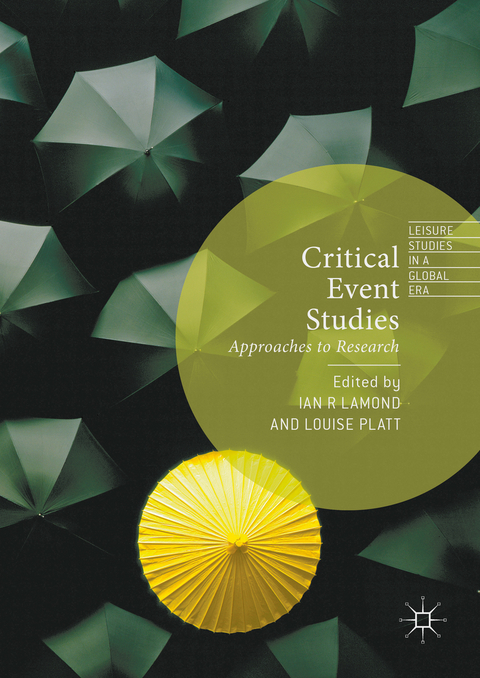
Critical Event Studies (eBook)
312 Seiten
Palgrave Macmillan UK (Verlag)
9781137523860 (ISBN)
Critical Event Studies is a growing field, not just within event management and event studies, but across the traditional and digital social sciences. This volume -with contributions from a range of international scholars- is the first to consider the wide variety of research approaches being used by academics from around the world, whose interests lie within the reach of this emerging field. Each chapter uses one or more case examples to present and discuss different methodological approaches applicable to research within critical event studies. Students and academics alike will find inspiration and critical reflection on methodology that can support their own projects.
Ian R Lamond is Senior Lecturer in Events at Leeds Beckett University, UK with a background in community theatre, arts development and cultural and political activism. His research interests include critical events studies; event theory, discourse and the body; critical discourse studies; social philosophy; political communication; and political sociology.
Louise Platt is Senior Lecturer in Festivals and Events Management at Manchester Metropolitan University, UK, where she is a programme leader for Events Management. She has a background the performing arts sector. Her research interests include mundane leisure practice and urban cultural events.
Critical Event Studies is a growing field, not just within event management and event studies, but across the traditional and digital social sciences. This volume -with contributions from a range of international scholars- is the first to consider the wide variety of research approaches being used by academics from around the world, whose interests lie within the reach of this emerging field. Each chapter uses one or more case examples to present and discuss different methodological approaches applicable to research within critical event studies. Students and academics alike will find inspiration and critical reflection on methodology that can support their own projects.
Ian R Lamond is Senior Lecturer in Events at Leeds Beckett University, UK with a background in community theatre, arts development and cultural and political activism. His research interests include critical events studies; event theory, discourse and the body; critical discourse studies; social philosophy; political communication; and political sociology. Louise Platt is Senior Lecturer in Festivals and Events Management at Manchester Metropolitan University, UK, where she is a programme leader for Events Management. She has a background the performing arts sector. Her research interests include mundane leisure practice and urban cultural events.
Contents 6
About the Authors 10
List of Figures 18
List of Tables 20
1: Introduction 21
What Is Critical Event Studies? 23
Outline of the Book 25
Part I: Critical Considerations 26
Part II: Discursive, Historical, and Ideological Perspectives 28
Part III: Encountering the Event 31
References 33
Part I: Critical Considerations 35
2: Problems of Involvement and Detachment: A Critical Approach to Researching Live Event Experiences 36
Introduction 36
Research Philosophy: The Problem of Binary Opposites 37
Norbert Elias and Problems of Involvement and Detachment 39
A Detour via Detachment 42
A Figurational Method 44
Conclusion 51
Notes 52
References 52
3: A Qualitative Case Study of the 2010 Football World Cup in South Africa: Practical Considerations and Personal Dilemmas 55
Making Sense of the Experience: Researching the 2010 FIFA Football World Cup in South Africa 55
Researching Sport Mega-Events: The State of Play 56
Issues in the Research Process: Case Study 59
Issues in the Research Process: In-Situ Snowballing 62
Issues in the Research Process: Negotiating the Insider-Outsider Dichotomy 64
Understanding South Africa 2010: Reflections on the Research Process 67
Concluding Points 72
Notes 73
References 73
4: Creating Critical Festival Discourse Through Flexible Mixed Methodological Research Design 76
Introduction 76
Philosophical Underpinning the Emergence of a Multimethods Approach to Studying Cultural Festivals
Positivist and Phenomenological Research Traditions 78
Social Constructivism 80
Trustworthiness 82
Mixed Methods, Design, and Implementation 84
Data Collection and Analysis 85
Primary Data Collection and Analysis 91
Ethical Considerations in Festival and Events Research 96
Methodological Principles to Inform and Guide Your Future Research Journey 98
References 99
Part II: Discursive, Historical, and Ideological Perspectives 101
5: The Rewards and Risks of Historical Events Studies Research 102
Why History? 102
Approaches to Events Studies 104
History in Events Studies 104
Events Studies in History 104
Methodology Available 106
Magazines, Leaflets, Flyers, and Brochures 107
Minute Books 108
Personal Papers and Organisational Collections 108
Official Documents 109
Digital Media, Newspapers, and the Press 109
Oral History 110
Case Study: Commonwealth Games 1986 111
Literature on Commonwealth Games 113
Archives 114
Why Our Conclusions Are Relevant to Events Studies 116
Concluding Remarks 119
References 120
6: Space and Memory in the Huashan Event 123
Introduction 123
Huashan Event: Unexpected Controversies of Troy, Troy…Taiwan 124
Production of Cultural Meanings: Performance, Memory, and Space 126
Metaphysical Present: Troy, Troy…Taiwan 132
Reproduction of Space: The Transformation of Huashan Winery 138
Notes 142
References 143
7: CDA, Critical Events and Critical Event Studies: How to Make Sense of Critical Events in a Society of Radical Change 145
Introduction 145
Critical Events in a Globalized Era of Radical Change 146
Making Sense of Critical Events Through Discourse Theory and CDA 148
Research Methodology in CDA 151
Using a Discourse-Analytical Approach as an Example of the Analysis of a Critical Event: The Struggle of the Spanish Indignados 152
Scope of the Struggle of 15M 152
Theoretical Framework 153
The Methodological Framework 153
The Analytical Framework 154
Interpretation 156
Evaluation of the Impact of the Struggle 156
The Role of the Internet and Social Media 157
Further Reflections on CES 157
Recommendations for Performing CES Research 158
Conclusions 160
Notes 160
References 160
8: Using a Corpus-Assisted Discourse Studies (CADS) Approach to Investigate Constructions of Identities in Media Reporting Surrounding Mega Sports Events: The Case of the London Olympics 2012 162
Introduction 162
Media Representations of Sport 165
The Methodology of Corpus-Assisted Discourse Studies (CADS): Principles and Tools 169
Discursive Constructions of Identities in Media Reporting During Global Sports Events: The Case of the London Olympics 2012 173
Conclusions 181
Notes 183
References 184
9: Examining Parasport Events Through the Lens of Critical Disability Studies 188
Studying Major Events: A Research Predicament 188
From Impacts to Process Evaluation 189
Assessing Leveraging of Parasport Events: Case Study 191
Methodological Preoccupations 193
Tools of the Trade: Methods 194
Documentation Analysis 195
Strategic Interviews 196
Observations 197
Surveys 199
Methodological Conundrums—Insiders and Outsiders… 200
Concluding Thoughts 201
Notes 202
References 203
Part III: Encountering the Event 206
10: Participatory Research: Case Study of a Community Event 207
Introduction 207
Participatory Research Processes 208
Case Study of a Community Event 212
Agreeing on the Area of Study 213
Working Together to Identify Mutually Agreed Actions 214
Becoming Immersed in the Research Project 216
Working Together to Share Their Experiences of the Research and the Data and Re-evaluate the Research Questions Posed in Phase 1 217
Authors’ Lessons Learned 218
Suggestions for Participatory Researchers 219
Conclusions 220
References 222
11: Researching from the Inside: Autoethnography and Critical Event Studies 224
Introduction 224
Autoethnography in Critical Event Studies: What and Why? 225
Autoethnography in Critical Event Studies: How? 227
Evocative Autoethnography, According to Ellis (1999) 228
Selecting a Topic 229
Data 229
Writing 230
Sharing 230
Autoethnography in Critical Event Studies: Ethics 231
Autoethnography in Critical Event Studies: Evaluation 233
Autoethnography in Critical Event Studies: Opportunities 235
References 237
12: An Ethnographic Approach to the Taking Place of the Event 241
Introduction 241
Event as Conflictual Taking Place 242
Researching the Contingent Conflictuality of Events 245
Case Studies 248
2010 FIFA Wold Cup, Johannesburg 249
Popolando-mi Culture 2014, Milan 253
Concluding Remarks 256
Notes 257
References 258
13: Experience Sampling Methods in Critical Event Studies: Theory and Practice 262
Introduction 262
An Overview of Experience Sampling Methods 263
Descriptive Experience Sampling 264
An Ontological and Epistemological Shift 265
Critical Realism 266
The Theory of Emergence and False Beliefs 267
False Beliefs 267
Phenomenology 268
Phenomenology in Event Management 269
Existential Phenomenology 270
Lifeworld 271
Implementing a Descriptive Sampling Method 272
Sample 272
Recruitment 273
Participant Incentives 274
Research Site 274
Equipment 274
Pre-briefing 275
The Phenomenological Interview 277
Conclusion 279
References 279
14: The Strength of Festival Ties: Social Network Analysis and the 2014 Edinburgh International Science Festival 285
Introduction 285
A Critique of Stakeholder-Focused Events Research and Considerations of Events Industry Network Analysis 287
Research and Development of Edinburgh’s Festival and Event Networks 291
Social Network Analysis and the 2014 Edinburgh International Science Festival 293
Step One: Read up on the Literature 294
Step Two: Developing a Theoretical Framework 295
Step Three: Developing a Research Question or Hypothesis 295
Step Four: Who Is Your Population? What Is Your Network Boundary? 296
Step Five: Gathering the Data 297
Step Six: Some Considerations on Gathering Network Data 299
Step Seven: Inputting and Structuring Data into Matrices 301
Step Eight: Initial Visualisation of the Network 301
Step Nine: Further Analysis and Interpretation of Results 302
Social Network Analysis Terms and Case Study Findings 303
Hypothesis 1: Social Network Analysis can identify individuals that others consider most important in their own work with the festival 303
Hypothesis 2: Relational Data Can Help Reveal Those People Most Important to the Functioning of the EISF Network 304
Hypothesis 3: On the Eve of the EISF There Will be Distinct Sub-networks Within the Wider Network 306
Hypothesis 4: Established and Returning Staff Are More Likely than New Recruits to Play a Central Role in the EISF Network 307
Hypothesis 5: The EISF’s Social Network Reflects the Extent to Which People Establish Festival Careers by Moving Between Organisations 309
Critical Discussion and Further Research 311
References 313
Index 317
| Erscheint lt. Verlag | 10.6.2016 |
|---|---|
| Reihe/Serie | Leisure Studies in a Global Era | Leisure Studies in a Global Era |
| Zusatzinfo | XIX, 312 p. 14 illus., 10 illus. in color. |
| Verlagsort | London |
| Sprache | englisch |
| Themenwelt | Sozialwissenschaften ► Kommunikation / Medien ► Medienwissenschaft |
| Sozialwissenschaften ► Politik / Verwaltung | |
| Sozialwissenschaften ► Soziologie ► Empirische Sozialforschung | |
| Wirtschaft | |
| Schlagworte | Cultural Events • Culture • discourse • Events Management • Event Studies • Festivals • football world cup • Leisure • media • Methodology • Politics • social context • Social Interaction • Social Networks • sports events |
| ISBN-13 | 9781137523860 / 9781137523860 |
| Informationen gemäß Produktsicherheitsverordnung (GPSR) | |
| Haben Sie eine Frage zum Produkt? |
 PDF (Wasserzeichen)
DRM: Digitales Wasserzeichen
Dieses eBook enthält ein digitales Wasserzeichen und ist damit für Sie personalisiert. Bei einer missbräuchlichen Weitergabe des eBooks an Dritte ist eine Rückverfolgung an die Quelle möglich.
Dateiformat: PDF (Portable Document Format)
Mit einem festen Seitenlayout eignet sich die PDF besonders für Fachbücher mit Spalten, Tabellen und Abbildungen. Eine PDF kann auf fast allen Geräten angezeigt werden, ist aber für kleine Displays (Smartphone, eReader) nur eingeschränkt geeignet.
Systemvoraussetzungen:
PC/Mac: Mit einem PC oder Mac können Sie dieses eBook lesen. Sie benötigen dafür einen PDF-Viewer - z.B. den Adobe Reader oder Adobe Digital Editions.
eReader: Dieses eBook kann mit (fast) allen eBook-Readern gelesen werden. Mit dem amazon-Kindle ist es aber nicht kompatibel.
Smartphone/Tablet: Egal ob Apple oder Android, dieses eBook können Sie lesen. Sie benötigen dafür einen PDF-Viewer - z.B. die kostenlose Adobe Digital Editions-App.
Buying eBooks from abroad
For tax law reasons we can sell eBooks just within Germany and Switzerland. Regrettably we cannot fulfill eBook-orders from other countries.
aus dem Bereich