Deviance and Deviants (eBook)
336 Seiten
Wiley-Blackwell (Verlag)
978-1-118-60465-6 (ISBN)
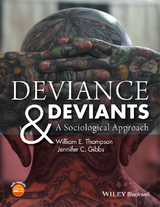
This comprehensive and engaging textbook provides a fresh and sociologically-grounded examination of how deviance is constructed and defined and what it means to be classed a deviant.
- Covers an array of deviances, including sexual, physical, mental, and criminal, as well as deviances often overlooked in the literature, such as elite deviance, cyber-deviance, and deviant occupations
- Examines the popular notions and pseudoscientific explanations upon which the most pervasive myths surrounding deviance and deviants are founded
- Features an analytical through-line assessing the complex and multifaceted relationship between deviance and the media
- Enhanced with extensive pedagogical features, including a glossary of key terms, lists of specific learning outcomes in each chapter, and critical thinking questions designed to assess those outcomes
- Comprehensive instructor ancillaries include PowerPoint slides, a test bank for each chapter, instructor outlines, and sample activities and projects; a student study guide also is available
William E. Thompson is Professor of Sociology and Criminal Justice at Texas A&M University-Commerce. He is the co-author of Society in Focus: An Introduction to Sociology (with J. Hickey and M. Thompson, 8th edition, 2017) a leading introductory sociology textbook, and Juvenile Delinquency: A Sociological Approach (with J. Bynum, 10th edition, 2017) one of the foremost textbooks on delinquency studies. Professor Thompson has published more than forty articles in professional journals, including several that have been reprinted in textbooks and anthologies.
Jennifer C. Gibbs is Assistant Professor of Criminal Justice at Pennsylvania State University-Harrisburg. With articles published in several journals, including Crime, Law and Social Change, Police Practice and Research: An International Journal, and Violence Against Women, Dr. Gibbs is a member of the American Society of Criminology and the Academy of Criminal Justice Sciences.William E. Thompson is Professor of Sociology and Criminal Justice at Texas A&M University-Commerce. He is the co-author of Society in Focus: An Introduction to Sociology (with J. Hickey and M. Thompson, 8th edition, 2017) a leading introductory sociology textbook, and Juvenile Delinquency: A Sociological Approach (with J. Bynum, 10th edition, 2017) one of the foremost textbooks on delinquency studies. Professor Thompson has published more than forty articles in professional journals, including several that have been reprinted in textbooks and anthologies. Jennifer C. Gibbs is Assistant Professor of Criminal Justice at Pennsylvania State University-Harrisburg. With articles published in several journals, including Crime, Law and Social Change, Police Practice and Research: An International Journal, and Violence Against Women, Dr. Gibbs is a member of the American Society of Criminology and the Academy of Criminal Justice Sciences.
1
Defining Social Deviance and Deviants
Student Learning Outcomes
After reading this chapter students will be able to:
- Define deviance from an absolutist position, from the statistical anomaly view, and from the sociological approach which focuses on the normative relativist perspective and the social construction of deviance.
- Explain how deviance is socially constructed around a range of tolerance that is relative to culture, time, place, and situation in regard to acts, actors, and a social audience.
- Identify the role of media in defining deviance.
- Distinguish between crime and deviance.
- Distinguish between diversity and deviance.
- Identify some of the negative consequences and positive aspects of deviance.
One of the first videos depicted live kittens being placed in sealed clear plastic bags and filmed while suffocating. Another depicted a live kitten being fed to a python. Animal rights activists demanded that the videos be removed from the internet and that the alleged creator and poster of those videos, Canadian Eric Clinton Newman, aka Luka Rocco Magnotta, be arrested and brought to justice for animal cruelty. Police investigations indicated that Newman legally changed his name in 2006 to Magnotta and had begun a fledgling acting career in both straight and gay pornographic movies. He also was allegedly linked to some white supremacist groups, and had three convictions for consumer fraud related to a stolen credit card on his record. No doubt, Luka Magnotta would be defined as a “deviant” by most people’s standards. Those early revelations represented only the tip of the iceberg, however, as more information surfaced about the 29‐year‐old Canadian. His final post was an 11‐minute video of him brutally slaying and dismembering a 33‐year‐old male Chinese student attending Concordia University. The video also included scenes depicting cannibalism and necrophilia. Magnotta then allegedly mailed several severed body parts to members of various branches of the Canadian government, prompting police to launch a worldwide manhunt for one of the most deviant individuals in modern history (Magnay, 2012).
What is Deviance?
Animal cruelty, pornography, fraud, murder, mutilation, necrophilia – not much mystery in how and why Luka Rocco Magnotta became defined as a deviant. Most deviance, however, is much less sensational and far less clear‐cut. Even some of the aforementioned acts must be socially scrutinized before being defined as deviant. Take animal cruelty for example. What Magnotta did to the kittens almost certainly qualifies as animal cruelty. But other cases are not as clear‐cut. For example, several years ago England outlawed the cropping of dogs’ tails and ears because it was considered to be cruel and inhumane treatment. Yet despite protests from PETA and other animal rights advocates, both procedures are still routinely performed on certain breeds in the United States by licensed veterinarians who are paid to do so by loving pet owners. Pornography has always been difficult to define, prompting the US Supreme Court to refuse to set any uniform standards deferring to “local community standards” (378 U.S. 184, 84 S.Ct. 1676). Thus, while some librarians may feel compelled to black out certain parts of the anatomy from photographs in National Geographic, other libraries may subscribe to far more sexually explicit magazines, and a triple XXX video store might do business only a few blocks away. Fraud is a crime in most societies, but false and misleading advertising has become widely accepted as the norm, and at least one presidential candidate declared that the United States’ Social Security system is nothing more than “an elaborate Ponzi scheme.” Although murder, mutilation, and necrophilia are almost universally condemned, even those acts must be socially defined. Soldiers who kill the enemy during combat are not only not viewed as being non‐deviant, they might receive a medal and be hailed as heroes for doing so. Mutilating dead bodies is a ghastly act, but almost anybody who has witnessed a routine autopsy could argue that the medical procedure, while perfectly legal and sometimes required, is somewhat gruesome. No known society has promoted necrophilia, but a bill was introduced in Egypt to make it legal for a husband to have sex with his wife up to six hours after her death (Paperluss, 2012). The bill was not acted upon by the Egyptian Parliament, and some even reported that it was a hoax. Nevertheless, the point is that despite the unquestioned deviance of the heinous acts performed by Magnotta, deviance and deviants are part and parcel of the society in which they occur. Defining deviance requires people to make judgments – judgments about what is good or bad, right or wrong, legal or illegal. These judgments are made within personal, social, cultural, and political contexts. Let’s take a look at some of the ways that deviant behavior is defined and at the social processes involved in determining if something or someone is deviant.
The absolutist position
According to baseball legend, three umpires explained the process of calling “balls” and “strikes.” The first one stated, “It’s simple; some’s balls and some’s strikes and I calls ‘em as they is.” The second umpire responded, “Some’s balls and some’s strikes and I calls ‘em as I sess ‘em.” The third declared, “Some’s balls and some’s strikes, but they ain’t nothin’ ‘til I calls ‘em” (cited in Nimmo, 1978:77). Some people, like the first umpire, believe that defining deviance is simply a matter of defining what “is.” From this absolutist position, some things are right, others are wrong. Some things are good, others are bad. Some things are legal, others are illegal. Some things are deviant while others are not. This dichotomous view of the world revolves around the position that there is widespread consensus (if not unanimity) in agreement as to what is and what is not acceptable social behavior. From the absolutist position, there is no ambiguity about deviance and conformity: rules are rules, and you either conform to them or deviate from them, but you cannot do both, at least not at the same time.
An obvious weakness of the absolutist view of deviance is that it assumes widespread agreement on a common set of values that guide human behavior and lead to the creation of commonly accepted standards of what people should and should not do. Perhaps in a small homogeneous society, such consensus is possible, and the absolutist position may have merit. In any large heterogeneous society, however, there are many different sets of values and consensus about what constitute deviance and conformity is much more difficult to achieve. Consequently, an alternative view to defining deviance looks more at what most people do as being commonly accepted (conformity) and the behavior of only a few as being deviant.
The statistical anomaly view
A somewhat less rigid, more democratic, and yet still somewhat arbitrary view of deviance is the statistical anomaly view which looks at patterns of behavior, and determines what are the most common behaviors in a given social circumstance and declares them as constituting the norm. Anything deviating from the statistical norm is considered deviant. While this perspective does not directly correlate to the second umpire’s version of balls and strikes, it does allow for some judgment, and/or interpretation as to what is or is not deviant. For example, when the vast majority of young people in the United States waited until they were legally married to have sex (if there was such a time), premarital sex was considered deviant. Today, when the majority of people report that they are sexually active before marriage, a virgin on his or her wedding day might be the one who is considered deviant. Such was the theme of the popular movie The 40‐year‐old Virgin – a premise considered by many Americans to be downright ridiculous. Right‐handed people comprise about 90 percent of the population, thus making left‐handed people statistically deviant. In some cultures, left‐handed people are considered to be unlucky, and in some cases, even dangerous; in other cultures, left‐handed people are viewed as being more creative and intuitive, perhaps even having mystical powers (Haviland et al., 2010). Baseball managers consider left‐handers (southpaws) to be better suited to be pitchers and first‐basemen, while rarely seeing them as viable catchers or third‐basemen. Some basketball players consider being left‐handed as an advantage since most defenders expect their opponents to dribble and shoot with their right hands. Conversely, any “leftie” who has used a pair of scissors, turned a door knob, or performed any one of a thousand other routine tasks designed for right‐handers, knows that while they may not be “deviant,” they certainly are in a statistical minority, and must often learn to “conform” to the expectations of a right‐handed world.
Box 1.1 In their own words
Being deviant: A left‐hander in a right‐handed...
| Erscheint lt. Verlag | 8.6.2016 |
|---|---|
| Sprache | englisch |
| Themenwelt | Recht / Steuern ► Strafrecht ► Kriminologie |
| Sozialwissenschaften ► Soziologie | |
| Schlagworte | alcoholism • Corporate Crime • Crime • Criminology • Cultural Studies • Cyberbullying • Cyberdeviance • Gender • Human sexuality • Identity • Journalism • Kriminologie • Law • <p>Sociology • Media Studies • Mental Illness • Rechtswissenschaft • sexual deviance • social control</p> • sociology of work • subcultures • Suicide |
| ISBN-10 | 1-118-60465-2 / 1118604652 |
| ISBN-13 | 978-1-118-60465-6 / 9781118604656 |
| Informationen gemäß Produktsicherheitsverordnung (GPSR) | |
| Haben Sie eine Frage zum Produkt? |
 EPUB (Adobe DRM)
Kopierschutz: Adobe-DRM
Adobe-DRM ist ein Kopierschutz, der das eBook vor Mißbrauch schützen soll. Dabei wird das eBook bereits beim Download auf Ihre persönliche Adobe-ID autorisiert. Lesen können Sie das eBook dann nur auf den Geräten, welche ebenfalls auf Ihre Adobe-ID registriert sind.
Details zum Adobe-DRM
Dateiformat: EPUB (Electronic Publication)
EPUB ist ein offener Standard für eBooks und eignet sich besonders zur Darstellung von Belletristik und Sachbüchern. Der Fließtext wird dynamisch an die Display- und Schriftgröße angepasst. Auch für mobile Lesegeräte ist EPUB daher gut geeignet.
Systemvoraussetzungen:
PC/Mac: Mit einem PC oder Mac können Sie dieses eBook lesen. Sie benötigen eine
eReader: Dieses eBook kann mit (fast) allen eBook-Readern gelesen werden. Mit dem amazon-Kindle ist es aber nicht kompatibel.
Smartphone/Tablet: Egal ob Apple oder Android, dieses eBook können Sie lesen. Sie benötigen eine
Geräteliste und zusätzliche Hinweise
Buying eBooks from abroad
For tax law reasons we can sell eBooks just within Germany and Switzerland. Regrettably we cannot fulfill eBook-orders from other countries.
aus dem Bereich