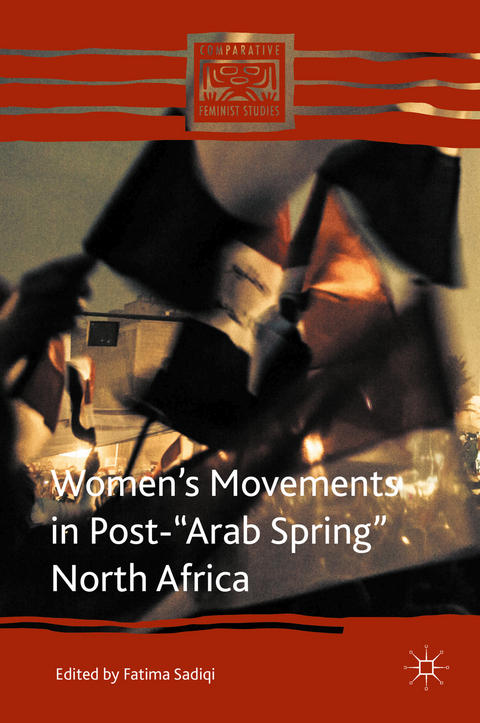
Women’s Movements in Post-“Arab Spring” North Africa (eBook)
325 Seiten
Palgrave Macmillan US (Verlag)
978-1-137-50675-7 (ISBN)
Unexpected and transformative revolutions broke off in North Africa and quickly spread to the Middle East and the rest of the world in 2010 and 2011. Spontaneous, leaderless, youth-driven, and backed by social media, these revolutions called for karamah (dignity) and democracy. Centering on women's movements before, during, and after the revolutions, Women's Movements in Post-'Arab Spring' North Africa highlights the broader sources of authority that affected the emergence of new feminist actors and agents and their impact on the sociopolitical landscapes of the region. Until recently, studies of North African women's movements have focused on single aspects of women's achievements at a time. By providing a comparative analysis, this book for the first time sheds light not only on the role that these superstructures play in shaping women's experiences in North Africa, but also on the rich variety of women's responses to authority, and their potential contributions to African and global feminist thought. From the pre-history of the revolutions to their aftermath, the far-reaching historical and national scope of this collection expands the study of women's movements in North Africa beyond national borders, while still paying close attention to local characteristics.
Khadija Arfaoui, Independent Scholar, Tunisia Margot Badran, Woodrow Wilson International Center for Scholars, USA Soumia Boutkhil, Mohammed I University, Morocco miriam cooke, Duke University, USA Névine El Nossery, University of Wisconsin-Madison, USA Manal Elattir, Anarouz, Morocco Yamina El Kirat El Allame, Mohammed V University, Morocco Moha Ennaji, Center for Intercultural Dialogue and Migration Studies, Morocco; Rutgers University, USA Sondra Hale, University of California, Los Angeles, USA Nabila Hamza, Independent Scholar, Tunisia Rachida Kerkech, Ecole Normale Supérieure (ENS), France; University Mohammed V, Morocco Moushira Khattab, Independent Scholar, Egypt Lilia Labidi, University of Tunis, Tunisia; Woodrow Wilson Center, USA Céline Lesourd, Centre National de la Recherche Scientifique (CNRS), France Ellen McLearney, Duke University, USA Amanda Rogers, University of Wisconsin, Madison, USA Youness Tihm, Brandeis University, USA Rachid Tlemçani, University of Algiers, Algeria Dina Wahba, Cairo University, Egypt Abdellatif Zaki, Hassan II Institute for Agronomy and Veterinary Medicine, Morocco
Centering on women's movements before, during, and after the revolutions, Women's Movements in Post-"e;Arab Spring"e; North Africa highlights the broader sources of authority that affected the emergence of new feminist actors and agents and their impact on the sociopolitical landscapes of the region.
Fatima Sadiqi is Professor of Linguistics and Gender Studies at the University of Fez, Morocco. Her work focuses on women's issues in modern North Africa, the Middle East, and the Mediterranean world. She is author and editor of numerous volumes and journal issues, including Women, Gender and Language, Women and Knowledge in the Mediterranean, and Moroccan Feminist Discourses .
Series Editor's Preface; Chandra Talpade MohantyIntroduction: The Centrality of Women's Movements in the Post-Revolution Dynamics in North Africa; Fatima SadiqiPART I: CONTEXTUALIZING WOMEN'S MOVEMENTS IN NORTH AFRICA: CONCEPTUAL ISSUES 1. The Center: A Post-Revolution Space for Women's Movements in North Africa. Morocco as an Example; Fatima Sadiqi2. Women and the Arab Spring: A Transnational, Feminist Revolution; miriam cooke 3. Creative Disobedience: Feminism, Islam, and Revolution in Egypt; Margot Badran4. Gendering the Egyptian Revolution; Dina Wahba5. The Lipstick on the Edge of the Well: Mauritanian Women and Political Power (1960 2014); Céline LesourdPART II: SPECIFIC COUNTRY EXPERIENCES 6. About North African Women's Rights After the Arab Spring; Moha Ennaji7. Women's Rights and Equality: Egyptian Constitutional Law; Ellen McLearney8. The Struggle of Egyptian Women for Equal Rights Continues: Two-Steps Forward, One-Step Backward; Moushira Khattab9. Women, Art, and Revolution in the Streets of Egypt; Nevine El Nossery10. Notes on Sudanese Women's Activism, Movements, and Leadership; Sondra Hale11. Revolutionary Nuns or Totalitarian Pawns: Evaluating Libyan State Feminism After Mu'ammar al-Gaddafi; Amanda Rogers12. Tunisian Women's Literature and the Critique of Authority: Sources, Contexts, and the Tunisian 'Arab Spring"; Lilia Labidi13. Engendering Tunisia's Democratic Transition: What Challenges Are Facing Women?; Nabila Hamza14. Women and Leadership in the Post-Arab Spring: The Case of Tunisia; Khadija Arfaoui15. The Algerian Woman Issue: Struggles, Islamic Violence, and Cooptation; Rachid Tlemçani16. Moroccan Women in Limbo: On Liminal Citizenship and the Quest for Equality; Soumia Boutkhil17. Moroccan Women's Cultural Rights: A Psycho-Social Perspective on Cultural Paradoxes; Rachida Kerkech18. Women's Economic Empowerment in Morocco: The Case of Social Entrepreneurship; Manal Elattir, Yamina El Kirat El Allame, and Youness Tihm19. Reflections on the 20-February Movement: Hope Renewed, Hope Frustrated for Women; Abdellatif Zaki
| Erscheint lt. Verlag | 23.5.2016 |
|---|---|
| Reihe/Serie | Comparative Feminist Studies | Comparative Feminist Studies |
| Zusatzinfo | XII, 325 p. |
| Verlagsort | New York |
| Sprache | englisch |
| Themenwelt | Sozialwissenschaften ► Politik / Verwaltung ► Politische Theorie |
| Sozialwissenschaften ► Soziologie ► Gender Studies | |
| Sozialwissenschaften ► Soziologie ► Spezielle Soziologien | |
| Technik | |
| Schlagworte | arab spring • Constitution • Creative resistance • Feminism • Gender • Literature • media • North Africa • Philosophy • quality • Social Science • State • Violence • Women • Womenâs rights movements • Women’s rights movements |
| ISBN-10 | 1-137-50675-X / 113750675X |
| ISBN-13 | 978-1-137-50675-7 / 9781137506757 |
| Informationen gemäß Produktsicherheitsverordnung (GPSR) | |
| Haben Sie eine Frage zum Produkt? |
 PDF (Wasserzeichen)
DRM: Digitales Wasserzeichen
Dieses eBook enthält ein digitales Wasserzeichen und ist damit für Sie personalisiert. Bei einer missbräuchlichen Weitergabe des eBooks an Dritte ist eine Rückverfolgung an die Quelle möglich.
Dateiformat: PDF (Portable Document Format)
Mit einem festen Seitenlayout eignet sich die PDF besonders für Fachbücher mit Spalten, Tabellen und Abbildungen. Eine PDF kann auf fast allen Geräten angezeigt werden, ist aber für kleine Displays (Smartphone, eReader) nur eingeschränkt geeignet.
Systemvoraussetzungen:
PC/Mac: Mit einem PC oder Mac können Sie dieses eBook lesen. Sie benötigen dafür einen PDF-Viewer - z.B. den Adobe Reader oder Adobe Digital Editions.
eReader: Dieses eBook kann mit (fast) allen eBook-Readern gelesen werden. Mit dem amazon-Kindle ist es aber nicht kompatibel.
Smartphone/Tablet: Egal ob Apple oder Android, dieses eBook können Sie lesen. Sie benötigen dafür einen PDF-Viewer - z.B. die kostenlose Adobe Digital Editions-App.
Buying eBooks from abroad
For tax law reasons we can sell eBooks just within Germany and Switzerland. Regrettably we cannot fulfill eBook-orders from other countries.
aus dem Bereich