


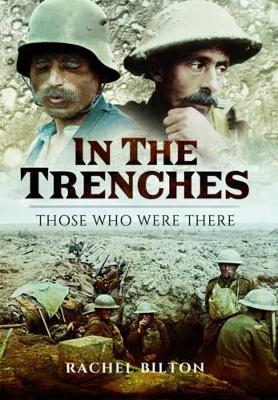
In the Trenches: Those Who Were There
Seiten
2017
Pen & Sword Military (Verlag)
978-1-4738-6713-0 (ISBN)
Pen & Sword Military (Verlag)
978-1-4738-6713-0 (ISBN)
- Keine Verlagsinformationen verfügbar
- Artikel merken
A collection of stories written by men who were there, penned shortly after the events.
A wide range of personal experiences are covered in the seventeen chapters of this book. All the stories are written by the participants who describe exactly what happened to them while they fought in the greatest battles of the First World War. What makes them special is that their stories were written while the images were fresh in their minds. The experiences recorded are those of civilians, officers and men, in the mud of the Western Front, in the sand of the desert, on the scorching beaches of Gallipoli and on the forgotten front of Salonika. Where possible information about these men has been provided to explain their life before and after the war. Also included are rarely seen images that augment the text. The stories cover the whole of the war, starting with the chance meeting of a reporter and men of the Royal Field Artillery resting after the retreat. Wilfrid Ewart paints a vivid picture of everyday life in the trenches during the first winter of the war. Captain Pollard, a VC winner, provides a grim vignette, breathlessly told, of an infantry charge on a German trench.Sergeant Cooper details life in the French Foreign Legion at Gallipoli and the 'fierce fighting such as men reckless to the point of indifference can execute'.
Charles Douie describes the battlefields of the Somme when the guns are silent. The bitter story of the hell endured by the men who bled and died during the battle for Passchendaele is told by A.M. Burrage, ex-Private X. The psychiatric problems of war are clearly outlined by David Phillips and Herbert Read tells of days of fighting, hunger, desperation, loss of life, all thrown away for no gain when the order to evacuate the post was given. Two stories close the war: the first battle between tanks and a poignant description of the end of the war.
A wide range of personal experiences are covered in the seventeen chapters of this book. All the stories are written by the participants who describe exactly what happened to them while they fought in the greatest battles of the First World War. What makes them special is that their stories were written while the images were fresh in their minds. The experiences recorded are those of civilians, officers and men, in the mud of the Western Front, in the sand of the desert, on the scorching beaches of Gallipoli and on the forgotten front of Salonika. Where possible information about these men has been provided to explain their life before and after the war. Also included are rarely seen images that augment the text. The stories cover the whole of the war, starting with the chance meeting of a reporter and men of the Royal Field Artillery resting after the retreat. Wilfrid Ewart paints a vivid picture of everyday life in the trenches during the first winter of the war. Captain Pollard, a VC winner, provides a grim vignette, breathlessly told, of an infantry charge on a German trench.Sergeant Cooper details life in the French Foreign Legion at Gallipoli and the 'fierce fighting such as men reckless to the point of indifference can execute'.
Charles Douie describes the battlefields of the Somme when the guns are silent. The bitter story of the hell endured by the men who bled and died during the battle for Passchendaele is told by A.M. Burrage, ex-Private X. The psychiatric problems of war are clearly outlined by David Phillips and Herbert Read tells of days of fighting, hunger, desperation, loss of life, all thrown away for no gain when the order to evacuate the post was given. Two stories close the war: the first battle between tanks and a poignant description of the end of the war.
Rachel Bilton is currently studying in France and intends to pursue a career in journalism and/or publishing when she graduates. This is her first book and it is part of a trilogy; she has also edited the third part. These two books will be followed by another on Great War escapes. Rachel has always been interested in history, particularly the more deadly parts. She is trying to find the answer to why so many men wanted to kill complete strangers for four years.
| Erscheinungsdatum | 29.03.2017 |
|---|---|
| Zusatzinfo | 16 illustrations - 8 pages of plates |
| Verlagsort | South Yorkshire |
| Sprache | englisch |
| Maße | 156 x 234 mm |
| Themenwelt | Geschichte ► Allgemeine Geschichte ► Neuzeit (bis 1918) |
| Geschichte ► Allgemeine Geschichte ► 1918 bis 1945 | |
| Geisteswissenschaften ► Geschichte ► Regional- / Ländergeschichte | |
| Geschichte ► Teilgebiete der Geschichte ► Militärgeschichte | |
| Sozialwissenschaften ► Politik / Verwaltung | |
| ISBN-10 | 1-4738-6713-4 / 1473867134 |
| ISBN-13 | 978-1-4738-6713-0 / 9781473867130 |
| Zustand | Neuware |
| Informationen gemäß Produktsicherheitsverordnung (GPSR) | |
| Haben Sie eine Frage zum Produkt? |
Mehr entdecken
aus dem Bereich


aus dem Bereich
Geschichte einer wilden Handlung
Buch | Hardcover (2024)
C.H.Beck (Verlag)
CHF 47,60


