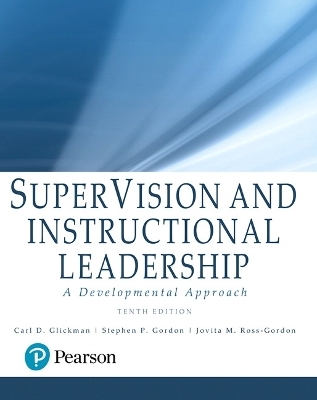
SuperVision and Instructional Leadership
Pearson (Hersteller)
978-0-13-452194-7 (ISBN)
SuperVision and Instructional Leadership looks at the purposes, practices and structure of supervision and instructional leadership today. You'll consider what's needed for successful supervision, the role of interpersonal skills, different approaches to supervision, and related technical skills and cultural tasks.
For courses in supervision (educational administration and leadership).
Pearson eText is an easy-to-use digital textbook that you can purchase on your own or instructors can assign for their course. The mobile app lets you keep on learning, no matter where your day takes you, even offline. You can also add highlights, bookmarks, and notes in your Pearson eText to study how you like.
NOTE: This ISBN is for the Pearson eText access card. Pearson eText is a fully digital delivery of Pearson content. Before purchasing, check that you have the correct ISBN. To register for and use Pearson eText, you may also need a course invite link, which your instructor will provide. Follow the instructions provided on the access card to learn more.
Carl D. Glickman is Professor Emeritus of Education at the University of Georgia. He began his career as a Teacher Corp intern in the rural south and later was a principal of award-winning schools in New Hampshire. At the University of Georgia he and colleagues founded the Georgia League of Professional Schools, a nationally validated network of high-functioning public schools dedicated to the principles of democratic education. He is the author or editor of 14 books on school leadership, educational renewal, and the moral imperative of education. Stephen P. Gordon is a professor of Education and Community Leadership at Texas State University. He is author of the book Professional Development for School Improvement, co-author of the books The Basic Guide to Supervision and Instructional Leadership, and How to Help Beginning Teachers Succeed, and editor of the books Collaborative Action Research and Standards for Instructional Supervision: Enhancing Teaching and Learning. Dr. Gordon, the former director of the National Center for School Improvement, also was lead consultant for the ASCD video series Improving Instruction through Observation and Feedback. Jovita M. Ross-Gordon is a professor of Adult, Professional and Community Education at Texas State University Dr. Ross-Gordon is the author, editor, or co-editor of several books including the 2010 Handbook of Adult and Continuing Education. She has also published numerous chapters and articles on the teaching and learning of adults, particularly in the setting of higher education. She is currently co-editor-in-chief of New Directions for Adult and Continuing Education, and has served in numerous leadership positions with professional organizations focusing on adult education.
BRIEF TABLE OF CONTENTS Part One: Introduction 1 SuperVision for Successful Schools Part Two: Knowledge 2 The Norm: Why Traditional Schools Are as They Are 3 The Dynamic School 4 Adult and Teacher Development Within the Context of the School 5 Reflections on Educational Beliefs, Teaching, and Supervision Part Three: Interpersonal Skills 6 Supervisory Behavior Continuum: Know Thyself 7 Directive Control Behaviors 8 Directive Informational Behaviors 9 Collaborative Behaviors 10 Nondirective Behaviors 11 Developmental Supervision Part Four: Technical Skills 12 Observing Skills 13 Assessing and Planning Skills 14 Implementation and Evaluation Skills Part Five: Technical Tasks of Supervision 15 Direct Assistance to Teachers 16 Evaluation of Teaching 17 Group Development 18 Professional Development 19 Curriculum Development 20 Action Research: The School as the Center of Inquiry Part Six: Cultural Tasks of Supervision 21 Facilitating Change 22 Addressing Diversity 23 Building Community DETAILED TABLE OF CONTENTS Part One: Introduction 1 1. SuperVision for Successful Schools 3 SuperVision: A New Name for a New Paradigm 6 Supervisory Glue as a Metaphor for Success 9 New Roles for Supervisors and Teachers 9 Supervision and Moral Purpose 17 Organization of This Book 18 Reflective Exercise 20 Part Two: Knowledge 21 2. The Norm: Why Traditional Schools Are as They Are 23 The Work Environment or Culture of Schools: The Legacy of the One-Room Schoolhouse 24 Cultures Within Cultures 32 Looking Deeper: The Newtonian Paradigm and Traditional Schools 34 Reflective Exercise 38 3. The Dynamic School 39 Shared Leadership, Collegiality, and Collaboration 41 A Cause Beyond Oneself 41 Professional Development 42 Positive Learning Climate 43 Authentic Curriculum, Instruction, and Assessment 44 Democracy 46 Inquiry 47 Cultural Responsiveness 48 Partnerships and Networks 49 Beyond Newtonianism: The Quantum Paradigm and Dynamic Schools 54 Closing Question 61 Reflective Exercise 61 4. Adult and Teacher Development Within the Context of the School 62 Adults as Learners 63 Adult and Teacher Development 75 Development: Ebb and Flow 91 Reflective Exercise 92 5. Reflections on Educational Beliefs, Teaching, and Supervision 93 Beliefs, Goals, and Effective Teaching 94 Beliefs About Education 96 Supervisory Beliefs 97 Supervisory Platform as Related to Educational Philosophy 99 Checking Your Own Supervisory Beliefs 103 What Does Your Belief Mean in Terms of Supervisor and Teacher Responsibility? 106 Educational Philosophy, Teachers, Supervisors, and Supervisory Approach 107 Where You Stand Depends on Where You Sit: Effects of Culture on Beliefs 107 Reflective Exercise 109 Part Three: Interpersonal Skills 111 6. Supervisory Behavior Continuum: Know Thyself 113 Outcomes of Conference 116 Valid Assessment of Self 117 Cognitive Dissonance 124 Comparing Self-Perceptions with Others' Perceptions 124 Comparing Self-Perceptions to Recorded Behaviors 126 360-Degree Feedback 127 Reflective Exercise 128 7. Directive Control Behaviors 130 Characteristics of Teachers Best Matched with Directive Control Behaviors 131 Directive Control Sequence of Behaviors 132 A History of Overreliance on Control 136 Issues in Directive Control 136 When to Use Directive Control Behaviors 137 Moving from Directive Control Toward Directive Informational Behaviors 138 Reflective Exercise 139 8. Directive Informational Behaviors 140 Characteristics of Teachers Best Matched with Directive Informational Behaviors 141 Directive Informational Sequence of Behaviors 142 Comparing Directive Control and Directive Informational Statements 145 Issues in the Directive Informational Approach 147 When to Use Directive Informational Behaviors 147 Moving from Directive Informational Toward Collaborative Behaviors 148 Reflective Exercise 149 9. Collaborative Behaviors 150 Characteristics of Teachers Best Matched with Collaborative Behaviors 151 Collaborative Sequence of Behaviors 152 Issues in Collaborative Supervision 156 When to Use Collaborative Behaviors 157 Moving from Collaborative Toward Nondirective Behaviors 158 Reflective Exercise 159 10. Nondirective Behaviors 160 Characteristics of Teachers Best Matched with Nondirective Behaviors 161 Nondirective Sequence of Behaviors 162 Initiating Nondirective Supervision 166 Nondirective, Not Laissez-Faire, Supervision 167 Issues with Nondirective Supervision 168 When to Use Nondirective Behaviors 169 Reflective Exercise 171 11. Developmental Supervision 172 Phase 1: Choosing the Best Approach 173 Phase 2: Applying the Chosen Approach 175 Phase 3: Fostering Teacher Development 176 Not Algorithms, but Guideposts for Decisions 177 Case Studies in Developmental Supervision 178 Reflective Exercise 188 Part Four: Technical Skills 191 12. Observing Skills 193 Quantitative Observations 196 Qualitative Observations 203 Tailored Observation Systems 208 Schoolwide Classroom Observation 210 Review of Types and Purposes of Observation 214 Trends and Cautions Regarding Observation 215 Reflective Exercise 219 13. Assessing and Planning Skills 220 Personal Improvement 221 Instructional Improvement Within the Organization 228 Ways of Assessing Need 229 Analyzing Organizational Needs 234 Planning 238 Reflective Exercise 247 14. Implementation and Evaluation Skills 248 Stages of Implementation 249 Factors that Affect Implementation 251 Implementation at the Individual Level 253 Evaluation of Instructional Improvement Efforts 255 Two Types of Program Evaluation: Formative and Summative 257 Program Evaluation and Teacher Empowerment 263 Reflective Exercise 264 Part Five: Technical Tasks of Supervision 265 15. Direct Assistance to Teachers 267 Clinical Supervision 268 The Relationship of Clinical Supervision with Other Processes 273 Peer Coaching 274 Mentoring 278 Using Direct Assistance to Improve Classroom Culture 282 Reflective Exercise 283 16. Evaluation of Teaching 284 The New Wave of Evaluation Systems: From the Frying Pan to the Fire? 286 Summative and Formative Evaluation 288 Suggestions for Summative Evaluation 293 Suggestions for Formative Evaluation 295 Beyond Evaluation of Individual Teaching 300 Reflective Exercise 301 17. Group Development 302 Stages of Group Development 303 Characteristics of Effective Groups 306 Group Member Roles 307 Applying Developmental Supervision to Groups 314 Resolving Conflict 316 Preparing for Group Meetings 320 Reflective Exercise 324 18. Professional Development 325 Characteristics of Successful Professional Development Programs 327 Integrating Schoolwide, Group, and Individual Professional Development 328 Alternative Professional Development Formats 329 Stages of Professional Development 331 Evaluating Professional Development 332 Teachers as Objects or Agents in Professional Development 333 Reflective Exercise 337 19. Curriculum Development 338 Legislated Learning 340 Curriculum Development as a Vehicle for Enhancing Collective Thinking About Instruction 342 The Curriculum and Cultural Diversity 357 Curriculum Mapping-and Remapping 359 Developing Curriculum Units: Understanding by Design 363 Reflective Exercise 366 20. Action Research: The School as the Center of Inquiry 367 How Is Action Research Conducted? 370 Characteristics of Successful Action Research 374 Expanding Boundaries: Alternative Approaches to Action Research 375 Shared Governance for Action Research 379 Suggestions for Assisting Action Research 384 Reflective Exercise 385 Part Six: Cultural Tasks of Supervision 387 21. Facilitating Change 389 Chaos Theory 392 Postmodern Theory 395 Education Change Theory 398 Making Connections 407 Changing the Conditions of Teaching 407 Reflective Exercise 410 22. Addressing Diversity 411 Achievement Gaps Among Economic, Racial, and Ethnic Groups 412 Gender Equity 428 Equity for Sexual and Gender Minorities 430 Equity for Students with Disabilities 433 Overarching Patterns 437 Connecting the Technical Tasks of Supervision to Cultural Responsiveness 437 Reflective Exercise 438 23. Building Community 439 Democratic Community 442 Moral Community* 444 Professional Learning Community 449 Community of Inquiry 451 Engagement with the Larger Community 452 Five Attributes, One Community 455 Conclusion 456 Reflective Exercise 458 Appendix A: Educational Philosophy Q Sort* 459 Appendix B: Review of Interpersonal Behavior in the Four Supervisory Approaches 465 References 467 Name Index 497 Subject Index 502
| Erscheint lt. Verlag | 1.1.2017 |
|---|---|
| Sprache | englisch |
| Maße | 10 x 10 mm |
| Gewicht | 1000 g |
| Themenwelt | Sozialwissenschaften ► Pädagogik |
| ISBN-10 | 0-13-452194-3 / 0134521943 |
| ISBN-13 | 978-0-13-452194-7 / 9780134521947 |
| Zustand | Neuware |
| Informationen gemäß Produktsicherheitsverordnung (GPSR) | |
| Haben Sie eine Frage zum Produkt? |
aus dem Bereich