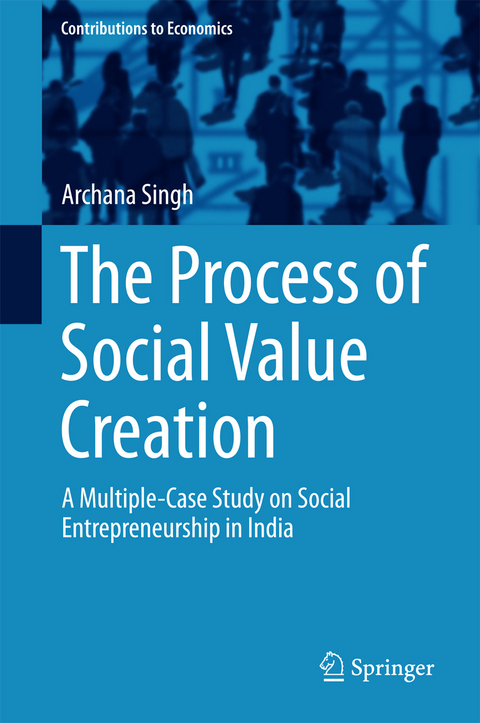
The Process of Social Value Creation (eBook)
XXIII, 237 Seiten
Springer India (Verlag)
978-81-322-2827-1 (ISBN)
Archana Singh is an Assistant Professor at the Centre for Social Entrepreneurship, School of Management and Labour Studies, Tata Institute of Social Sciences (TISS), Mumbai, India and is presently working in the field of social entrepreneurship. Prior to this academic positions, she has worked with different non-governmental organisations (NGOs) in rural as well as in urban areas on diverse issues such as women's Self Help Groups (SHGs), women empowerment, reproductive and child health, and HIV/AIDs awareness among sex workers. Dr. Singh obtained her PhD and MPhil from TISS, Mumbai, and has published in national and international journals (International Journal of Social Entrepreneurship and Innovation, International Journal of Sociology and Social Policy, and Social Marketing Quarterly) in areas of social entrepreneurship, technology and innovation, and social change. She has also contributed in the edited book 'Technology and Innovation for Social Change' (Springer, 2014). Apart from teaching at TISS (Mumbai and Hyderabad campus), she has been involved in teaching to Graduate students at Kennesaw State University, Georgia, Atlanta (USA) through web mode. Her research interests include social entrepreneurship, women empowerment, social value, social change, social work, and corporate social responsibility.
This book discusses social entrepreneurship, especially in context of India. It focuses on understanding the whole process of social value creation, i.e. social entrepreneurship - opportunity identification, resource mobilisation, social value, capabilities of social entrepreneurs and innovation in three different types of social enterprises - (i) non-profit or charitable ones; (ii) non-profit social enterprise, sustainable with the combined income of grants, subsidies and own earned income; self-sustainable not-for-profit social enterprise; and hybrid social enterprise; and (iii) for-profit social enterprises. Sample cases of social entrepreneurs (Ashoka Fellows) were selected from three inter-linked sectors -- health, education and livelihood. To provide a comprehensive view, interviews were taken not only from the founders (social entrepreneurs), management personnel, and other employees, but also from the beneficiaries. The book comprises how, on the basis of cross-comparison between three types of social enterprises, several propositions and finally theoretical framework on social entrepreneurship have been developed. It proposes that social entrepreneurship can be acquired and that these social entrepreneurs can help solve the larger social problems faced both by developing and developed nations.
Archana Singh is an Assistant Professor at the Centre for Social Entrepreneurship, School of Management and Labour Studies, Tata Institute of Social Sciences (TISS), Mumbai, India and is presently working in the field of social entrepreneurship. Prior to this academic positions, she has worked with different non-governmental organisations (NGOs) in rural as well as in urban areas on diverse issues such as women’s Self Help Groups (SHGs), women empowerment, reproductive and child health, and HIV/AIDs awareness among sex workers. Dr. Singh obtained her PhD and MPhil from TISS, Mumbai, and has published in national and international journals (International Journal of Social Entrepreneurship and Innovation, International Journal of Sociology and Social Policy, and Social Marketing Quarterly) in areas of social entrepreneurship, technology and innovation, and social change. She has also contributed in the edited book ‘Technology and Innovation for Social Change’ (Springer, 2014). Apart from teaching at TISS (Mumbai and Hyderabad campus), she has been involved in teaching to Graduate students at Kennesaw State University, Georgia, Atlanta (USA) through web mode. Her research interests include social entrepreneurship, women empowerment, social value, social change, social work, and corporate social responsibility.
Chapter 1. Introduction.- Part 1. In Search of Meaning.- Chapter 2. Reviewing Social Entrepreneurship Knowledge.- Chapter 3. The Conceptual Model: Contextualising Social Entrepreneurship.- Part 2. Caselets.- Chapter 4. Indian Social Entrepreneurs.- Part 3. The Process of Social Value Creation: Toward Emerging Theory of Social Entrepreneurship.- Chapter 5. The Concepts of ‘Social Value Creation’ and ‘Social Value’.- Chapter 6. Opportunity Recognition/Identification.- Chapter 7. Resource Mobilisation (Resourcefulness).- Chapter 8. Capabilities of Social Entrepreneurs.- Chapter 9. Creating Values for the Beneficiaries: Interplay of Opportunity Recognition, Resource Mobilisation (Resourcefulness) and Capabilities of Social Entrepreneurs.- Part 4. Conclusion.- Chapter 10. Summary and Conclusion.
| Erscheint lt. Verlag | 3.5.2016 |
|---|---|
| Reihe/Serie | Contributions to Economics | Contributions to Economics |
| Zusatzinfo | XXIII, 237 p. 8 illus., 7 illus. in color. |
| Verlagsort | New Delhi |
| Sprache | englisch |
| Themenwelt | Sozialwissenschaften ► Pädagogik ► Sozialpädagogik |
| Sozialwissenschaften ► Politik / Verwaltung | |
| Sozialwissenschaften ► Soziologie | |
| Wirtschaft ► Betriebswirtschaft / Management ► Logistik / Produktion | |
| Wirtschaft ► Betriebswirtschaft / Management ► Planung / Organisation | |
| Wirtschaft ► Betriebswirtschaft / Management ► Unternehmensführung / Management | |
| Schlagworte | Innovation • Opportunity Identification • Resource mobilization • Social Entrepreneur • Social Entrepreneurship • Social Value |
| ISBN-10 | 81-322-2827-8 / 8132228278 |
| ISBN-13 | 978-81-322-2827-1 / 9788132228271 |
| Informationen gemäß Produktsicherheitsverordnung (GPSR) | |
| Haben Sie eine Frage zum Produkt? |
 PDF (Wasserzeichen)
DRM: Digitales Wasserzeichen
Dieses eBook enthält ein digitales Wasserzeichen und ist damit für Sie personalisiert. Bei einer missbräuchlichen Weitergabe des eBooks an Dritte ist eine Rückverfolgung an die Quelle möglich.
Dateiformat: PDF (Portable Document Format)
Mit einem festen Seitenlayout eignet sich die PDF besonders für Fachbücher mit Spalten, Tabellen und Abbildungen. Eine PDF kann auf fast allen Geräten angezeigt werden, ist aber für kleine Displays (Smartphone, eReader) nur eingeschränkt geeignet.
Systemvoraussetzungen:
PC/Mac: Mit einem PC oder Mac können Sie dieses eBook lesen. Sie benötigen dafür einen PDF-Viewer - z.B. den Adobe Reader oder Adobe Digital Editions.
eReader: Dieses eBook kann mit (fast) allen eBook-Readern gelesen werden. Mit dem amazon-Kindle ist es aber nicht kompatibel.
Smartphone/Tablet: Egal ob Apple oder Android, dieses eBook können Sie lesen. Sie benötigen dafür einen PDF-Viewer - z.B. die kostenlose Adobe Digital Editions-App.
Buying eBooks from abroad
For tax law reasons we can sell eBooks just within Germany and Switzerland. Regrettably we cannot fulfill eBook-orders from other countries.
aus dem Bereich