


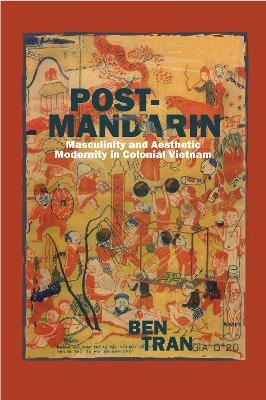
Post-Mandarin
Masculinity and Aesthetic Modernity in Colonial Vietnam
Seiten
2017
Fordham University Press (Verlag)
978-0-8232-7314-0 (ISBN)
Fordham University Press (Verlag)
978-0-8232-7314-0 (ISBN)
Post-Mandarin offers an engaging look at a cohort of Vietnamese intellectuals who adopted European fields of knowledge, a new Romanized alphabet, and print media—all of which were foreign and illegible to their fathers. This new generation of intellectuals established Vietnam’s modern anticolonial literature.
Post-Mandarin offers an engaging look at a cohort of Vietnamese intellectuals who adopted European fields of knowledge, a new Romanized alphabet, and print media—all of which were foreign and illegible to their fathers. This new generation of intellectuals established Vietnam's modern anticolonial literature.
The term "post-mandarin" illuminates how Vietnam's deracinated figures of intellectual authority adapted to a literary field moving away from a male-to-male literary address toward print culture. With this shift, post-mandarin intellectuals increasingly wrote for and about women.
Post-Mandarin illustrates the significance of the inclusion of modern women in the world of letters: a more democratic system of aesthetic and political representation that gave rise to anticolonial nationalism. This conceptualization of the "post-mandarin" promises to have a significant impact on the fields of literary theory, postcolonial studies, East Asian and Southeast Asian studies, and modernist studies.
Post-Mandarin offers an engaging look at a cohort of Vietnamese intellectuals who adopted European fields of knowledge, a new Romanized alphabet, and print media—all of which were foreign and illegible to their fathers. This new generation of intellectuals established Vietnam's modern anticolonial literature.
The term "post-mandarin" illuminates how Vietnam's deracinated figures of intellectual authority adapted to a literary field moving away from a male-to-male literary address toward print culture. With this shift, post-mandarin intellectuals increasingly wrote for and about women.
Post-Mandarin illustrates the significance of the inclusion of modern women in the world of letters: a more democratic system of aesthetic and political representation that gave rise to anticolonial nationalism. This conceptualization of the "post-mandarin" promises to have a significant impact on the fields of literary theory, postcolonial studies, East Asian and Southeast Asian studies, and modernist studies.
Ben Tran is Assistant Professor of Asian Studies and English at Vanderbilt University.
Introduction: The Post-Mandarin 1. Autoethnography and Post-Mandarin Masculinity 2. Pornography as Realism, Realism as Aesthetic Modernity 3. The Sociological Novel and Anticolonialism 4. I Speak in the Third Person: Women and Language in Colonial Vietnam 5. Queer Internationalism and Post-mandarin Literature Conclusion Acknowledgments Notes Bibliography Index
| Erscheinungsdatum | 07.01.2017 |
|---|---|
| Verlagsort | New York |
| Sprache | englisch |
| Maße | 152 x 229 mm |
| Themenwelt | Sachbuch/Ratgeber ► Geschichte / Politik ► Allgemeines / Lexika |
| Geschichte ► Allgemeine Geschichte ► Neuzeit (bis 1918) | |
| Geisteswissenschaften ► Geschichte ► Regional- / Ländergeschichte | |
| Geisteswissenschaften ► Sprach- / Literaturwissenschaft ► Anglistik / Amerikanistik | |
| Geisteswissenschaften ► Sprach- / Literaturwissenschaft ► Literaturwissenschaft | |
| Geisteswissenschaften ► Sprach- / Literaturwissenschaft ► Sprachwissenschaft | |
| Sozialwissenschaften ► Soziologie | |
| ISBN-10 | 0-8232-7314-8 / 0823273148 |
| ISBN-13 | 978-0-8232-7314-0 / 9780823273140 |
| Zustand | Neuware |
| Informationen gemäß Produktsicherheitsverordnung (GPSR) | |
| Haben Sie eine Frage zum Produkt? |
Mehr entdecken
aus dem Bereich



aus dem Bereich
Geschichte einer wilden Handlung
Buch | Hardcover (2024)
C.H.Beck (Verlag)
CHF 47,60


