


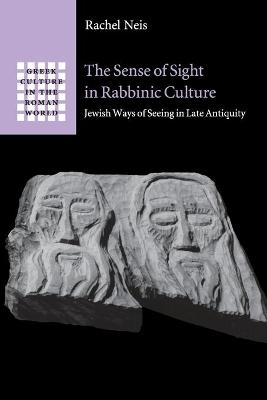
The Sense of Sight in Rabbinic Culture
Jewish Ways of Seeing in Late Antiquity
Seiten
2016
Cambridge University Press (Verlag)
978-1-316-62890-4 (ISBN)
Cambridge University Press (Verlag)
978-1-316-62890-4 (ISBN)
Vision was a powerful sense in the ancient world. How did the rabbis living in Roman Palestine and Persian Mesopotamia understand and seek to discipline and cultivate it? This book offers a new perspective on the significance of sight for the rabbis, of interest to a wide range of scholars.
This book studies the significance of sight in rabbinic cultures across Palestine and Mesopotamia (approximately from the first to seventh centuries). It tracks the extent and effect to which the rabbis living in the Greco-Roman and Persian worlds sought to appropriate, recast and discipline contemporaneous understandings of sight. Sight had a crucial role to play in the realms of divinity, sexuality and gender, idolatry and, ultimately, rabbinic subjectivity. The rabbis lived in a world in which the eyes were at once potent and vulnerable: eyes were thought to touch objects of vision, while also acting as an entryway into the viewer. Rabbis, Romans, Zoroastrians, Christians and others were all concerned with the protection and exploitation of vision. Employing many different sources, Professor Neis considers how the rabbis engaged varieties of late antique visualities, along with rabbinic narrative, exegetical and legal strategies, as part of an effort to cultivate and mark a 'rabbinic eye'.
This book studies the significance of sight in rabbinic cultures across Palestine and Mesopotamia (approximately from the first to seventh centuries). It tracks the extent and effect to which the rabbis living in the Greco-Roman and Persian worlds sought to appropriate, recast and discipline contemporaneous understandings of sight. Sight had a crucial role to play in the realms of divinity, sexuality and gender, idolatry and, ultimately, rabbinic subjectivity. The rabbis lived in a world in which the eyes were at once potent and vulnerable: eyes were thought to touch objects of vision, while also acting as an entryway into the viewer. Rabbis, Romans, Zoroastrians, Christians and others were all concerned with the protection and exploitation of vision. Employing many different sources, Professor Neis considers how the rabbis engaged varieties of late antique visualities, along with rabbinic narrative, exegetical and legal strategies, as part of an effort to cultivate and mark a 'rabbinic eye'.
Rachel Neis is an Assistant Professor in the History Department and in the Program for Judaic Studies at the University of Michigan. Her interests include rabbinic literature and culture, the history of the senses, and comparative ancient and contemporary law and legal theory.
Introduction; 1. Visual theory; 2. God-gazing and homovisuality; 3. Heterovisuality, face-bread and cherubs; 4. Visual eros; 5. Eyeing idols; 6. Seeing sages; Conclusion.
| Erscheinungsdatum | 04.10.2016 |
|---|---|
| Reihe/Serie | Greek Culture in the Roman World |
| Zusatzinfo | Worked examples or Exercises |
| Verlagsort | Cambridge |
| Sprache | englisch |
| Maße | 153 x 230 mm |
| Gewicht | 500 g |
| Themenwelt | Geschichte ► Allgemeine Geschichte ► Vor- und Frühgeschichte |
| Geschichte ► Allgemeine Geschichte ► Altertum / Antike | |
| Geschichte ► Allgemeine Geschichte ► Mittelalter | |
| Geisteswissenschaften ► Geschichte ► Regional- / Ländergeschichte | |
| Geisteswissenschaften ► Religion / Theologie ► Judentum | |
| Sozialwissenschaften ► Soziologie | |
| ISBN-10 | 1-316-62890-6 / 1316628906 |
| ISBN-13 | 978-1-316-62890-4 / 9781316628904 |
| Zustand | Neuware |
| Informationen gemäß Produktsicherheitsverordnung (GPSR) | |
| Haben Sie eine Frage zum Produkt? |
Mehr entdecken
aus dem Bereich



aus dem Bereich
Reise in die Römerzeit
Buch | Hardcover (2025)
Galiani Berlin (Verlag)
CHF 44,75
auf den Spuren der frühen Zivilisationen
Buch | Hardcover (2023)
C.H.Beck (Verlag)
CHF 27,95


