


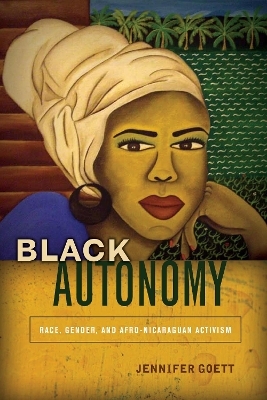
Black Autonomy
Race, Gender, and Afro-Nicaraguan Activism
Seiten
2016
Stanford University Press (Verlag)
978-0-8047-9956-0 (ISBN)
Stanford University Press (Verlag)
978-0-8047-9956-0 (ISBN)
Decades after the first multicultural reforms were introduced in Latin America, Afrodescendant people from the region are still disproportionately impoverished, underserved, policed, and incarcerated. In Nicaragua, Afrodescendants have mobilized to confront this state of siege through the politics of black autonomy. For women and men grappling with postwar violence, black autonomy has its own cultural meanings as a political aspiration and a way of crafting selfhood and solidarity.
Jennifer Goett's ethnography examines the race and gender politics of activism for autonomous rights in an Afrodescendant. Creole community in Nicaragua. Weaving together fifteen years of research, Black Autonomy follows this community-based movement from its inception in the late 1990s to its realization as an autonomous territory in 2009 and beyond. Goett argues that despite significant gains in multicultural recognition, Afro-Nicaraguan Creoles continue to grapple with the day-to-day violence of capitalist intensification, racialized policing, and drug war militarization in their territories. Activists have responded by adopting a politics of autonomy based on race pride, territoriality, self-determination, and self-defense. Black Autonomy shows how this political radicalism is rooted in African diasporic identification and gendered cultural practices that women and men use to assert control over their bodies, labor, and spaces in an atmosphere of violence.
Jennifer Goett's ethnography examines the race and gender politics of activism for autonomous rights in an Afrodescendant. Creole community in Nicaragua. Weaving together fifteen years of research, Black Autonomy follows this community-based movement from its inception in the late 1990s to its realization as an autonomous territory in 2009 and beyond. Goett argues that despite significant gains in multicultural recognition, Afro-Nicaraguan Creoles continue to grapple with the day-to-day violence of capitalist intensification, racialized policing, and drug war militarization in their territories. Activists have responded by adopting a politics of autonomy based on race pride, territoriality, self-determination, and self-defense. Black Autonomy shows how this political radicalism is rooted in African diasporic identification and gendered cultural practices that women and men use to assert control over their bodies, labor, and spaces in an atmosphere of violence.
Jennifer Goett is Associate Professor of Comparative Cultures and Politics at James Madison College, Michigan State University.
Introduction
1. Women's Origin Stories
2. "Bad Boys" and Direct Resistance
3. Life on the Edge of the Global Economy
4. From Cold Wars to Drug Wars
5. Sexual Violence and Autonomous Politics
Epilogue
| Erscheinungsdatum | 03.12.2016 |
|---|---|
| Zusatzinfo | 11 halftones, 1 map |
| Verlagsort | Palo Alto |
| Sprache | englisch |
| Maße | 153 x 229 mm |
| Themenwelt | Literatur ► Biografien / Erfahrungsberichte |
| Literatur ► Briefe / Tagebücher | |
| Sozialwissenschaften ► Ethnologie | |
| Sozialwissenschaften ► Politik / Verwaltung | |
| Sozialwissenschaften ► Soziologie ► Gender Studies | |
| ISBN-10 | 0-8047-9956-3 / 0804799563 |
| ISBN-13 | 978-0-8047-9956-0 / 9780804799560 |
| Zustand | Neuware |
| Informationen gemäß Produktsicherheitsverordnung (GPSR) | |
| Haben Sie eine Frage zum Produkt? |
Mehr entdecken
aus dem Bereich



aus dem Bereich
Mein Leben zwischen Öffentlichkeit und Selbstschutz | Limitierte …
Buch | Softcover (2025)
riva (Verlag)
CHF 33,90
eine kritische Theorie in 99 Fragmenten
Buch | Softcover (2023)
Campus (Verlag)
CHF 55,95


