


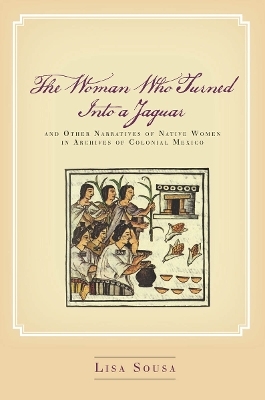
The Woman Who Turned Into a Jaguar, and Other Narratives of Native Women in Archives of Colonial Mexico
Seiten
2017
|
New edition
Stanford University Press (Verlag)
978-0-8047-5640-2 (ISBN)
Stanford University Press (Verlag)
978-0-8047-5640-2 (ISBN)
This book is an ambitious and wide-ranging social and cultural history of gender relations among indigenous peoples of New Spain, from the Spanish conquest through the first half of the eighteenth century. In this expansive account, Lisa Sousa focuses on four native groups in highland Mexico—the Nahua, Mixtec, Zapotec, and Mixe—and traces cross-cultural similarities and differences in the roles and status attributed to women in prehispanic and colonial Mesoamerica.
Sousa intricately renders the full complexity of women's life experiences in the household and community, from the significance of their names, age, and social standing, to their identities, ethnicities, family, dress, work, roles, sexuality, acts of resistance, and relationships with men and other women. Drawing on a rich collection of archival, textual, and pictorial sources, she traces the shifts in women's economic, political, and social standing to evaluate the influence of Spanish ideologies on native attitudes and practices around sex and gender in the first several generations after contact. Though catastrophic depopulation, economic pressures, and the imposition of Christianity slowly eroded indigenous women's status following the Spanish conquest, Sousa argues that gender relations nevertheless remained more complementary than patriarchal, with women maintaining a unique position across the first two centuries of colonial rule.
Sousa intricately renders the full complexity of women's life experiences in the household and community, from the significance of their names, age, and social standing, to their identities, ethnicities, family, dress, work, roles, sexuality, acts of resistance, and relationships with men and other women. Drawing on a rich collection of archival, textual, and pictorial sources, she traces the shifts in women's economic, political, and social standing to evaluate the influence of Spanish ideologies on native attitudes and practices around sex and gender in the first several generations after contact. Though catastrophic depopulation, economic pressures, and the imposition of Christianity slowly eroded indigenous women's status following the Spanish conquest, Sousa argues that gender relations nevertheless remained more complementary than patriarchal, with women maintaining a unique position across the first two centuries of colonial rule.
Lisa Sousa is Professor of History at Occidental College.
1. Introduction
2. Gender and the Body
3. Marriage Encounters
4. Marital Relations
5. Sexual Attitudes and Concepts
6. Sexual Crimes
7. Duties and Responsibilities
8. Household and Community
9. Rebellious Women
10. Conclusion
| Erscheinungsdatum | 22.01.2017 |
|---|---|
| Verlagsort | Palo Alto |
| Sprache | englisch |
| Maße | 152 x 229 mm |
| Themenwelt | Sachbuch/Ratgeber ► Geschichte / Politik ► Allgemeines / Lexika |
| Geisteswissenschaften ► Geschichte ► Regional- / Ländergeschichte | |
| Sozialwissenschaften ► Ethnologie | |
| Sozialwissenschaften ► Soziologie ► Gender Studies | |
| ISBN-10 | 0-8047-5640-6 / 0804756406 |
| ISBN-13 | 978-0-8047-5640-2 / 9780804756402 |
| Zustand | Neuware |
| Informationen gemäß Produktsicherheitsverordnung (GPSR) | |
| Haben Sie eine Frage zum Produkt? |
Mehr entdecken
aus dem Bereich



aus dem Bereich
Handbuch zum Lesen des Himmels
Buch | Hardcover (2025)
Harpercollins (Verlag)
CHF 30,80
historische Porträts von George Washington bis Donald Trump
Buch | Softcover (2025)
C.H.Beck (Verlag)
CHF 33,55


