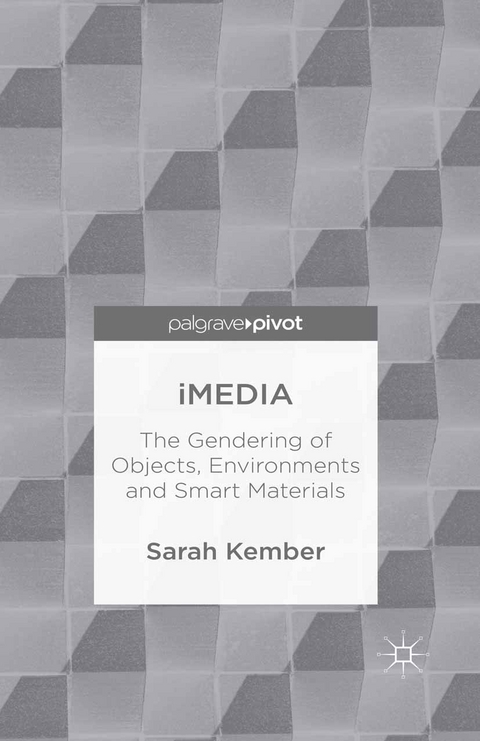
iMedia (eBook)
VI, 122 Seiten
Palgrave Macmillan UK (Verlag)
978-1-137-37485-1 (ISBN)
Sarah Kember is Professor of New Technologies of Communication at Goldsmiths, University of London, UK. Her recent publications include Life After New Media: Mediation as a Vital Process (2012). She is the Director of Goldsmiths Press and co-PI of an RCUK funded project on digital publishing (CREATe).
What can queer feminist writing strategies such as parody and irony do to outsmart the sexism of smart objects, environments and materials and open out the new dialecticism of structure and scale, critique and creativity? Drawing on science and technology studies and feminist theory, this book examines the gendering of current and future media technologies such as smart phones, Google glass, robot nurses, tablets and face recognition. Kember argues that there is a tendency to affirm and celebrate the existence of smart and often sexist objects, environments and materials in themselves; to elide writing and other forms of mediation; and to engage in disembodied knowledge practices. Disembodied knowledge practices tend towards a scientism that currently includes physics envy and are also masculinist. Where there is some degree of convergence between masculinist and feminist thinking about objects, environments and materials, there is also divergence, conflict and the possibleopening towards a politics of imedia. Presenting a lively manifesto for refiguring imedia, this book forms an often neglected gender critique of developments in smart technologies and will be essential reading for scholars in Communication Studies, Cultural and Media, Science and Technology and Feminism.
Sarah Kember is Professor of New Technologies of Communication at Goldsmiths, University of London, UK. Her recent publications include Life After New Media: Mediation as a Vital Process (2012). She is the Director of Goldsmiths Press and co-PI of an RCUK funded project on digital publishing (CREATe).
| Erscheint lt. Verlag | 5.4.2016 |
|---|---|
| Zusatzinfo | VI, 122 p. |
| Verlagsort | London |
| Sprache | englisch |
| Themenwelt | Sozialwissenschaften ► Kommunikation / Medien ► Medienwissenschaft |
| Sozialwissenschaften ► Politik / Verwaltung | |
| Sozialwissenschaften ► Soziologie ► Gender Studies | |
| Schlagworte | Ambient Intelligence • Environment • ethics • Feminism • feminist ethics • feminist politics • Gender • Gender and Technology • immediacy • Internet • internet of things • Masculinism • Material • media • Mediation • object oriented ontology • Politics • Praxis • Science • Sexism • smart environments • Technologie • Technology • technology and life • technology and time • ubiquitous computing • Women |
| ISBN-10 | 1-137-37485-3 / 1137374853 |
| ISBN-13 | 978-1-137-37485-1 / 9781137374851 |
| Informationen gemäß Produktsicherheitsverordnung (GPSR) | |
| Haben Sie eine Frage zum Produkt? |
 PDF (Wasserzeichen)
DRM: Digitales Wasserzeichen
Dieses eBook enthält ein digitales Wasserzeichen und ist damit für Sie personalisiert. Bei einer missbräuchlichen Weitergabe des eBooks an Dritte ist eine Rückverfolgung an die Quelle möglich.
Dateiformat: PDF (Portable Document Format)
Mit einem festen Seitenlayout eignet sich die PDF besonders für Fachbücher mit Spalten, Tabellen und Abbildungen. Eine PDF kann auf fast allen Geräten angezeigt werden, ist aber für kleine Displays (Smartphone, eReader) nur eingeschränkt geeignet.
Systemvoraussetzungen:
PC/Mac: Mit einem PC oder Mac können Sie dieses eBook lesen. Sie benötigen dafür einen PDF-Viewer - z.B. den Adobe Reader oder Adobe Digital Editions.
eReader: Dieses eBook kann mit (fast) allen eBook-Readern gelesen werden. Mit dem amazon-Kindle ist es aber nicht kompatibel.
Smartphone/Tablet: Egal ob Apple oder Android, dieses eBook können Sie lesen. Sie benötigen dafür einen PDF-Viewer - z.B. die kostenlose Adobe Digital Editions-App.
Buying eBooks from abroad
For tax law reasons we can sell eBooks just within Germany and Switzerland. Regrettably we cannot fulfill eBook-orders from other countries.
aus dem Bereich