


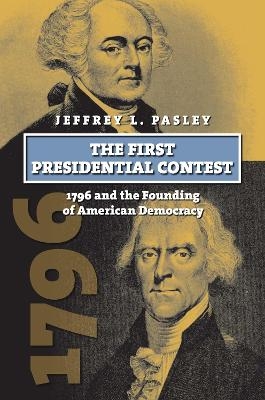
The First Presidential Contest
1796 and the Founding of American Democracy
Seiten
2016
University Press of Kansas (Verlag)
978-0-7006-2351-8 (ISBN)
University Press of Kansas (Verlag)
978-0-7006-2351-8 (ISBN)
At first glance, the first American presidential contest looks unfamiliar - parties were frowned upon, there was no national vote, and the candidates did not even participate (the political mores of the day forbade it). Yet for all that, Jeffrey L. Pasley contends, the election of 1796 was “absolutely seminal”, setting the stage for all of American politics to follow.
This is the first study in half a century to focus on the election of 1796. At first glance, the first presidential contest looks unfamiliar-parties were frowned upon, there was no national vote, and the candidates did not even participate (the political mores of the day forbade it). Yet for all that, Jeffrey L. Pasley contends, the election of 1796 was ""absolutely seminal,"" setting the stage for all of American politics to follow.
Challenging much of the conventional understanding of this election, Pasley argues that Federalist and Democratic-Republican were deeply meaningful categories for politicians and citizens of the 1790s, even if the names could be inconsistent and the institutional presence lacking. He treats the 1796 election as a rough draft of the democratic presidential campaigns that came later rather than as the personal squabble depicted by other historians. It set the geographic pattern of New England competing with the South at the two extremes of American politics, and it established the basic ideological dynamic of a liberal, rights-spreading American left arrayed against a conservative, society-protecting right, each with its own competing model of leadership.
Rather than the inner thoughts and personal lives of the Founders, covered in so many other volumes, Pasley focuses on images of Adams and Jefferson created by supporters-and detractors-through the press, capturing the way that ordinary citizens in 1796 would have actually experienced candidates they never heard speak. Newspaper editors, minor officials, now forgotten congressman, and individual elector candidates all take a leading role in the story to show how politics of the day actually worked.
Pasley's cogent study rescues the election of 1796 from the shadow of 1800 and invites us to rethink how we view that campaign and the origins of American politics.
This is the first study in half a century to focus on the election of 1796. At first glance, the first presidential contest looks unfamiliar-parties were frowned upon, there was no national vote, and the candidates did not even participate (the political mores of the day forbade it). Yet for all that, Jeffrey L. Pasley contends, the election of 1796 was ""absolutely seminal,"" setting the stage for all of American politics to follow.
Challenging much of the conventional understanding of this election, Pasley argues that Federalist and Democratic-Republican were deeply meaningful categories for politicians and citizens of the 1790s, even if the names could be inconsistent and the institutional presence lacking. He treats the 1796 election as a rough draft of the democratic presidential campaigns that came later rather than as the personal squabble depicted by other historians. It set the geographic pattern of New England competing with the South at the two extremes of American politics, and it established the basic ideological dynamic of a liberal, rights-spreading American left arrayed against a conservative, society-protecting right, each with its own competing model of leadership.
Rather than the inner thoughts and personal lives of the Founders, covered in so many other volumes, Pasley focuses on images of Adams and Jefferson created by supporters-and detractors-through the press, capturing the way that ordinary citizens in 1796 would have actually experienced candidates they never heard speak. Newspaper editors, minor officials, now forgotten congressman, and individual elector candidates all take a leading role in the story to show how politics of the day actually worked.
Pasley's cogent study rescues the election of 1796 from the shadow of 1800 and invites us to rethink how we view that campaign and the origins of American politics.
Jeffrey L. Pasley is associate professor of history at the University of Missouri, USA. He is the author of ""The Tyranny of Printers"": Newspaper Politics in the Early American Republic and coeditor of Beyond the Founders: New Approaches to the Political History of the Early American Republic.
| Erscheinungsdatum | 01.01.2017 |
|---|---|
| Reihe/Serie | American Presidential Elections |
| Zusatzinfo | 19 illustrations |
| Verlagsort | Kansas |
| Sprache | englisch |
| Maße | 152 x 228 mm |
| Gewicht | 333 g |
| Themenwelt | Sachbuch/Ratgeber ► Geschichte / Politik ► Allgemeines / Lexika |
| Geschichte ► Allgemeine Geschichte ► Neuzeit (bis 1918) | |
| Geisteswissenschaften ► Geschichte ► Regional- / Ländergeschichte | |
| Sozialwissenschaften ► Politik / Verwaltung ► Politische Theorie | |
| Sozialwissenschaften ► Politik / Verwaltung ► Staat / Verwaltung | |
| ISBN-10 | 0-7006-2351-5 / 0700623515 |
| ISBN-13 | 978-0-7006-2351-8 / 9780700623518 |
| Zustand | Neuware |
| Informationen gemäß Produktsicherheitsverordnung (GPSR) | |
| Haben Sie eine Frage zum Produkt? |
Mehr entdecken
aus dem Bereich
aus dem Bereich
Geschichte einer wilden Handlung
Buch | Hardcover (2024)
C.H.Beck (Verlag)
CHF 47,60


