


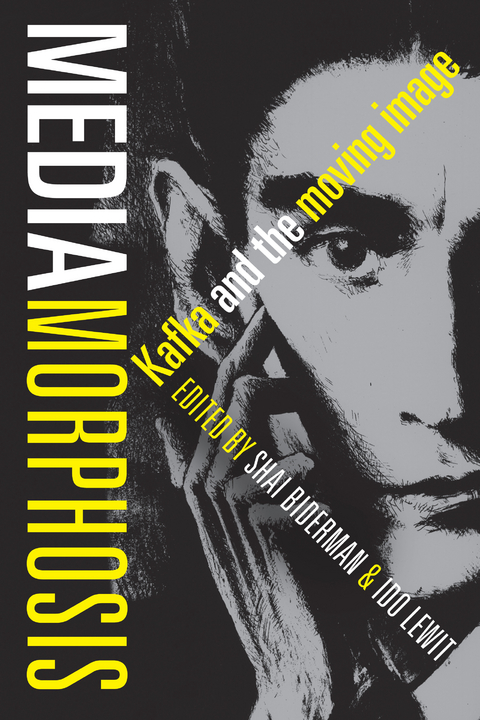
Mediamorphosis (eBook)
Columbia University Press (Verlag)
978-0-231-85089-6 (ISBN)
The idea of a visual manifestation of the work of Franz Kafka was denied by many-first and foremost by Kafka himself, who famously urged his publisher to avoid an image of an insect on the cover of Metamorphosis. Be that as it may, it is unlikely that such a central progenitor of twentieth-century art and thought as Kafka can be fully understood without reference to the revolutionary artistic medium of his century: cinema.Mediamorphosis compiles articles by some of today's leading forces in the scholarship of Kafka as well as film studies to provide a thorough investigation of the reciprocal relations between Kafka's work and the cinematic medium. The volume approaches the theoretical integration of Kafka and cinema via such issues as the cinematic qualities in Kafka's prose and the possibility of a visual manifestation of the Kafkaesque. Alongside these debates, the book investigates the capacity of cinema to incorporate and express the unique qualities of a Kafkaesque world through an analysis of cinematic adaptations of Kafka's prose, such as Michael Haneke's The Castle (1997) and Straub-Huillet's Class Relations (1984), as well as films that carry a more subtle relation to Kafka's oeuvre, such as the cinematic works of David Cronenberg, the films of the Coen brothers, Chris Marker's "e;film-essay,"e; Charlie Chaplin's tramp, and others.
Shai Biderman is professor of philosophy at Tel Aviv University. He teaches film and philosophy at TAU and at Beit-Berl College, Israel. He is the coeditor of The Philosophy of David Lynch.Ido Lewit is a PhD candidate in the Department of Film and Television at Tel Aviv University.
AcknowledgmentsNotes on ContributorsIntroduction, by Ido Lewit and Shai BidermanPart I. The Cinematic KafkaKafka, Rumour, Early Cinema: Archaic Moving Pictures, by Paul NorthSebald Goes to the Movies: Reading Kafka as Cinematography, by Nimrod MatanThe Ghost Is Clear: The POV of the Daydreamer, by Laurence A. RickelsMoving Pictures—Visual Pleasures: Kafka's Cinematic Writing, by Peter BeickenTo Move as the Image Moves: The Rule of Rhythmic Presence and Absence in Kafka's The Man Who Disappeared, by Tobias KuehneNoises Off: Cinematic Sound in Kafka's 'The Burrow', by Kata GellenGesture, Wardrobe, Backdrop and Prop in Franz Kafka's The Man Who Disappeared and Peter Weir's The Truman Show, by Idit AlphandaryThe Possibility of the Cinematic in 'The Metamorphosis' and 'The Burrow', by Kevin W. SweeneyPart II. The Kafkaesque Cinema'The Essential Is Sufficient': The Kafka Adaptations of Orson Welles, Straub-Huillet and Michael Haneke, by Martin Brady and Helen HughesK., the Tramp, and the Cinematic Vision: The Kafkaesque Chaplin, by Shai Biderman'The Medium Is the Message': Cronenberg 'Outkafkas' Kafka, by Iris BruceThe Absurdity of Human Existence: 'The Metamorphosis' and The Fly, by William J. Devlin and Angel M. Cooper'This Is Not Nothing': Viewing the Coen Brothers Through the Lens of Kafka, by Ido LewitThe Face: K. and Keaton, by Omri Ben-YehudaTranslating Kafka into Italian: Kafkaesque Themes in Eilo Petri's Films, by Fernando Gabriel Pagnoni Berns and Leonardo Acosta LandoEpilogue: A Personal Quest Into the Cinematic KafkaesqueMagic, Mystery and Miracle: Re-spiralling Marker and Kafka, by Dan GevaTranscribing Kafka Into Film: A Tortuous Love-Story, by Henry SussmanIndex
| Erscheint lt. Verlag | 26.2.2016 |
|---|---|
| Verlagsort | New York |
| Sprache | englisch |
| Themenwelt | Kunst / Musik / Theater ► Film / TV |
| Kunst / Musik / Theater ► Theater / Ballett | |
| Geisteswissenschaften ► Sprach- / Literaturwissenschaft ► Anglistik / Amerikanistik | |
| Geisteswissenschaften ► Sprach- / Literaturwissenschaft ► Literaturwissenschaft | |
| Sozialwissenschaften ► Kommunikation / Medien ► Medienwissenschaft | |
| ISBN-10 | 0-231-85089-1 / 0231850891 |
| ISBN-13 | 978-0-231-85089-6 / 9780231850896 |
| Informationen gemäß Produktsicherheitsverordnung (GPSR) | |
| Haben Sie eine Frage zum Produkt? |
 EPUB (Adobe DRM)
Kopierschutz: Adobe-DRM
Adobe-DRM ist ein Kopierschutz, der das eBook vor Mißbrauch schützen soll. Dabei wird das eBook bereits beim Download auf Ihre persönliche Adobe-ID autorisiert. Lesen können Sie das eBook dann nur auf den Geräten, welche ebenfalls auf Ihre Adobe-ID registriert sind.
Details zum Adobe-DRM
Dateiformat: EPUB (Electronic Publication)
EPUB ist ein offener Standard für eBooks und eignet sich besonders zur Darstellung von Belletristik und Sachbüchern. Der Fließtext wird dynamisch an die Display- und Schriftgröße angepasst. Auch für mobile Lesegeräte ist EPUB daher gut geeignet.
Systemvoraussetzungen:
PC/Mac: Mit einem PC oder Mac können Sie dieses eBook lesen. Sie benötigen eine
eReader: Dieses eBook kann mit (fast) allen eBook-Readern gelesen werden. Mit dem amazon-Kindle ist es aber nicht kompatibel.
Smartphone/Tablet: Egal ob Apple oder Android, dieses eBook können Sie lesen. Sie benötigen eine
Geräteliste und zusätzliche Hinweise
Buying eBooks from abroad
For tax law reasons we can sell eBooks just within Germany and Switzerland. Regrettably we cannot fulfill eBook-orders from other countries.
aus dem Bereich


