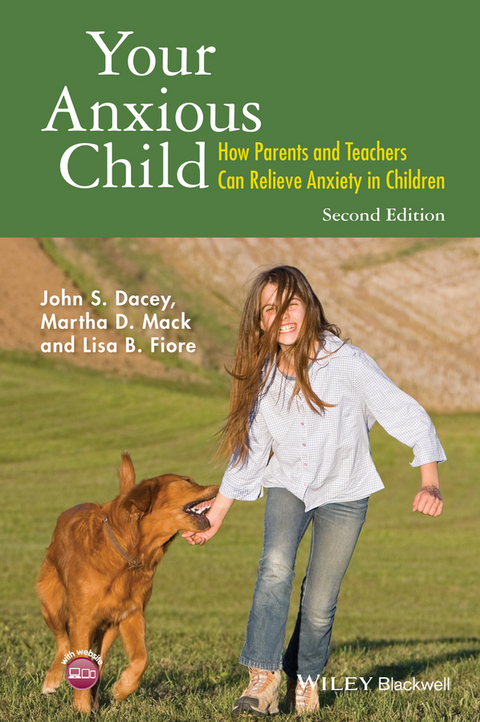
Your Anxious Child (eBook)
John Wiley & Sons (Verlag)
978-1-118-97476-6 (ISBN)
- Offers an array of innovative strategies organized into the authors' four-step 'COPE' program, which has undergone more than 20 years of successful field testing
- Each strategy is accompanied by a set of activities contextualized with full details of the appropriate age level, materials needed, suggested setting, and a template script
- Presents a straightforward account of anxiety, the most prevalent clinical diagnosis in young people, written with a careful balance of scientific evidence and benevolence
- Features a brand new chapter on preschoolers and a companion website that includes instructional MP3 recordings and a wealth of additional resources
A fully-revised and updated new edition of a bestselling book designed to help parents, teachers, and counsellors support young people suffering from anxiety. Offers an array of innovative strategies organized into the authors four-step COPE program, which has undergone more than 20 years of successful field testing Each strategy is accompanied by a set of activities contextualized with full details of the appropriate age level, materials needed, suggested setting, and a template script Presents a straightforward account of anxiety, the most prevalent clinical diagnosis in young people, written with a careful balance of scientific evidence and benevolence Features a brand new chapter on preschoolers and a companion website that includes instructional MP3 recordings and a wealth of additional resources
John S. Dacey is Professor Emeritus in the Lynch School of Education at Boston College, USA. He is the author of 14 books on anxiety, creativity, and human development, including Understanding Creativity: The Interplay of Biological, Psychological and Social Factors (1998) and The Nurturing Parent: How to Raise Creative, Loving, Responsible Children (1992). He also has a small practice as a licensed psychotherapist and frequently does workshops on the subjects of creative problem solving, dealing with emotional problems in the classroom, post-traumatic stress in the fire station, and social and emotional learning. Martha D. Mack is the former Early Childhood Director of the Nauset Integrated Preschool Program, Cape Cod, USA, and has been working in Early Childhood Education for 35 years. She has developed programs for preschoolers with and without disabilities in schools, and is involved with research that supports a developmentally appropriate preschool curriculum promoting socio-dramatic play, self-regulation and executive functioning through the teaching of literacy and mathematics. Lisa B. Fiore is Dean of Faculty and Professor of Education at Lesley University, USA. She is the author of several books on assessment and early childhood education, including Assessment of Young Children: A Collaborative Approach (2012) and LifeSmart: Exploring Human Development (2011). Her current research interests include social-emotional learning and development, mindfulness in education, and recognizing ordinary teaching moments as contemplative practice.
List of Illustrations ix
About the Authors xi
Acknowledgements xiii
About the Companion Website xv
1 What Is Anxiety? 1
2 The Eight Types of Anxiety Disorder 23
3 COPE Step One: Calming the Nervous System 39
4 COPE Step Two: Originating an Imaginative Plan 67
5 COPE Step Three: Persisting in the Face of Obstacles 95
6 COPE Step Four: Evaluating the Plan 117
7 Using Anxiety Strategies with Preschoolers 141
8 How Your Parenting Style Can Ease Your Child's Anxiety 161
References 181
Index 000
1
What Is Anxiety?
“What good are the best teachers or schools if the most vulnerable kids feel so unsafe that they are unavailable to learn?”1
It's hard to be the parent of an anxious child. And it is definitely harder than it was when this book was first published 15 years ago, in 2000. In the seven years before 2001, a US Secret Service study of incidents of targeted school shootings found 37 such incidents in US schools.2 From August to October 2013 alone, there were 16 school shootings resulting in 45 deaths and 78 non-fatal gunshot injuries. “We’ve become numb to this,” President Obama said.3 Our children haven’t.
While less horrendous, the data for schools around the world indicate a significant increase in school violence.4 We could cite many other new factors that have increased the level of stress among our children – cyberbullying, “designer” drugs, gangs, high-stakes testing – but there is no need. As a parent and/or an educator, you are surely aware that fear-provoking incidents have become more common in recent decades. In many schools globally, children now regularly practice not just fire drills, but also safety exercises such as “lock-down drills”. Thus they often estimate the likelihood of their becoming victims as being greater than it really is.
A huge number of children suffer from one (or more) of the eight anxiety disorders – anxiety is currently the most prevalent psychiatric diagnosis in individuals aged 16 and younger. For example, among the United Kingdom’s population, 24 percent will experience some kind of mental health problem in the course of a year. Mixed anxiety and depression is the most common mental disorder. Anxious children are two to four times more likely to develop depression, and as teenagers, they are much more likely to attempt suicide and to become involved with substance abuse.5
These dismal data are similar in the United States, Australia, and many other countries, and represent an increase of as much a 10 percent in the past two decades.6 A major cause worldwide is greater pressure to achieve in school. In an article entitled “Redefining teenage success”, Weiss called for changing the typical parental question from “How did you do on that test?” to “What did you enjoy learning today?” She argues that when children enjoy an experience, they are probably learning something.7
Internationally, this position is supported by UNICEF: “Child rights, dignity, participation and equity are at the core of the Council of Europe’s Child-Friendly Health Care Guidelines.”8 It is also backed by a study of 1,004 elementary, middle and high school Asian students aged nine to 19 years, which investigated their levels of generalized anxiety, social anxiety, and separation anxiety These findings were consistent with studies conducted in Western culture and suggest that the incidence of childhood anxiety is universal.9
So how can you help your anxious child? Often you don’t know what is causing her10 anxiety, and sometimes you’re not even aware that she is feeling frightened. Anxiety has been called the “silent affliction” because most sufferers try, and are able, to hide their distress from others. What can you as a parent do?
The Concerns of Four Worried Parents
“My Katie is a little chatterbox, but when you ask her to perform, even for the family, she gets so nervous that she freezes up. I wish I could help her relax more.”
“Almost since he was a baby, Jose has been a 'clinger'. He hated starting kindergarten and even now in the third grade, he misses me and can't wait to get home. He’s always worrying that something bad will happen. We thought up a plan to help him be less frightened, but it just didn't work out.”
“Our Damian is terrified of animals. He hates to walk down the street by himself. He thinks a squirrel is going to jump out at him! We took him to a psychologist who helped him think about his fears differently, and for while he was a lot better. Then a dog barked at him and he just gave up.”
“I wouldn't say Felicia has a disorder. She does most of the things the other kids do – it's just that she worries about doing everything. She's very capable, but she's always afraid she's going to screw up. She works hard to get over her fears and we tell her that she is doing better. She just can't see it, though. She just doesn’t realize the improvements she's made.”
These statements reflect the four central problems that all anxious children face:
- They find it harder than other children to calm themselves when they are in a stressful situation.
- Although many of them are above average in creativity,11 they seldom use this ability when thinking of strategies and tactics for coping with their anxiety because they have become inflexible in their thinking.
- Even when they do have a good plan, they tend to become discouraged after a while and often quit trying.
- Even when they are making progress in reducing their anxious feelings, they fail to recognize their progress.
The good news is that although medications can be helpful, studies have shown that about 90 percent of all anxious children can be greatly helped by learning coping skills.12 The goal of our book is straightforward: we want to empower you and your child to relieve her feelings of anxiety. In the chapters that follow, we will provide strategies that form the basis for our four-step COPE program, one step for each of the four difficulties described in the parental statements. COPE has undergone 25 years of successful field testing in schools and with individual children in various parts of the country.13 These activities will help you to deal effectively with each of the four problems we listed above. This master plan, which will be used throughout this book, has been designed to ensure that all children are given opportunities to regulate their anxiety level. We will say more about this later in this chapter.
We know that as parents, you are often faced with questions from your child such as “What if I'm not picked for the soccer team?”, “What if I can't tie a square knot when it's my turn?”, or “What if nobody gives me a Valentine?” It is difficult to know whether your child's worries are a case of the “what ifs” or she has a serious anxiety problem. If the latter, everyday tasks and events can become extremely challenging, with seemingly insurmountable obstacles. She simply can't imagine personal success when she first imagines failure or harm.
The Nature of Anxiety
Almost all children experience fear when they perceive a threat, be it real or imaginary. In fact, a moderate amount of fear can motivate them to learn new things. Whether the perceived threat takes the form of a dentist, a witch, or a snake, all kids encounter stressful situations, and these circumstances change as the child matures into adolescence. For example, preschoolers may feel afraid of the dark, being alone, or monsters, while older children may worry about rejection by peers or incompetence in school activities. Children and adolescents inevitably come to learn about potentially fearful, even dangerous, risks. The ways they respond to anxiety depend on their individual personalities and their developmental level.
The terms fear, worry, and anxiety are often used interchangeably. In fact, there are subtle differences that are worth noting here. Psychologists use the word fear to describe frightened feelings toward a clear danger or threat. Fear is a reaction to an environmental threat that is focused on a specific object, individual, or circumstance. Worry is similar to fear, in that it refers to less intense foreboding about specific future events.
In contrast, anxiety is a general frightened response to a source that is not readily identifiable. It could be the perception of a threat of what might have happened in the past or might happen in the future. An anxious child or adolescent may feel emotionally torn over some event which she cannot control. When a child is unable to think of a solution to the problem, their thinking becomes inflexible due to feelings of helplessness. In summary, anxiety is a response to events or people that pose no immediate threat, although to the individual they seem quite menacing.
When Anxiety Becomes a Problem
In the simplest sense, anxiety is the feeling that one's wellbeing is endangered. Under some circumstances, a potential threat is readily resolved, such as the first time a child musters the courage to blow bubbles in the swimming pool. When she hears applause for joining the ranks of the minnows, the threatened feeling is replaced by a feeling of success.
Some children, however, find it more difficult to experience success in everyday situations. They find themselves plagued by self-doubts that are more pervasive than a simple fear. Most of the time, this feeling is the result of two types of mistaken thinking:
- Faulty perception of the facts; and/or
- Misunderstanding of the meaning of the facts.
Examples of Mistaken Thinking
Fact: My heart is being faster than usual now.
Faulty perception of the fact: “My heart is racing;...
| Erscheint lt. Verlag | 22.3.2016 |
|---|---|
| Sprache | englisch |
| Themenwelt | Sachbuch/Ratgeber ► Gesundheit / Leben / Psychologie ► Familie / Erziehung |
| Sachbuch/Ratgeber ► Gesundheit / Leben / Psychologie ► Lebenshilfe / Lebensführung | |
| Sachbuch/Ratgeber ► Gesundheit / Leben / Psychologie ► Psychologie | |
| Sachbuch/Ratgeber ► Gesundheit / Leben / Psychologie ► Schwangerschaft / Geburt | |
| Geisteswissenschaften ► Psychologie ► Angst / Depression / Zwang | |
| Geisteswissenschaften ► Psychologie ► Entwicklungspsychologie | |
| Sozialwissenschaften ► Pädagogik ► Didaktik | |
| Schlagworte | adolescence • Angst • Anxiety • Bildungswesen • Bullying • Child & Adolescent Clinical Psychology • COPE program • Counseling • Cyberbullying • Development • Early childhood education • Education • family psychologists • Kinderpsychologie • Klinische Psychologie • Klinische Psychologie / Kinder u. Jugendliche • Mental Health • parenting • Psychologie • Psychology • psychotherapy • Ratgeber • Ratgeber Erziehung • School Counselors • Self-Help • therapy |
| ISBN-10 | 1-118-97476-X / 111897476X |
| ISBN-13 | 978-1-118-97476-6 / 9781118974766 |
| Informationen gemäß Produktsicherheitsverordnung (GPSR) | |
| Haben Sie eine Frage zum Produkt? |
 EPUB (Adobe DRM)
Kopierschutz: Adobe-DRM
Adobe-DRM ist ein Kopierschutz, der das eBook vor Mißbrauch schützen soll. Dabei wird das eBook bereits beim Download auf Ihre persönliche Adobe-ID autorisiert. Lesen können Sie das eBook dann nur auf den Geräten, welche ebenfalls auf Ihre Adobe-ID registriert sind.
Details zum Adobe-DRM
Dateiformat: EPUB (Electronic Publication)
EPUB ist ein offener Standard für eBooks und eignet sich besonders zur Darstellung von Belletristik und Sachbüchern. Der Fließtext wird dynamisch an die Display- und Schriftgröße angepasst. Auch für mobile Lesegeräte ist EPUB daher gut geeignet.
Systemvoraussetzungen:
PC/Mac: Mit einem PC oder Mac können Sie dieses eBook lesen. Sie benötigen eine
eReader: Dieses eBook kann mit (fast) allen eBook-Readern gelesen werden. Mit dem amazon-Kindle ist es aber nicht kompatibel.
Smartphone/Tablet: Egal ob Apple oder Android, dieses eBook können Sie lesen. Sie benötigen eine
Geräteliste und zusätzliche Hinweise
Buying eBooks from abroad
For tax law reasons we can sell eBooks just within Germany and Switzerland. Regrettably we cannot fulfill eBook-orders from other countries.
aus dem Bereich