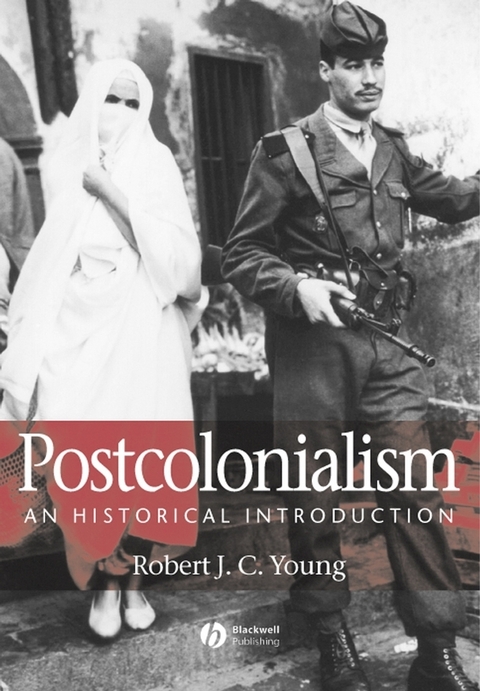
Postcolonialism (eBook)
512 Seiten
John Wiley & Sons (Verlag)
978-1-119-28895-4 (ISBN)
Robert J. C. Young is Professor of English and Critical Theory at Oxford University and a fellow of Wadham College. He is the author of White Mythologies: Writing History and the West (1990), Colonial Desire: Hybridity in Theory, Culture, and Race (1995), and Torn Halves: Political Conflict in Literary and Cultural Theory (1996). Robert Young is also the General Editor of Interventions: International Journal of Postcolonial Studies.
1. Colonialism and the Politics of Postcolonial Critique.
Part I: Concepts in History:.
2. Colonialism.
3. Imperialism.
4. Neocolonialism.
5. Postcolonialism.
Part II: European Anti-colonialism:.
6. Las Casas to Burke.
7. Nineteenth-century Liberalism.
8. Marx on Colonialism and Imperialism.
Part III: The Internationals:.
9. Socialism and Nationalism: The First International to the
Russian Revolution.
10. The Third International, to the Baku Congress of the Peoples
of the East.
11. The Women's International, the Third and the Fourth
Internationals.
Part IV: Theoretical Practices of the Freedom
Struggles:.
12. The National Liberation Movements: Introduction.
13. Marxism and the National Liberation Movements.
14. China, Egypt, Bandung.
15. Latin America I: Mariátegui, Transculturation and
Cultural Dependency.
16. Latin America II: Cuba: Guevara, Castro and the
Tricontinental.
17. Africa I: Anglophone African Socialism.
18. Africa II: Nkrumah and Pan-Africanism.
19. Africa III: The Senghors and Francophone African
Socialism.
20. Africa IV: Fanon/Cabral.
21. The Subject of Violence: Algeria, Ireland.
22. India I: Marxism in India.
23. India II: Gandhi's Counter-modernity.
Part V: Formations of Postcolonial Theory:.
24. India III: Hybridity and Subaltern Agency:.
25. Women, Gender and Anti-colonialism.
26. Edward Said and Colonial Discourse.
27. Foucault in Tunisia.
28. Subjectivity and History: Derrida in Algeria.
Epilogue: Tricontinentalism, for a Transnational Social
Justice.
"The foremost postcolonial theorist in Britain" Times Higher
Education Supplement
"In pursuing the historical past of postcolonial discourse,
Robert Young makes a truly insightful and inventive contribution to
the development of the field. His intricate and exhaustive study
finds its inspiration in the exhilarating events and ideals of
anti-colonialist struggle. Inspired by the imaginative spirit of
emancipation, Young argues that the great anti-colonial movements
were also transformative and hybrid moments that reshaped both
power and knowledge. The fine achievement of this provocative
account lies in reviving and revising the remarkable dawning of the
Third World as we emerge into the global conceits of the third
millennium." Homi K. Bhabha, Harvard University
"Robert Young points postcolonial studies in new directions,
paradoxically by offering a timely reminder of the field's
historical beginnings in anticolonial struggles. This book combines
scholarship and polemic admirably in its project of situating and
redirecting postcolonial studies today. It is a major work, marking
a turning-point in thinking and research in the field."
Rajeswari Sunder Rajan, Nehru Memorial Library, New
Delhi
"Steadfastly avoiding the glib formulas and fashionable notions
with which Eng Lit is now awash, Young gives us instead a
meticulously researched, soberly detailed set of histories - of
classical European colonialism, international socialism, and a
range of nationalist movements from China and Egypt to Cuba and
Algeria. The result is a timely portrait of the various unsavoury
ways in which the West has sought cynically to derail emancipation
of others while prating piously of its own liberties." Terry
Eagleton, Times Literary Supplement
"Young (Oxford) offers a panoramic view of the political and
intellectual origins of postcolonial thought. Young helpfully
synthesizes a great deal of material. In addition to the canonical
topics, he covers some that are neglected by most scholars. Highly
recommended for upper-division undergraduates through faculty."
Choice
"Young does a brilliant job in laying the foundations for the
further understanding of this urgent dilemma." Times Higher
Education Supplement
| Erscheint lt. Verlag | 3.3.2016 |
|---|---|
| Sprache | englisch |
| Themenwelt | Literatur |
| Geschichte ► Teilgebiete der Geschichte ► Wirtschaftsgeschichte | |
| Geisteswissenschaften ► Sprach- / Literaturwissenschaft ► Anglistik / Amerikanistik | |
| Geisteswissenschaften ► Sprach- / Literaturwissenschaft ► Literaturwissenschaft | |
| Sozialwissenschaften ► Politik / Verwaltung | |
| Schlagworte | Literature • Literaturwissenschaft • postcolonial theory • Theorie der Postkolonialzeit |
| ISBN-10 | 1-119-28895-9 / 1119288959 |
| ISBN-13 | 978-1-119-28895-4 / 9781119288954 |
| Informationen gemäß Produktsicherheitsverordnung (GPSR) | |
| Haben Sie eine Frage zum Produkt? |
 PDF (Adobe DRM)
Kopierschutz: Adobe-DRM
Adobe-DRM ist ein Kopierschutz, der das eBook vor Mißbrauch schützen soll. Dabei wird das eBook bereits beim Download auf Ihre persönliche Adobe-ID autorisiert. Lesen können Sie das eBook dann nur auf den Geräten, welche ebenfalls auf Ihre Adobe-ID registriert sind.
Details zum Adobe-DRM
Dateiformat: PDF (Portable Document Format)
Mit einem festen Seitenlayout eignet sich die PDF besonders für Fachbücher mit Spalten, Tabellen und Abbildungen. Eine PDF kann auf fast allen Geräten angezeigt werden, ist aber für kleine Displays (Smartphone, eReader) nur eingeschränkt geeignet.
Systemvoraussetzungen:
PC/Mac: Mit einem PC oder Mac können Sie dieses eBook lesen. Sie benötigen eine
eReader: Dieses eBook kann mit (fast) allen eBook-Readern gelesen werden. Mit dem amazon-Kindle ist es aber nicht kompatibel.
Smartphone/Tablet: Egal ob Apple oder Android, dieses eBook können Sie lesen. Sie benötigen eine
Geräteliste und zusätzliche Hinweise
Buying eBooks from abroad
For tax law reasons we can sell eBooks just within Germany and Switzerland. Regrettably we cannot fulfill eBook-orders from other countries.
aus dem Bereich