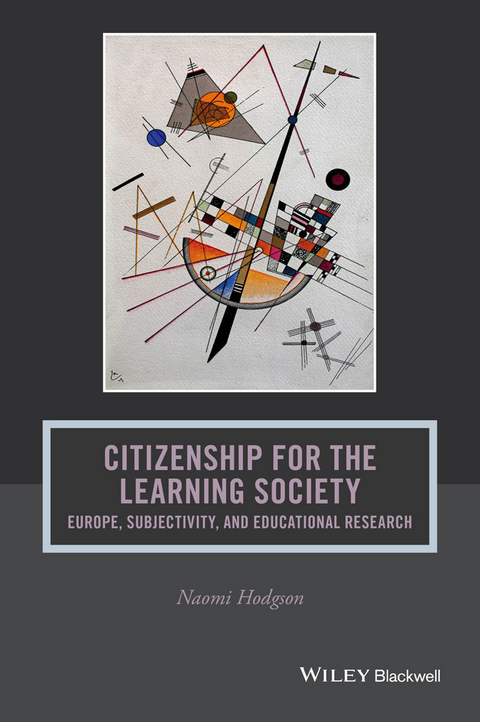
Citizenship for the Learning Society (eBook)
John Wiley & Sons (Verlag)
978-1-119-15208-8 (ISBN)
Within Citizenship for the Learning Society, the governance of the learning citizen is mapped in relation to European educational and cultural policy. Prevalent notions of voice and narrative - in policy and in educational research - are analysed in relation to Europe's history.
- The text is concerned with the way in which 'European citizenship' is understood in current policy, the way in which the term 'citizenship' operates, and how learning is central to this
- Analysis combines educational philosophy and theory with anthropological, sociological, and classic philosophical literature
- Draws on both Continental European (Foucault, Deleuze, Heidegger, Levinas) and American (Cavell, Emerson, Thoreau) philosophy
- Material is organised in two parts: Part One discusses the discourses and practices of citizenship in the European learning society, in both educational and cultural policy and educational research, from the perspective of governmentality; Part Two provides analysis of particular aspects of this discourse
Naomi Hodgson is a Visiting Research Associate in the Centre for Philosophy of Education at University College London. She is also an affiliate of the Laboratory for Education and Society, KU Leuven, Belgium and Visiting Lecturer at Leeds Trinity University, UK. Her research interests include the role of learning and research in current modes of governmentality, subjectivity, and technologies of accountability, on which she has published a number of journal articles and book chapters. She is currently Reviews Editor for the Journal of Philosophy of Education.
Within Citizenship for the Learning Society, the governance of the learning citizen is mapped in relation to European educational and cultural policy. Prevalent notions of voice and narrative - in policy and in educational research - are analysed in relation to Europe s history. The text is concerned with the way in which European citizenship is understood in current policy, the way in which the term citizenship operates, and how learning is central to this Analysis combines educational philosophy and theory with anthropological, sociological, and classic philosophical literature Draws on both Continental European (Foucault, Deleuze, Heidegger, Levinas) and American (Cavell, Emerson, Thoreau) philosophy Material is organised in two parts: Part One discusses the discourses and practices of citizenship in the European learning society, in both educational and cultural policy and educational research, from the perspective of governmentality; Part Two provides analysis of particular aspects of this discourse
Naomi Hodgson is a Visiting Research Associate in the Centre for Philosophy of Education at University College London. She is also an affiliate of the Laboratory for Education and Society, KU Leuven, Belgium and Visiting Lecturer at Leeds Trinity University, UK. Her research interests include the role of learning and research in current modes of governmentality, subjectivity, and technologies of accountability, on which she has published a number of journal articles and book chapters. She is currently Reviews Editor for the Journal of Philosophy of Education.
Preface vi
Acknowledgements ix
1 Introduction 1
Part One 41
2 Constructing Europe: Citizenship, Learning, and Accountability 43
3 Environment, Heritage, and the Ecological Subject 69
4 The Subject and the Educational in Educational Research 88
Between Part One and Part Two 125
Part Two 135
5 1933, Or Rebirth 137
6 America, Or Leaving Home 167
7 Plato, Or Return to the Cave 188
8 Conclusion 206
References 215
Index 223
'What lies behind the recent calls for multicultural citizenship, lifelong learning, and well-being? Is the trend toward voice and narrative in educational research truly liberatory? What does the accountability movement signal about our new relationship to ourselves? I recommend this book for its disturbing answer to these questions and its subtle exploration of an alternative path.'
Chris Higgins, University of Illinois at Urbana-Champaign, USA
Editor, Educational Theory
Author of The Good Life of Teaching: An Ethics of Professional Practice
'In this wide-ranging, searching, and highly original book Naomi Hodgson analyses some of the watchwords of our time: citizenship education, the learning society, well-being, among others. Surely no sensible person can be against these? Yet, as Hodgson shows, they carry with them unexpected implications, particularly for the nature of educational research and the identity of the educational researcher.'
Richard Smith, Durham University, UK
2
Constructing Europe: Citizenship, Learning, and Accountability
INTRODUCTION
As a starting point for considering how citizenship, and the relationship between citizenship and education, have come to be understood in the European context in recent years, this chapter begins by providing some historical background to European integration. In particular it draws attention to the way that history has been used to promote a European identity since the European Union and, with it, ‘European citizenship’ were created in 1992. This is placed in the context of an understanding of advanced liberalism or neoliberalism from the perspective of governmentality, following on from the introduction to this political rationality given in the previous chapter.
Current practices of accountability are indicative of the need to evidence the existence of a European public. Large-scale attempts to foster a European consciousness were made following the creation of European citizenship by the ratification of the Maastricht Treaty in 1992 (OJEU, 1992). Following this, EU policy-makers sought to create a European identity, a European public, to ‘displace the cultural hegemony of nationalism’ (Shore, 2000, p. 21). The creation of symbols of Europe such as a flag and a currency are particularly visible examples of the process of constructing ‘Europe’ anew. Large-scale measures in the areas of education and culture in particular have sought to make Europe visible and tangible to its citizens. Through the promotion of a shared European heritage (see Shore, 2000), educational exchange programmes between member states (e.g. SOCRATES and ERASMUS), ‘European Years of…’, and the Capital of Culture competition, time and space themselves have been reordered in the process of Europeanisation (Shore, 2000, p. 50).
The Bologna Declaration of 1999 intensified the rate and level of integration, as it sought to ‘establish a more complete and far-reaching Europe’.1 The Declaration, which began the process of creating a European Area of Higher Education, makes clear the centrality of education to the future development of Europe:
A Europe of Knowledge is now widely recognised as an irreplaceable factor for social and human growth and as an indispensable component to consolidate and enrich the European citizenship, capable of giving its citizens the necessary competences to face the challenges of the new millennium, together with an awareness of shared values and belonging to a common social and cultural space.
The importance of education and educational co-operation in the development and strengthening of stable, peaceful and democratic societies is universally acknowledged as paramount … (p. 1).
The Declaration provides the basis for the pursuit of compatibility and comparability of European higher education institutions, mobility, increasing competitiveness, and the acceptance of the interrelationship between these objectives, citizenship, and the promotion of European culture:
We must in particular look at the objective of increasing the international competitiveness of the European system of higher education. The vitality and efficiency of any civilisation can be measured by the appeal that its culture has for other countries. We need to ensure that the European higher education system acquires a world-wide degree of attraction equal to our extraordinary cultural and scientific traditions (pp. 2–3).
Subsequent developments have taken place at the local political, institutional, and individual levels as Europe has sought to standardise practices of measurement, presentation, and accountability within and across the member states. Part of what has been termed the ‘Europeanisation’ of Europe, this requires the categorisation of phenomena as European. Concepts such as ‘European citizen’, ‘common European values’, ‘European culture’, and ‘European public opinion’ have become part of our vocabulary that renders them less open to question. They ‘become part of the fabric of our subjectivity’ (Shore, 2000, p. 29).
The framing of the relationship between globalisation and its socioeconomic challenges has made the need to attend to questions of citizenship, particularly through education, self-evident. The shift in the mode of governance has not only entailed using education as a means of educating citizens about Europe: in the current context, education – or more specifically, learning – has become a central aspect of how what constitutes citizenship is understood.
Examples of recent educational and cultural policy in this chapter illustrate this further, highlighting terms that are central to producing a particular mode of governance. These examples illustrate the practices of accountability that have emerged in recent years that require governments, institutions, organisations, and individuals to speak about themselves in particular ways. Practices of accountability and a concern with the citizen’s relationship to a European narrative are shown to be related in the way that they demand particular forms of accounting for ourselves and thus constitute a particular self-understanding. The next section provides further background to the history of European integration, following the Second World War, again focussing on the way in which culture and history have been used in the promotion of a European identity. Further detail on the political context of advanced or neoliberalism2 is also given, and this indicates the centrality of learning to this current mode of government.
To develop this account, and to further illustrate the relationship between citizenship and education, or learning, attention is given to the discourse of heritage and how this operates in this mode of governance. These policies draw attention to a particular political rationality. This is then discussed further in terms of the practices of accountability that have developed in recent years to enable mobility, comparability, and compatibility within and between European states and institutions, and their competitors. The practices of accountability that have been developed show the aspects of the self that are being rendered objects of government. Happiness, wellbeing, and active citizenship are shown to be operationalised in the name of democracy and social justice, and are thus becoming objects of measurement, self-improvement, and accountability. These require a particular relationship of ourselves to ourselves, and form part of practices that call for us to understand ourselves as European.
ADVANCED LIBERALISM AND THE USE OF HISTORY
The promotion of European culture has entailed the promotion of a particular European history or heritage. The narrative of Europe according to which its history, our shared heritage, is promoted, derives from the founding principles of the European Union, or the European Coal and Steel Community as it was first established in 1951. This post-war organisation was considered to mark the birth of a United Europe committed to the promotion of peace. Nationalism, insecurity, and instability were seen as the risks against which European unity and solidarity were the only solution (Shore, 2000, p. 16). In his proposal for the European Coal and Steel Community, French Foreign Minister Robert Schuman stated:
World peace cannot be safeguarded without the making of creative efforts proportionate to the dangers which threaten it. The contribution which an organized and living Europe can bring to civilization is indispensable to the maintenance of peaceful relations. In taking upon herself for more than 20 years the role of champion of a united Europe, France has always had as her essential aim the service of peace. A united Europe was not achieved and we had war (Schuman, 1950).3
The 1951 Treaty that formalised Schuman’s proposals created an economic community between continental Western European countries. In addition to economic stability and the improvement of living and working conditions, the agreement was also promoted as a means to overcome the possibility of war between European states and as a first step towards further integration. The emphasis remained on economic integration, as it was assumed that a European consciousness would organically develop as a result of this. In the early 1970s, however, more explicit references were made to culture as a means of fostering a European identity.
During the 1980s, information and culture became both the means and the content for the promotion of a European identity (Shore, 2000, p. 45). There was no formal legal jurisdiction for cultural policy at this time and so measures were justified on economic grounds. Shore cites European Commission President Jacques Delors: ‘The culture industry will tomorrow be one of the biggest industries, a creator of wealth and jobs … We have to build a powerful European culture industry that will enable us to be in control of both the medium and its content, maintaining our standards of civilization, and encouraging the creative people amongst us’ (Delors cited in Shore, 2000, p. 46).
The ratification of the Maastricht Treaty in 1992 formalised the cultural and educational jurisdiction of the European Community and a range of measures were proposed to enhance European consciousness among its citizens, to address the lack of a ‘sufficient consciousness of their European heritage and identity’ (Shore, 2000, p. 49). Various...
| Erscheint lt. Verlag | 2.3.2016 |
|---|---|
| Reihe/Serie | Journal of Philosophy of Education |
| Journal of Philosophy of Education | Journal of Philosophy of Education |
| Sprache | englisch |
| Themenwelt | Geisteswissenschaften ► Philosophie ► Allgemeines / Lexika |
| Geisteswissenschaften ► Philosophie ► Geschichte der Philosophie | |
| Geisteswissenschaften ► Philosophie ► Philosophie der Neuzeit | |
| Sozialwissenschaften ► Pädagogik ► Allgemeines / Lexika | |
| Sozialwissenschaften ► Pädagogik ► Bildungstheorie | |
| Schlagworte | Accountability • Angewandte Philosophie • Applied Philosophy • Bildungswesen • Cavell • Citizenship • Cultural Policy • Education • Educational Policy • Educational Research • Emerson • European citizenship • European History • European identity • Foucault • Governmentality • Heidegger • Levinas • Pädagogik • Pädagogik • Philosophie • Philosophie der Bildung u. Erziehung • Philosophy • Philosophy of education • Plato • Theorie der Pädagogik • Theorie der Pädagogik • Theory of Education • Thoreau |
| ISBN-10 | 1-119-15208-9 / 1119152089 |
| ISBN-13 | 978-1-119-15208-8 / 9781119152088 |
| Informationen gemäß Produktsicherheitsverordnung (GPSR) | |
| Haben Sie eine Frage zum Produkt? |
 EPUB (Adobe DRM)
Kopierschutz: Adobe-DRM
Adobe-DRM ist ein Kopierschutz, der das eBook vor Mißbrauch schützen soll. Dabei wird das eBook bereits beim Download auf Ihre persönliche Adobe-ID autorisiert. Lesen können Sie das eBook dann nur auf den Geräten, welche ebenfalls auf Ihre Adobe-ID registriert sind.
Details zum Adobe-DRM
Dateiformat: EPUB (Electronic Publication)
EPUB ist ein offener Standard für eBooks und eignet sich besonders zur Darstellung von Belletristik und Sachbüchern. Der Fließtext wird dynamisch an die Display- und Schriftgröße angepasst. Auch für mobile Lesegeräte ist EPUB daher gut geeignet.
Systemvoraussetzungen:
PC/Mac: Mit einem PC oder Mac können Sie dieses eBook lesen. Sie benötigen eine
eReader: Dieses eBook kann mit (fast) allen eBook-Readern gelesen werden. Mit dem amazon-Kindle ist es aber nicht kompatibel.
Smartphone/Tablet: Egal ob Apple oder Android, dieses eBook können Sie lesen. Sie benötigen eine
Geräteliste und zusätzliche Hinweise
Buying eBooks from abroad
For tax law reasons we can sell eBooks just within Germany and Switzerland. Regrettably we cannot fulfill eBook-orders from other countries.
aus dem Bereich