


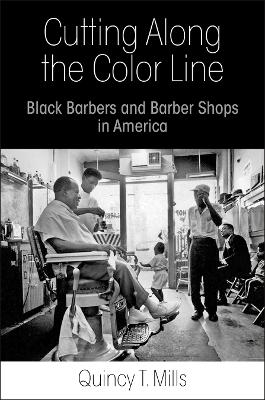
Cutting Along the Color Line
Black Barbers and Barber Shops in America
Seiten
2016
University of Pennsylvania Press (Verlag)
978-0-8122-2379-8 (ISBN)
University of Pennsylvania Press (Verlag)
978-0-8122-2379-8 (ISBN)
Cutting Along the Color Line chronicles the cultural history of barber shops as businesses and civic institutions, demonstrating their central role in civil rights struggles throughout the nineteenth and twentieth centuries.
Today, black-owned barber shops play a central role in African American public life. The intimacy of commercial grooming encourages both confidentiality and camaraderie, which make the barber shop an important gathering place for African American men to talk freely. But for many years preceding and even after the Civil War, black barbers endured a measure of social stigma for perpetuating inequality: though the profession offered economic mobility to black entrepreneurs, black barbers were obliged by custom to serve an exclusively white clientele. Quincy T. Mills traces the lineage from these nineteenth-century barbers to the bustling enterprises of today, demonstrating that the livelihood offered by the service economy was crucial to the development of a black commercial sphere and the barber shop as a democratic social space.
Cutting Along the Color Line chronicles the cultural history of black barber shops as businesses and civic institutions. Through several generations of barbers, Mills examines the transition from slavery to freedom in the nineteenth century, the early twentieth-century expansion of black consumerism, and the challenges of professionalization, licensing laws, and competition from white barbers. He finds that the profession played a significant though complicated role in twentieth-century racial politics: while the services of shaving and grooming were instrumental in the creation of socially acceptable black masculinity, barbering permitted the financial independence to maintain public spaces that fostered civil rights politics. This sweeping, engaging history of an iconic cultural establishment shows that black entrepreneurship was intimately linked to the struggle for equality.
Today, black-owned barber shops play a central role in African American public life. The intimacy of commercial grooming encourages both confidentiality and camaraderie, which make the barber shop an important gathering place for African American men to talk freely. But for many years preceding and even after the Civil War, black barbers endured a measure of social stigma for perpetuating inequality: though the profession offered economic mobility to black entrepreneurs, black barbers were obliged by custom to serve an exclusively white clientele. Quincy T. Mills traces the lineage from these nineteenth-century barbers to the bustling enterprises of today, demonstrating that the livelihood offered by the service economy was crucial to the development of a black commercial sphere and the barber shop as a democratic social space.
Cutting Along the Color Line chronicles the cultural history of black barber shops as businesses and civic institutions. Through several generations of barbers, Mills examines the transition from slavery to freedom in the nineteenth century, the early twentieth-century expansion of black consumerism, and the challenges of professionalization, licensing laws, and competition from white barbers. He finds that the profession played a significant though complicated role in twentieth-century racial politics: while the services of shaving and grooming were instrumental in the creation of socially acceptable black masculinity, barbering permitted the financial independence to maintain public spaces that fostered civil rights politics. This sweeping, engaging history of an iconic cultural establishment shows that black entrepreneurship was intimately linked to the struggle for equality.
Quincy T. Mills is Associate Professor of History at Vassar College.
Preface
Introduction
PART I. BARBERING IN SLAVERY AND FREEDOM
Chapter 1. Barbering for Freedom in Antebellum America
Chapter 2. The Politics of "Color-Line" Barber Shops After the Civil War
Chapter 3. Race, Regulation, and the Modern Barber Shop
PART II. BLACK BARBERS, PATRONS, AND PUBLIC SPACES
Chapter 4. Rise of the New Negro Barber
Chapter 5. Bigger Than a Haircut: Desegregation and the Barber Shop
Chapter 6. The Culture and Economy of Modern Black Barber Shops
Epilogue
Notes
Index
Acknowledgments
| Erscheinungsdatum | 14.01.2017 |
|---|---|
| Zusatzinfo | 19 illus. |
| Verlagsort | Pennsylvania |
| Sprache | englisch |
| Maße | 152 x 229 mm |
| Themenwelt | Geschichte ► Allgemeine Geschichte ► Neuzeit (bis 1918) |
| Geisteswissenschaften ► Geschichte ► Regional- / Ländergeschichte | |
| Geschichte ► Teilgebiete der Geschichte ► Kulturgeschichte | |
| Sozialwissenschaften ► Soziologie | |
| ISBN-10 | 0-8122-2379-9 / 0812223799 |
| ISBN-13 | 978-0-8122-2379-8 / 9780812223798 |
| Zustand | Neuware |
| Informationen gemäß Produktsicherheitsverordnung (GPSR) | |
| Haben Sie eine Frage zum Produkt? |
Mehr entdecken
aus dem Bereich



aus dem Bereich
Geschichte einer wilden Handlung
Buch | Hardcover (2024)
C.H.Beck (Verlag)
CHF 47,60


