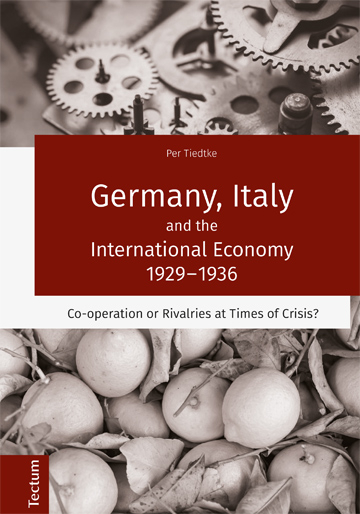
Germany, Italy and the International Economy 1929-1936
Tectum Wissenschaftsverlag
978-3-8288-3718-8 (ISBN)
Introduction
1 Setting the Research Agenda
2 Time Frame
3 Historiography of the German-Italian Economic Relationship
4 Notes on Basic Concepts and Methodology
5 Structure and Empirical Basis
Chapter 1: Prologue – Framing the German-Italian Economic Relationship
1 From the Late Nineteenth Century to the 1920s
2 The Impact of the World Economic Crisis
3 Institutional Change in Foreign Trade
Part I: Becoming Partners? Bilateral Economic Rapprochement 1929–1936
Chapter 2: Failing Attempts in the Reconstruction after the Crash
Introduction: The Situation in 1929
1 New Initiatives after the End of the “Battaglia per la Economia”
2 Attempt No 1: The Spiral of Protectionism
3 Attempt No 2: Political Rhetoric without Action
4 Attempt No 3: “Foreign Exchange War”
Chapter 3: Political Will and Economic Realities after the Nazi Seizure of Power
Introduction: Institutions of the Economic Relationship before and after 1933
1 Brothers in Mind Down to Business?
2 Conflict over Artificial Fibres
3 A New Nazi Foreign Economic Policy
4 The Clearing Agreement of 1934
Chapter 4: Continuing Conflicts and New Collaboration
Introduction: From Hitler’s Seizure of Power to the Commercial “Axis”
1 Evolving Institutions in the Commercial Sphere
2 Industrial Co-operation
3 Changing Trade and the Devaluation of the Lira in 1936
Conclusion Part I: The Economic Foundations of the “Rome-Berlin Axis”
Part II: Ambivalent Co-Ordination at the International Stage 1929–1933
Chapter 5: The International Implications of the German-Italian Economic Relationship
Introduction: The Big Picture
1 Towards Regionalism
2 Crisis and Opportunities in Southeastern Europe
3 The League of Nations’ Search for Economic Relief
Chapter 6: Political Revisionism and International Economic Rescue
Introduction: Towards International Collaboration
1 Intensifying Contact at the International Organisation
2 Customs Unions – A Political Response to Economic Crisis
3 Second Effort: Commercial Preferences
Chapter 7: From International Co-Ordination to Confrontational Bilateralism
Introduction: Circumventing International Opposition
1 A Common Stance at the International Economic Conferences?
2 Hiding from International Responsibility
3 Hidden Preferences: The Brocchi Contracts
Conclusion Part II: The Triumph of Bilateralism
Part III: The Quest for New Markets 1933–1936
Chapter 8: Hinterland/Retroterra – Entangled Economic Expansion in Southeastern Europe
Introduction: Economic Expansion after 1933
1 Transfer of Commercial Policy
2 Connecting Southeastern Europe with the World – Hamburg/Bremen vs. Trieste
3 Institutional Competition in Fascist Italy’s Best Market: Yugoslavia
4 Collaboration among Equals or Subordination?
Chapter 9: Beyond Europe – Co-operation and Rivalries in the Mare Nostrum
Introduction: Separated Spaces?
1 Joint Manoeuvres in Turkey
2 Egypt – Commercial Expansion on Ideological Tailwind?
3 Italy’s Multiple Replacement through Nazi Germany’s Trade with Palestine
4 Iraq’s oil
Conclusion and Outlook
Appendix
Sources
Literature
Major Actors
List of Abbreviations
| Erscheinungsdatum | 18.04.2016 |
|---|---|
| Sprache | englisch |
| Maße | 148 x 210 mm |
| Gewicht | 603 g |
| Themenwelt | Geschichte ► Allgemeine Geschichte ► 1918 bis 1945 |
| Geisteswissenschaften ► Geschichte ► Regional- / Ländergeschichte | |
| Geschichte ► Teilgebiete der Geschichte ► Wirtschaftsgeschichte | |
| Sozialwissenschaften ► Politik / Verwaltung ► Politische Theorie | |
| Schlagworte | 1930 bis 1939 n. Chr. • Deutsch-italienische Beziehungen • Deutschland • Deutschland: Weimarer Republik (1918 bis 1933 n. C • Economic relationships • Europäische Geschichte • Faschismus • Faschismus und Nationalsozialismus • Fascism • German-Italic Relationship • GermanItalic Relationship • Great Depression • Interwar Period • Italien • Italien nach dem ersten Weltkrieg und der Faschism • League of Nations • National Socialism • Nationalsozialismus • Rome-Berlin Axis • Völkerbund • Weimarer Republik • Weltwirtschaftskrise • Wirtschaftsgeschichte • Worldwide economic crisis • Zwischenkriegszeit |
| ISBN-10 | 3-8288-3718-2 / 3828837182 |
| ISBN-13 | 978-3-8288-3718-8 / 9783828837188 |
| Zustand | Neuware |
| Informationen gemäß Produktsicherheitsverordnung (GPSR) | |
| Haben Sie eine Frage zum Produkt? |
aus dem Bereich