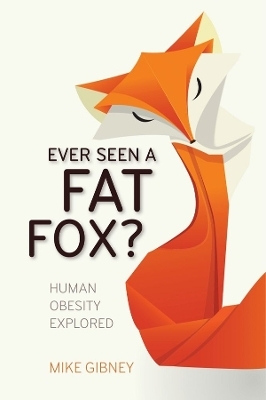
Ever Seen a Fat Fox?
University College Dublin Press (Verlag)
978-1-910820-08-7 (ISBN)
Ever seen a fat fox? Didn't think so. Why it is that only humans - or animals in the care of humans - develop obesity? In Ever Seen a Fat Fox?: Human Obesity Explored Professor Mike Gibney delves into the history of the human relationship with food. He traces the evolution of our modern diet and looks to science to offer solutions to the phenomenon of human obesity. He calls on governments to cease the single-issue ad-hoc approach and demands a massive governmental long-term investment in weight management. It is a commonly held belief that obesity is a recent phenomenon. Professor Gibney reveals that obesity is nothing new - in fact, the modern upward trend in obesity began in the mid-nineteenth century. Obesity has been part of human experience whenever and wherever we've had affluence. There are many who seek to apportion blame for the epidemic of obesity. Blaming the food industry for obesity is always popular: sugar is public enemy number one. Debunking exaggerated views and cutting through the mixed messaging Gibney demonstrates that most food processing techniques are old, hundreds and thousands of years old.The genetics of obesity, the practice of dieting, and the value of physical activity are thoroughly assessed.
The failures of the players in obesity - including the media, scientists, academic organisations, international agencies, specifically the WHO, and the food industry are brought into sharp focus. What can we learn from the fox? An expert in public health and personalised nutrition with bestselling books and over 300 peer-reviewed papers in the area, Professor Mike Gibney uncovers the full story behind obesity based on painstaking research, and offers us tangible solutions to this very human phenomenon.
Professor Mike Gibney has worked as a teaching fellow at the University of Sydney where he took his PhD and has lectured at University of Southampton, Trinity College Dublin and University College Dublin. He is a former President of the Nutrition Society and a fellow of the International Union of Nutritional Sciences. He has served on many high-level international advisory committees both in the EU, the FAO and WHO. His research area is in public health and personalised nutrition, and he has published over 300 peer-reviewed papers in the area. He has been Principal Investigator on several very large EU funded projects, most recently in the area of personalised nutrition (www.food4me.org). Previous publications include Nutrition, Diet and Health (Cambridge University Press, 1986) and Something to Chew On: Challenging Controversies in Food and Health (UCD Press, 2012). He writes a blog at 'Gibneyonfood'.
Preface; Introduction; Chapter 1. Ever seen a fat fox?; Chapter 2. Obesity and health measurements and metrics; Chapter 3. Human obesity - old and new; Chapter 4. The human food chain - old and new; Chapter 5. Culpable foods; Chapter 6. Regulating Food intake - the eyes have it; Chapter 7. Fitness and fatness; Chapter 8. Weight management - the personal perspective; Chapter 9. Weight management - the national perspective; Chapter 10. The nature versus nurture debate; Chapter 11. Eating disorders; Chapter 12. The stigmatisation of fatness; Chapter 13. Obesity - politics, players and ploys; Chapter 14: Reflections and projections; Notes; Index.
| Erscheinungsdatum | 19.11.2016 |
|---|---|
| Sprache | englisch |
| Maße | 156 x 234 mm |
| Themenwelt | Medizin / Pharmazie ► Gesundheitsfachberufe ► Diätassistenz / Ernährungsberatung |
| Sozialwissenschaften | |
| ISBN-10 | 1-910820-08-3 / 1910820083 |
| ISBN-13 | 978-1-910820-08-7 / 9781910820087 |
| Zustand | Neuware |
| Informationen gemäß Produktsicherheitsverordnung (GPSR) | |
| Haben Sie eine Frage zum Produkt? |
aus dem Bereich