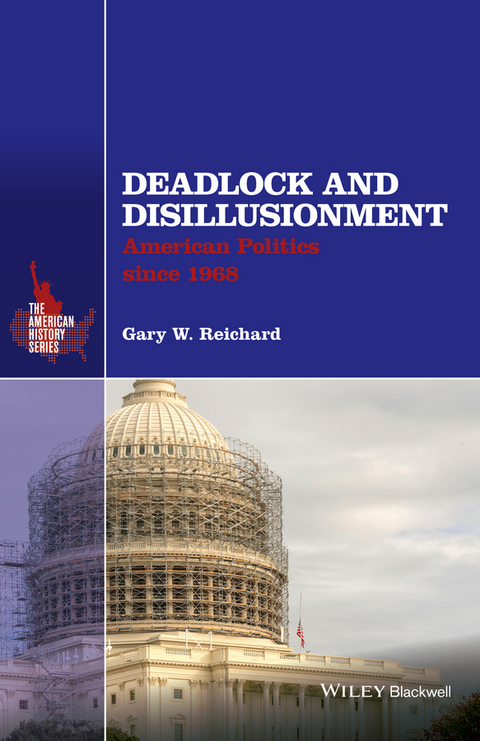
Deadlock and Disillusionment (eBook)
John Wiley & Sons (Verlag)
978-1-118-93437-1 (ISBN)
- Rejects conventional wisdom that the dominant force shaping recent American politics in the last half century has been the 'rise of the Right'
- Considers the achievements and frustrations of each administration, from Nixon to Obama, in its assessment of contemporary U.S. politics
- Features authorship by an expert scholar in the field who takes a thematic rather than a partisan approach to recent American politics
- Offers a concise, comprehensive, and thoroughly up-to-date synthesis of the literature in the field and concludes with a comprehensive bibliographical essay, an aid to student research
Gary W. Reichard is Provost / Senior Vice President for Academic Affairs and Professor of History at the College of Staten Island, City University of New York. In addition to teaching post-World War II United States history at the college level, Reichard has taught the history of American political parties and the history of American immigration and ethnicity. He is the author of The Reaffirmation of Republicanism: Dwight D. Eisenhower and the Eighty-third Congress and Politics as Usual: The Age of Truman and Eisenhower (2nd Ed.), and is a former member of the Executive Board of the Organization of American Historians.
Gary W. Reichard is Provost / Senior Vice President for Academic Affairs and Professor of History at the College of Staten Island, City University of New York. In addition to teaching post-World War II United States history at the college level, Reichard has taught the history of American political parties and the history of American immigration and ethnicity. He is the author of The Reaffirmation of Republicanism: Dwight D. Eisenhower and the Eighty-third Congress and Politics as Usual: The Age of Truman and Eisenhower (2nd Ed.), and is a former member of the Executive Board of the Organization of American Historians.
List of Illustrations vii
Preface ix
Introduction: 1968--The End of an Era 1
1 The Politics of Cynicism, 1968-1974 5
The Shaping of a New Majority 7
Conservatism as Reform 16
The Politics of War and Détente 19
Watergate and Its Aftermath 30
2 The Futility of Moderation, 1974-1976 43
The Politics of Forgiveness 44
President as Political Prisoner 48
Détente Derailed 53
3 Dashed Hopes, 1976-1980 60
Fractured Majority 61
Threading the Needle 73
The Abandonment of Idealism 78
4 Dogma and (More) Disappointment, 1980-1988 89
The Rise of the Right 90
Reaganomics 96
Culture Wars and Party Politics 107
Reagan's World 117
5 Squandering the Inheritance, 1988-1992 136
Succession by Hardball 137
The Bills Come Due 144
New World (Dis)Order 153
6 The Deepening Divide, 1992-2000 171
The Illusion of Liberal Revival 172
The Politics of Triangulation 187
Quest for a Post -Cold War Foreign Policy 200
Crises of the Clinton Presidency 212
7 The Politics of Polarization, 2000-2008 221
Ultimate Deadlock: Bush v. Gore 222
The Politics of Anti -terrorism 233
Imagined Mandate 248
The Politics of Certitude 262
8 The Politics of Red and Blue, since 2008 277
The Politics of Hope 279
Government by Dysfunction 296
The Politics of Trench Warfare 315
Conclusion: Deadlock and Disillusionment 328
Bibliographical Essay 335
Index 355
1
The Politics of Cynicism, 1968–1974
As 1968 dawned, no one could have predicted the political landscape that would prevail little more than a year later. President Lyndon Johnson, widely regarded as a political maestro and the recipient of landslide endorsement by the voters four years earlier, would be in lonely exile in Texas on his Johnson City ranch. Former Alabama governor George Wallace, reviled by most of the public in the early 1960s for his clenched-teeth refusal to bow to civil rights advances whose time had come, would loom as a future presidential possibility based on his strong showing as a third-party candidate in November’s presidential election. Most significantly, Richard Nixon, who six years earlier had angrily announced his exit from politics, would occupy the White House. The Democrats would still control both houses of Congress, largely through inertia; but in truth, the party would lie in tatters as a result of the epic intra-party battles inside and outside the Chicago convention hall in which Hubert Humphrey secured the nomination as the Democrats’ standard-bearer in August. Finally, thanks to the inroads made by both Nixon and Wallace during the bitterly contested presidential campaign, the Solid Democratic South, which had prevailed for so many decades, would no longer be reliably Democratic.
Miseries unleashed by the Vietnam War were responsible for much of this turning inside out of American politics. But so, too, were the deep wounds inflicted by the assassinations of the Reverend Martin Luther King, Jr., and Bobby Kennedy, and the many lives lost and hopes dashed in the riot-torn spring and early summer of 1968. In a sense, Nixon’s triumph in the three-cornered presidential election of 1968 served as the ultimate expression of the sense of futility that so many Americans felt. A man who owed his political ascent to his skill at “slash-and-burn” politics (witness his role in the nefarious Alger Hiss case and his 1950 campaign against the “pink lady,” Helen Gahagan Douglas) had been called upon by the voters to try to bring order out of political chaos. “Bring Us Together Again”—the mythical slogan that Nixon invented and cited during his campaign—would be the theme of his inaugural speech in January 1969.
As president, Richard Nixon did anything but bring the nation together. Having successfully employed a divisive “southern strategy” to win first the Republican nomination and then the White House, he continued to encourage divisiveness in the electorate in the supposed interests of the “Silent Majority” of Americans whom he saw as aggrieved by the liberal excesses of the Great Society and hostile to the mostly youthful protesters who had taken to the streets in opposition to the Vietnam War and—sometimes—authority in general. Far more the cynical and self-interested pragmatist than the principled conservative for whom many of his supporters had hoped, Nixon carved out a mixed record in domestic policy. Having strongly implied in the 1968 campaign that he had a plan to end U.S. participation in the war in Vietnam with honor, he instead steadily escalated a damaging air war against the enemy until, four years into his presidency, he found a way to extricate U.S. troops from a losing situation.
Ultimately, Nixon was done in by the very cynicism that had propelled him into the White House and fueled his major decisions as president. Obsessed with winning re-election in 1972, distrustful of nearly everyone around him, and certain that his political critics were potential enemies of the state, he condoned illegal tactics to eliminate any and all challenges to his presidency. Then—even worse—he lied repeatedly to the American people about his role in such excesses. As a result, less than two years after having won a smashing re-election victory, he became the first U.S. president to resign from office. If the American people were “brought together” by the Nixon presidency, it was only in shared disgust and distrust for all things Washington.
The Shaping of a New Majority
Forces pointing to backlash against the national Democratic party were of nearly unprecedented proportions in 1968. First and foremost, of course, was the deep public frustration with the course and costs (in lives and dollars) of the Vietnam War, especially after the Tet offensive in February, in which the enemy caught U.S. forces by surprise. Added to this were widespread distaste and disappointment with what were seen as the excesses of President Lyndon Johnson’s Great Society, especially its civil rights component. Nearly as powerful was a deepening public concern about crime in the streets and the increasing stridency and violence of protests against the war and around race issues. “In the popular mind,” writes Lewis Gould in 1968: The Election that Changed America, “the state of race relations became linked to protests against the war in Vietnam. The resulting social trauma was seen as evidence that the Johnson administration was insensitive to issues of ‘law and order’ and unwilling to take a tough stand against domestic dissent.” Simultaneously, significant changes in the demographics of the United States had obvious political implications. The mushrooming growth and increasing political clout of the “Sunbelt,” and particularly its sprawling suburbs, held great, if still incalculable, potential for upending liberal Democratic dominance.
Lyndon Johnson’s vulnerabilities were so extreme by late 1967 as to invite potential challenges from within his own party. First to emerge, at the end of November, was Senator Eugene McCarthy of Minnesota, who had responded to the pleadings of anti-war activists to take up their cause (after their first choice, New York’s senator Robert F. Kennedy, had declined to take the political risk). When McCarthy confounded early predictions by winning 42 percent of the Democratic vote in the March 12 New Hampshire primary (to Johnson’s 49 percent), the media treated it as a defeat for the president. Four days later, a potentially more formidable challenge presented itself when the once reluctant Kennedy formally announced his own anti-war candidacy.
Johnson later claimed that he had much earlier discussed with his wife Lady Bird and his close political ally John Connally the possibility of not seeking re-election and that he had originally planned to include such an announcement in his January 1968 State of the Union address. Whether or not he had made up his mind earlier, on March 31 the president stunned the nation by announcing at the end of a televised speech on the war, “I shall not seek, and I will not accept, the nomination of my party for another term as your President.”
All bets were now off as to how the Democratic race might turn out. McCarthy and Kennedy, as the only declared candidates, briefly had the contest to themselves. In late April, however, a third candidate emerged: Vice President Hubert Humphrey. As vice president, Humphrey had suffered more than a few cruel, public humiliations at the hands of Johnson, but he had remained loyal, in the hope that someday he would have his own shot at the presidency. Declaring too late to contest the two anti-war candidates in the primaries (which he would likely have lost anyway), Humphrey set to work among local and state party leaders in order to amass the necessary number of delegates for nomination.
Kennedy and McCarthy traded victories in a string of hard-fought primaries into the early summer. The June 5 California contest was critical. As the final votes were being tallied in the Golden State’s primary, Kennedy’s victory seemed at last to have narrowed the contest to a two-man race between himself and Humphrey. Within moments of exiting his victory celebration in a Los Angeles hotel, however, he was assassinated by a single gunman, Sirhan Sirhan. As the horror of yet another senseless assassination slowly faded in the weeks that followed, gloom and despair deepened in the Democratic party. Without the support of those who had backed Kennedy, it was impossible for McCarthy to prevail in the Democratic National Convention in Chicago, but deep and lingering animosities between the backers of the two anti-war candidates created a divide that could not be breached.
The Republican nomination contest, meanwhile, unfolded relatively smoothly. The campaign of the early front-runner, Michigan governor George Romney, had imploded in February as a result of his unfortunate comment that he had been “brainwashed” while meeting with U.S. military leaders in Vietnam. His withdrawal from the field on the eve of the important New Hampshire primary resulted in a whopping victory for Richard Nixon, who won almost 80 percent of the vote. Only two challengers remained: New York governor Nelson Rockefeller, the choice of the most moderate elements in the GOP; and a rapidly rising star on the party’s right, California’s recently elected governor, the telegenic former movie star Ronald Reagan. Rockefeller waited too long to declare himself a candidate and won only one primary. Reagan was another matter. Wildly popular among Republican conservatives because of his effective and loyal support for Barry Goldwater in the disastrous 1964 GOP presidential campaign, he had the additional advantage of being a fresh new face (and voice). In 1968, however, Reagan was still too new, and Nixon had...
| Erscheint lt. Verlag | 22.2.2016 |
|---|---|
| Reihe/Serie | The American History Series |
| The American History Series | The American History Series |
| Sprache | englisch |
| Themenwelt | Geschichte ► Allgemeine Geschichte ► Zeitgeschichte |
| Geisteswissenschaften ► Geschichte ► Regional- / Ländergeschichte | |
| Sozialwissenschaften ► Politik / Verwaltung | |
| Schlagworte | 911 • Afghanistan • American Politics • Clinton Era • contemporary american history • Geschichte • Geschichte der Politik u. Diplomatie • Geschichte der USA • Great Recession • History • Iran-Contra • LBJ • Liberals • Obama Presidency • Political & Diplomatic History • Political Science • Politik • Politik / Amerika • Politikwissenschaft • Reaganomics • recent U.S. history • Recent U.S. politics • Republican Ascendancy • trickle-down economics • USA /Geschichte, Politik 1945 ff • us history • U.S. History • U.S. invasion of Iraq • Vietnam • War on Terrorism • Watergate |
| ISBN-10 | 1-118-93437-7 / 1118934377 |
| ISBN-13 | 978-1-118-93437-1 / 9781118934371 |
| Informationen gemäß Produktsicherheitsverordnung (GPSR) | |
| Haben Sie eine Frage zum Produkt? |
 EPUB (Adobe DRM)
Kopierschutz: Adobe-DRM
Adobe-DRM ist ein Kopierschutz, der das eBook vor Mißbrauch schützen soll. Dabei wird das eBook bereits beim Download auf Ihre persönliche Adobe-ID autorisiert. Lesen können Sie das eBook dann nur auf den Geräten, welche ebenfalls auf Ihre Adobe-ID registriert sind.
Details zum Adobe-DRM
Dateiformat: EPUB (Electronic Publication)
EPUB ist ein offener Standard für eBooks und eignet sich besonders zur Darstellung von Belletristik und Sachbüchern. Der Fließtext wird dynamisch an die Display- und Schriftgröße angepasst. Auch für mobile Lesegeräte ist EPUB daher gut geeignet.
Systemvoraussetzungen:
PC/Mac: Mit einem PC oder Mac können Sie dieses eBook lesen. Sie benötigen eine
eReader: Dieses eBook kann mit (fast) allen eBook-Readern gelesen werden. Mit dem amazon-Kindle ist es aber nicht kompatibel.
Smartphone/Tablet: Egal ob Apple oder Android, dieses eBook können Sie lesen. Sie benötigen eine
Geräteliste und zusätzliche Hinweise
Buying eBooks from abroad
For tax law reasons we can sell eBooks just within Germany and Switzerland. Regrettably we cannot fulfill eBook-orders from other countries.
aus dem Bereich