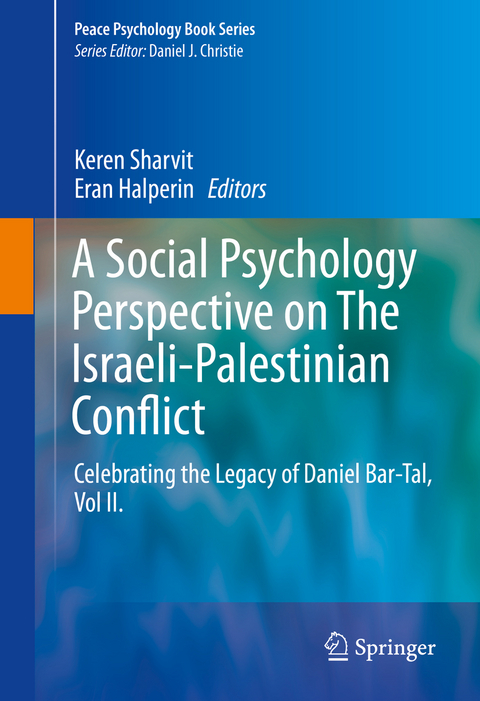
A Social Psychology Perspective on The Israeli-Palestinian Conflict (eBook)
XIV, 287 Seiten
Springer International Publishing (Verlag)
9783319248417 (ISBN)
Opening with an introduction to the Israeli-Palestinian conflict situation and a few chapters on the theoretical backgrounds of the creation of a societal ethos of conflict, the volume then moves to an analysis of the psycho-social underpinnings of the conflict, while concluding with a discussion of the possibility of long-standing peace in the region. Among the topics included in the coverage are:
· Identity formation during conflict· The Israeli and Palestinian ethos of conflict
· The important role of Palestinian and Israeli education
· An analysis of the leadership in the Israeli-Palestinian peace process· The challenges and potential towards a road to peace in the region
All contributors to the volume are pre-eminent scholars of the Israeli-Palestinian conflict, and many of them have felt the influence of Bar-Tal's formulations in their own work. A rich resource for those who are followers of Dr. Bar-Tal's work, for those who study intractable conflicts in all its forms, and for those who have a particular interest in the Israeli-Palestinian conflict, A Social Psychology Perspective of the Israeli-Palestinian Case offers a detailed exploration of the psychological underpinnings of the Israeli-Palestinian conflict and the barriers to and opportunities of the peace process.
Preface Keren Sharvit and Eran Halperin 1. Socio-psychological foundations of the Israeli-Palestinian conflict: Applying Daniel Bar-Tal’s theorizing Keren Sharvit Part 1: Acquisition of the Socio-Psychological Repertoire 2. Stereotypes and prejudice in conflict: A developmental perspective Yona Teichman 3. Young children’s experiences and learning in intractable conflicts Meytal Nasie Part 2: Collective Memory and Narratives 4. The Israeli collective memory of the Israeli-Arab/Palestinian conflict: Its characteristics and relation to the conflict Rafi Nets-Zehngut 5. The “silenced” narrative of 1948 War events among young Palestinians in Israel Eman Nahhas 6. Perceptions of collective narratives among Arab and Jewish adolescents in Israel: A decade of intractable conflict Anan Srour, Adi Mana and Shifra Sagy Part 3: Societal Beliefs and Ethos 7. “Seeing through a glass darkly”: Israeli and Egyptian images of the other during the Nasserite period (1952-1970) Elie Podeh 8. The Jewish- Israeli ethos of conflict Neta Oren 9. Ethos of conflict of the Palestinian society Ronni Shaked Part 4: Distress, emotions and ideology 10. Harmed by our protection: Exposure to political violence and political preferences in the range of fire Daphna Canetti 11. Emotions and emotion regulation in intractable conflict and their relation to the ethos of conflict in Israeli society Ruthie Pliskin and Eran Halperin Part 5: The role of education 12. When Jewish and Zionist identities encounter otherness: Educational case study Ohad David 13. Peace education between theory and practice: The Israeli case Soli Vered Part 6: Prospects for change? 14. Containing the duality: Leadership in the Israeli-Palestinian peace process Nimrod Rosler 15. The role of peace organizations during peacemaking processes: the case of the Jewish Israeli society Tamir Magal 16. The road to peace? The potential of structured encounters between Israeli Jews and Palestinians in promoting peace Ifat Maoz and Yiftach Ron 17. Addressing Israelis' and Palestinians' basic needs for agency and positive moral identity facilitates mutual prosociality Ilanit SimanTov-Nachlieli and Nurit Shnabel Transitional justice in societies emerging from intractable conflicts: Between the right to truth and collective memory Ofer Shinar Levanon
| Erscheint lt. Verlag | 22.1.2016 |
|---|---|
| Reihe/Serie | Peace Psychology Book Series | Peace Psychology Book Series |
| Zusatzinfo | XIV, 287 p. 7 illus., 1 illus. in color. |
| Verlagsort | Cham |
| Sprache | englisch |
| Themenwelt | Geisteswissenschaften ► Psychologie ► Sozialpsychologie |
| Sozialwissenschaften ► Politik / Verwaltung | |
| Schlagworte | collective memory in Israel • collective memory in Palestine • Collective Narrative • culture of conflict • peace in the Middle East • Political Psychology • psychological barriers to peace-making • societal beliefs and ethos • stereotypes and prejudice in conflict • the Israel-Palestinian peace process • Zionist identities |
| ISBN-13 | 9783319248417 / 9783319248417 |
| Informationen gemäß Produktsicherheitsverordnung (GPSR) | |
| Haben Sie eine Frage zum Produkt? |
 PDF (Wasserzeichen)
DRM: Digitales Wasserzeichen
Dieses eBook enthält ein digitales Wasserzeichen und ist damit für Sie personalisiert. Bei einer missbräuchlichen Weitergabe des eBooks an Dritte ist eine Rückverfolgung an die Quelle möglich.
Dateiformat: PDF (Portable Document Format)
Mit einem festen Seitenlayout eignet sich die PDF besonders für Fachbücher mit Spalten, Tabellen und Abbildungen. Eine PDF kann auf fast allen Geräten angezeigt werden, ist aber für kleine Displays (Smartphone, eReader) nur eingeschränkt geeignet.
Systemvoraussetzungen:
PC/Mac: Mit einem PC oder Mac können Sie dieses eBook lesen. Sie benötigen dafür einen PDF-Viewer - z.B. den Adobe Reader oder Adobe Digital Editions.
eReader: Dieses eBook kann mit (fast) allen eBook-Readern gelesen werden. Mit dem amazon-Kindle ist es aber nicht kompatibel.
Smartphone/Tablet: Egal ob Apple oder Android, dieses eBook können Sie lesen. Sie benötigen dafür einen PDF-Viewer - z.B. die kostenlose Adobe Digital Editions-App.
Buying eBooks from abroad
For tax law reasons we can sell eBooks just within Germany and Switzerland. Regrettably we cannot fulfill eBook-orders from other countries.
aus dem Bereich