


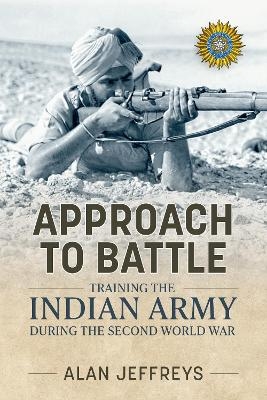
Approach to Battle
Training the Indian Army During the Second World War
Seiten
2017
Helion & Company (Verlag)
978-1-911096-51-1 (ISBN)
Helion & Company (Verlag)
978-1-911096-51-1 (ISBN)
- Titel ist leider vergriffen;
keine Neuauflage - Artikel merken
The Indian Army was the largest volunteer army during the Second World War. Indian Army divisions fought in the Middle East, North Africa and Italy - and went to make up the overwhelming majority of the troops in South East Asia. Over two million personnel served in the Indian Army - and India provided the base for supplies for the Middle Eastern and South East Asian theatres. This monograph is a modern historical interpretation of the Indian Army as a holistic organisation during the Second World War. It will look at training in India - charting how the Indian Army developed a more comprehensive training structure than any other Commonwealth country. This was achieved through both the dissemination of doctrine and the professionalism of a small coterie of Indian Army officers who brought about a military culture within the Indian Army - starting in the 1930s - that came to fruition during the Second World War, which informed the formal learning process. Finally, it will show that the Indian Army was reorganised after experiences of the First World War. During the interwar period, the army developed training and belief for both fighting on the North West Frontier, and as an aid to civil power. With the outbreak of the Second World War, in addition to these roles, the army had to expand and adapt to fighting modern professional armies in the difficult terrains of desert, jungle and mountain warfare. A clear development of doctrine and training can be seen, with many pamphlets being produced by GHQ India that were, in turn, used to formulate training within formations and then used in divisional, brigade and unit training instructions - thus a clear line of process can be seen not only from GHQ India down to brigade and battalion level, but also upwards from battalion and brigade level based on experience in battle that was absorbed into new training instructions. Together with the added impetus for education in the army, by 1945 the Indian Army had become a modern, professional and national army.
Alan Jeffreys is a curator at the Imperial War Museum and is an expert on tactics and training for jungle warfare and the British Army in the Far East during World War II.
| Erscheinungsdatum | 16.02.2017 |
|---|---|
| Reihe/Serie | War & Military Culture in South Asia 1757-1947 |
| Zusatzinfo | Illustrated. 6 maps. |
| Verlagsort | Solihull |
| Sprache | englisch |
| Maße | 152 x 235 mm |
| Themenwelt | Geschichte ► Allgemeine Geschichte ► Neuzeit (bis 1918) |
| Geschichte ► Allgemeine Geschichte ► 1918 bis 1945 | |
| Geschichte ► Teilgebiete der Geschichte ► Militärgeschichte | |
| Sozialwissenschaften ► Politik / Verwaltung | |
| ISBN-10 | 1-911096-51-6 / 1911096516 |
| ISBN-13 | 978-1-911096-51-1 / 9781911096511 |
| Zustand | Neuware |
| Informationen gemäß Produktsicherheitsverordnung (GPSR) | |
| Haben Sie eine Frage zum Produkt? |
Mehr entdecken
aus dem Bereich
aus dem Bereich
Geschichte einer wilden Handlung
Buch | Hardcover (2024)
C.H.Beck (Verlag)
CHF 47,60


