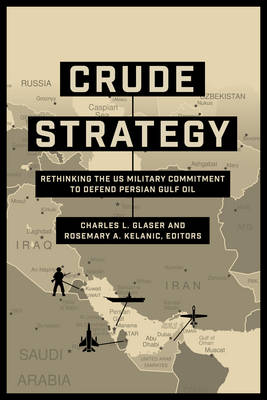
Crude Strategy
Georgetown University Press (Verlag)
978-1-62616-335-5 (ISBN)
Should the United States ask its military to guarantee the flow of oil from the Persian Gulf? If the US security commitment is in fact strategically sound, what posture should the military adopt to protect Persian Gulf oil? Charles L. Glaser and Rosemary A. Kelanic present a collection of new essays from a multidisciplinary team of political scientists, historians, and economists that provide answers to these questions. Contributors delve into a range of vital economic and security issues: the economic costs of a petroleum supply disruption, whether or not an American withdrawal increases the chances of oil-related turmoil, the internal stability of Saudi Arabia, budgetary costs of the forward deployment of US forces, and the possibility of blunting the effects of disruptions with investment in alternative energy resources. The result is a series of bold arguments toward a much-needed revision of US policy toward the Persian Gulf during an era of profound change in oil markets and the balance of power in the Middle East.
Charles L. Glaser is a professor in the Elliott School of International Affairs and Department of Political Science at George Washington University as well as director of the Elliott School's Institute for Security and Conflict Studies. He is the author of several books, including Rational Theory of International Politics: The Logic of Competition and Cooperation. Rosemary A. Kelanic is an assistant professor of political science at Williams College.
Preface Introduction Charles L. Glaser and Rosemary A. Kelanic Part I: Background1. The United States and the Persian Gulf: 1941-Present Salim Yaqub2. Assessing Current U.S. Policies and Goals in the Persian Gulf Daniel Byman Part II: Key Questions3. The Economic Costs of Persian Gulf Oil Supply Disruptions Kenneth R. Vincent4. Saudi Arabian Oil and U.S. Interests Thomas W. Lippman5. After America: The Flow of Persian Gulf Oil in the Absence of the U.S. Military ForceJoshua Rovner6. U.S. Spending on its Military Commitments to the Persian Gulf Eugene Gholz 7. Resilience by Other Means: The Potential Benefits of Alternative Government Investments in U.S. Energy SecurityJohn Duffield Part III: Conclusions and Policy Options8. Should the United States Stay in the Gulf? Charles L. Glaser and Rosemary A. Kelanic 9. The Future of U.S. Force Posture in the Gulf: The Case for a Residual Forward Presence Caitlin Talmadge About the ContributorsIndex
| Erscheinungsdatum | 11.08.2016 |
|---|---|
| Co-Autor | Charles L. Glaser, Rosemary A. Kelanic, Salim Yaqub |
| Zusatzinfo | Not illustrated |
| Verlagsort | Washington, DC |
| Sprache | englisch |
| Maße | 152 x 229 mm |
| Gewicht | 431 g |
| Themenwelt | Sozialwissenschaften ► Politik / Verwaltung ► Europäische / Internationale Politik |
| Technik ► Elektrotechnik / Energietechnik | |
| ISBN-10 | 1-62616-335-9 / 1626163359 |
| ISBN-13 | 978-1-62616-335-5 / 9781626163355 |
| Zustand | Neuware |
| Informationen gemäß Produktsicherheitsverordnung (GPSR) | |
| Haben Sie eine Frage zum Produkt? |
aus dem Bereich