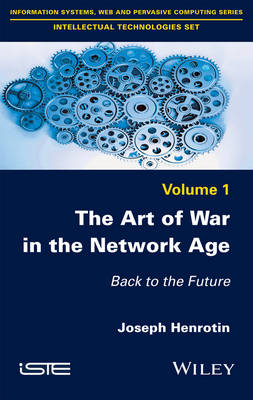
The Art of War in the Network Age
ISTE Ltd and John Wiley & Sons Inc (Verlag)
9781848219120 (ISBN)
Joseph Henrotin is a researcher at Centre d'Analyse et de Prévision des Risques Internationaux (CAPRI) and Institut de Stratégie et des Conflits (ISC) in Paris, France. He specializes in strategic theory and the evolution/integration of technologies in the military field.
Introduction ix
Chapter 1. Approaching Military Revolutions 1
1.1. Lexical varieties 3
1.1.1. MTR versus RMA 4
1.1.2. Military revolutions versus RMAs 6
1.1.3. Reassessing the notion of military revolution 9
1.1.4. An incomplete RMA? From revolution to transformation 11
1.2. Types of RMA 13
1.2.1. An example of techno-centric classification 13
1.2.2. Unlikely revolutions 15
1.2.3. Cohen and the "revolutionary types" 16
1.2.4. RMA schools at the turn of the millennium 19
Chapter 2. The Epistemology of RMA 23
2.1. Longue durée, conjoncture and event history … outdated? 24
2.2. RMA as a result of a long-term evolution? 25
2.2.1. From evolutionary to revolutionary longue durée 26
2.2.2. The eternal moment of changing epochs: RMA and postmodernity 28
2.2.3. An overused post-modernity, an assumed post-industrialism 32
2.2.4. The building of a revolution 35
2.3. Confronting the distinctive aspects of military revolutions 39
2.3.1. An anhistorical RMA? 39
2.3.2. Breaks and discontinuities 43
Chapter 3. A Paradigm Shift 49
3.1. A strategic consensus around the "paradigm shift" 49
3.1.1. Paradigm pluralities 50
3.1.2. The place of politics: scientific-rational and historical paradigms 52
3.1.3. The question of levels of engagement 54
3.1.4. A rethinking of strategy as an art 58
3.2. Strategy of means and RMA 63
3.2.1. A hidden revolution? RMA and genetic strategy 64
3.2.2. A failed revolution? RMA and industrial strategy 68
Chapter 4. Understanding (1): Piercing the Fog of War in Fluid Spaces 75
4.1. Strategy of fluid spaces 77
4.1.1. The fluid and the solid 78
4.1.2. SAGE, the first network-centric system 79
4.2. Fluidifying global spaces? 85
4.2.1. Figures of the fluidification of aerospatial spaces 87
4.2.2. Fluidification by reticulation 89
4.2.3. Operating in mixed spaces: generating political effect 92
Chapter 5. Understanding (2): Fluidifying the Solid? 99
5.1. The electronic battlefield 101
5.1.1. The Vietnam War 102
5.1.2. The European model of the RMA 104
5.2. The fragmentation of intelligence 110
5.2.1. Fragmenting and network-centering 110
5.2.2. The network-centric man 114
5.2.3. Uncertainty and new armies of the old regime 123
Chapter 6. Waging War in Network-centric Conditions 127
6.1. The kinematics of operations 127
6.1.1. On the conquest of time: chronostrategy 128
6.1.2. War and movement, war and command 134
6.1.3. Controlling and dominating 138
6.2. Waging war in networks 142
6.2.1. The paradox of the enemy: the (non-) responses to asymmetry and hybrid warfare 142
6.2.2. Future wars and wars in networks 145
6.2.3. Principles of war in the age of networks 148
Chapter 7. Striking in Network-centric Conditions 155
7.1. A paradoxical precision 156
7.1.1. Certainty of striking 157
7.1.2. Certain to succeed? 161
7.1.3. Wars lost by precision? 164
7.2. The retaliation against the Transformation: techno-guerillas and hybrid war 167
7.2.1. The state incubator 168
7.2.2. The true RMA and the future of war? 172
7.2.3. Adaptation by networks? 177
Conclusion 183
Glossary 187
Bibliography 191
Index 217
| Erscheinungsdatum | 24.09.2016 |
|---|---|
| Verlagsort | London |
| Sprache | englisch |
| Maße | 155 x 236 mm |
| Gewicht | 567 g |
| Themenwelt | Mathematik / Informatik ► Informatik ► Theorie / Studium |
| Sozialwissenschaften ► Politik / Verwaltung | |
| ISBN-13 | 9781848219120 / 9781848219120 |
| Zustand | Neuware |
| Informationen gemäß Produktsicherheitsverordnung (GPSR) | |
| Haben Sie eine Frage zum Produkt? |
aus dem Bereich