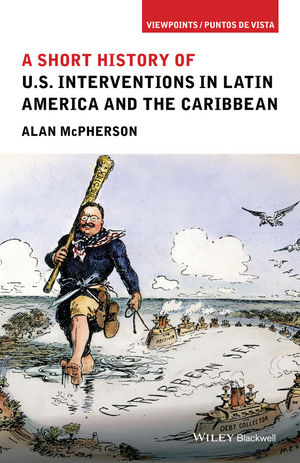
A Short History of U.S. Interventions in Latin America and the Caribbean (eBook)
John Wiley & Sons (Verlag)
978-1-118-95401-0 (ISBN)
- Engages in debates about the economic, military, political, and cultural motives that shaped U.S. interventions in Cuba, Nicaragua, Puerto Rico, Haiti, the Dominican Republic, Panama, Guatemala, Mexico, and elsewhere
- Deals with incidents that range from the taking of Florida to the Mexican War, the War of 1898, the Veracruz incident of 1914, the Bay of Pigs, and the 1989 invasion of Panama
- Features also the responses of Latin American countries to U.S. involvement
- Features unique coverage of 19th century interventions as well as 20th century incidents, and includes a series of helpful maps and illustrations
Alan McPherson is Professor of International and Area Studies, ConocoPhillips Chair in Latin American Studies, and Director of the Center for the Americas at the University of Oklahoma. He has published eight books, including the prize-winning Yankee No! Anti-Americanism in U.S.-Latin American Relations (2003) and The Invaded: How Latin Americans and their Allies Fought and Ended U.S. Occupations (2014).
Alan McPherson is Professor of International and Area Studies, ConocoPhillips Chair in Latin American Studies, and Director of the Center for the Americas at the University of Oklahoma. He has published eight books, including the prize-winning Yankee No! Anti-Americanism in U.S.-Latin American Relations (2003) and The Invaded: How Latin Americans and their Allies Fought and Ended U.S. Occupations (2014).
Series Editor's Preface viii
Acknowledgments x
List of Illustrations xi
Introduction: Topic and Themes 1
1 Expanding the Continental Republic, 1811-1897 10
2 The Cuban Crucible: Experiments in Overseas Empire, 1898-1922 34
3 Monopolizing the Central American Isthmus, 1903-1926 55
4 Wilsonian Interventions, 1913-1919 72
5 Accommodation and Resistance, 1917-1930 95
6 From Occupier to Good Neighbor, 1921-1936 115
7 Warding Off Global Ideologies, 1935-1954 133
8 Containing Revolution, 1959-1990 148
9 Identifying Post?]Cold War Political Threats, 1986-2016 172
Conclusion: Multitudes of Interventions 194
Bibliography 202
Index 209
Introduction
Topic and Themes
Has the United States sent people down here to teach us how to behave?
Desiderio Arias1
In April 2015, heads of state of all American republics gathered at the Summit of the Americas held in Panama City, Panama. On his way from the airport, Venezuelan President Nicolás Maduro stopped to lay a wreath at a monument commemorating the 1989 U.S. invasion of the host country. He called the intervention “an unforgivable attack on the people of Panama” and swore to the cheering crowd, “Never again a U.S. invasion in Latin America!”
U.S. President Barack Obama agreed with that last part. “The days in which our agenda in this hemisphere so often presumed that the US could meddle with impunity, those days are over.” 2 Calling himself “a student of history,” Obama added, “I’m certainly mindful that there are dark chapters in our own history in which we have not observed the principles and ideals upon which the country was founded.” At the same time, however, he refused to let the past determine the present: “I’m not interested in having battles that, frankly, started before I was born.”3
Was it fair for Maduro to bring up a generation-old invasion? Was Obama dismissive or appropriate? Was it really the case that U.S. interventions were a thing of the past?
These questions and more can be answered only by those with a firm background in the history of U.S. military interventions in Latin America and the Caribbean. This book surveys those interventions, from the No Transfer Resolution in 1811 to the drug wars of the 21st century. It narrates a few dozen of the most important interventions among the thousands of military landings by U.S. troops.
The Topic
This book’s definition of interventions is broad but not sprawling. It includes all dispatches of large groups of U.S. armed forces by the U.S. government to territories in the Western Hemisphere south of the Rio Grande (now) separating the United States and Mexico and including (now) Florida. It also includes the use of armed non-U.S. citizens funded, trained, and equipped by the U.S. government. These were “proxy wars,” in which Washington went to war through a stand-in – usually an army of locals combating their own country’s head of state. The definition of intervention also covers declared wars, actions otherwise allowed by the U.S. Congress, and blatantly illegal mobilizations. And it comprises interventions that were requested by heads of state in Latin America and the Caribbean.
The definition does not include private U.S. forces landing on Latin American shores without the approval of their government. Chapter 1 does survey private filibustering expeditions, mostly in the 1850s, because they illustrated important motivations and assumptions by U.S. citizens who embraced territorial expansion. But it does not consider them to be official U.S. interventions. It also does not include small military groups sent as part of a diplomatic body, or to train Latin American militaries. Finally, the definition does not include nonmilitary U.S. meddling. Spying, aid, military training, diplomatic arm-twisting, support for dictators, cultural programs, and pressures to open up markets to U.S. trade are common examples of programs that certainly qualify as U.S. pressure on Latin America but nevertheless do not rise to the definition of an intervention. As with small group missions, the book discusses many of these because they provide context. But they are not themselves military interventions.
A host of U.S. military forces carried out interventions in Latin America and the Caribbean. The most frequent were members of the U.S. Marine Corps, who were officially part of the U.S. Department of the Navy after 1834 but largely independent. They made their reputation as a rapid-response amphibious force – traveling by water like a navy, but disembarking and fighting like an army. “Bluejackets,” the name given to servicemembers of the U.S. Navy, often accompanied them. In other interventions, such as the land-based Punitive Expedition of 1916–1917, the U.S. Army took the lead. The cavalry, rangers, paratroopers, and pilots have also participated. As in any other military action, some at times displayed uncommon valor. For that courage during actions in Latin America, U.S. servicemembers won 162 Medals of Honor.
Not all Latin American nations have been targets of U.S. intervention. U.S. hegemony or control yes, but not military intervention. Almost all U.S. interventions took place in Mexico, Central America and Panama, and the Caribbean. These areas had in common that they were (1) geographically close to the United States, therefore easier to get to from U.S. naval bases and more integrated into the U.S. economy; (2) poor, and, with the exception of Mexico, small, so unable to beat back a force of even a few hundred or a few thousand marines; and (3) strategically valuable, located as they were in the waterways leading to the Panama Canal. Not for nothing did Alexander Hamilton in 1787 call the Caribbean basin “the American Mediterranean.”4
Interventions occurred not only in American republics with Latin-based languages such as Spanish and French, but also in the English-speaking Caribbean. And, in the nineteenth century, interventions took place in Spanish Florida and elsewhere in what was to become the continental United States.
South America contained some of the problems that might prompt an intervention further north, but U.S. officials deemed South American nations to be too far, too big, and too powerful to warrant interventions. Even in Mexico, where the United States intervened repeatedly, no serious thought was ever given to occupying the whole country. The experiences of fighting Mexicans during the Mexican War of 1846–1848 and the Punitive Expedition were enough to help banish the thought.
Themes: The Five C’s
To help readers navigate through the stories in this book, each chapter’s introduction will suggest how to fit them within the book’s five themes. These themes are easy to remember as the Five C’s: causes, consequences, contestation, collaboration, and context. Each should be considered in every intervention.
1. Causes.
U.S. officials, usually presidents, ordered interventions in Latin America and the Caribbean for a variety of reasons, and the student of interventions should keep in mind that variety is the most important characteristic of interventions. This book focuses first and foremost on the motivations of U.S. policymakers, and it argues that the most prominent cause of interventions – the one that those who ordered interventions most talked about – was the goal of political stability and political cultural change. When Desiderio Arias, the former Minister of War, suspected in 1916 that the United States was in the Dominican Republic to “teach” him and his compatriots “how to behave,” he was right on the mark. From spreading U.S. civilization in the nineteenth century, to President Woodrow Wilson’s desire to see only constitutional changes of power in Mexico, to fighting fascists in World War II, to keeping communism contained to Cuba in the Cold War, to restoring democracy in the 1990s, U.S. interventions in the region harbored above all political motives.
Interventions also had economic motivations, and these were, in some instances, the dominant impetuses. Some marines landed just to protect U.S. corporations. Some secretaries of state made sure Wall Street got its loans paid off. To be sure, it was and is legitimate for diplomats to want to protect and promote their country’s investments and markets abroad. And those concerns often were foremost in their conversations. But U.S. soldiers who managed interventions on a day-to-day basis worried a lot less about economics.
Many interventions also reflected the prevailing culture of those who ordered them. Racism and paternalism were especially prominent in U.S. culture (not to mention Latin American culture), especially in the nineteenth and early twentieth centuries. “Scientific” textbooks taught whites that race was a fixed biological fact and that there existed a limited number of “races” among humans – “Caucasian,” “Mongolian,” “Ethiopian,” “Malay,” “Australian,” “American,” and so on. It also indicated that some races were inferior while others were born to dominate. Biological theories about evolution influenced social scientists to devise Social Darwinism, or the theory that, in society too, some races were more “fit” to “survive.” Feelings of racial superiority sometimes led U.S. forces to commit heinous atrocities. Those feelings, however, did not necessarily lead “whites” to want to annihilate those civilizations they thought inferior. Sometimes they felt a paternal obligation to protect or teach so-called uncivilized peoples. Whatever the form culture took, it helped justify interventions again and again.
In some situations, finally, U.S. officials were primarily concerned with geostrategic issues. They looked at a map, pointed to where great empires had overseas possessions, and felt they should have some too. Transportation was often key: ports, railroads, canals, and...
| Erscheint lt. Verlag | 21.1.2016 |
|---|---|
| Reihe/Serie | Viewpoints / Puntos de Vista |
| Viewpoints / Puntos de Vista | Viewpoints / Puntos de Vista |
| Sprache | englisch |
| Themenwelt | Geisteswissenschaften ► Geschichte ► Regional- / Ländergeschichte |
| Geschichte ► Teilgebiete der Geschichte ► Militärgeschichte | |
| Sozialwissenschaften ► Politik / Verwaltung ► Europäische / Internationale Politik | |
| Schlagworte | banana wars • Caribbean • Central America • Cold War • Colombia • Cuba • Geschichte • Geschichte der Politik u. Diplomatie • Geschichte / Lateinamerika, karibischer Raum • Guatemala • Gunboat diplomacy • History • Karibisches Meer /Geschichte • Lateinamerika /Geschichte • Latin American & Caribbean History • LATIN AMERICAN POLITICS • Mexico • Monroe Doctrine • Nicaragua • panama canal • Political & Diplomatic History • Political Science • Politik • Politik / Lateinamerika • Politikwissenschaft • Post-Cold War • South America • Spanish American War • Texas • Theodore Roosevelt • U.S. imperialism • U.S. interventions • U.S.-Latin American Relations • Veracruz incident |
| ISBN-10 | 1-118-95401-7 / 1118954017 |
| ISBN-13 | 978-1-118-95401-0 / 9781118954010 |
| Informationen gemäß Produktsicherheitsverordnung (GPSR) | |
| Haben Sie eine Frage zum Produkt? |
 EPUB (Adobe DRM)
Kopierschutz: Adobe-DRM
Adobe-DRM ist ein Kopierschutz, der das eBook vor Mißbrauch schützen soll. Dabei wird das eBook bereits beim Download auf Ihre persönliche Adobe-ID autorisiert. Lesen können Sie das eBook dann nur auf den Geräten, welche ebenfalls auf Ihre Adobe-ID registriert sind.
Details zum Adobe-DRM
Dateiformat: EPUB (Electronic Publication)
EPUB ist ein offener Standard für eBooks und eignet sich besonders zur Darstellung von Belletristik und Sachbüchern. Der Fließtext wird dynamisch an die Display- und Schriftgröße angepasst. Auch für mobile Lesegeräte ist EPUB daher gut geeignet.
Systemvoraussetzungen:
PC/Mac: Mit einem PC oder Mac können Sie dieses eBook lesen. Sie benötigen eine
eReader: Dieses eBook kann mit (fast) allen eBook-Readern gelesen werden. Mit dem amazon-Kindle ist es aber nicht kompatibel.
Smartphone/Tablet: Egal ob Apple oder Android, dieses eBook können Sie lesen. Sie benötigen eine
Geräteliste und zusätzliche Hinweise
Buying eBooks from abroad
For tax law reasons we can sell eBooks just within Germany and Switzerland. Regrettably we cannot fulfill eBook-orders from other countries.
aus dem Bereich