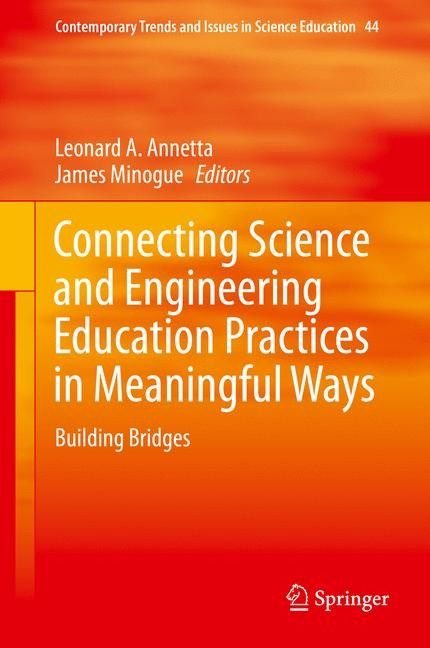
Connecting Science and Engineering Education Practices in Meaningful Ways (eBook)
XI, 385 Seiten
Springer International Publishing (Verlag)
978-3-319-16399-4 (ISBN)
The need for a scientifically literate citizenry, one that is able to think critically and engage productively in the engineering design process, has never been greater. By raising engineering design to the same level as scientific inquiry the Next Generation Science Standards' (NGSS) have signaled their commitment to the integration of engineering design into the fabric of science education. This call has raised many critical questions...How well do these new standards represent what actually engineers do? Where do the deep connections among science and engineering practices lie? To what extent can (or even should) science and engineering practices co-exist in formal and informal educational spaces? Which of the core science concepts are best to leverage in the pursuit of coherent and compelling integration of engineering practices? What science important content may be pushed aside? This book, tackles many of these tough questions head on.
All of the contributing authors consider the same core question: Given the rapidly changing landscape of science education, including the elevated status of engineering design, what are the best approaches to the effective integration of the science and engineering practices? They answered with rich descriptions of pioneering approaches, critical insights, and useful practical examples of how embodying a culture of interdisciplinarity and innovation can fuel the development of a scientifically literate citizenry
. This collection of work builds traversable bridges across diverse research communities and begins to break down long standing disciplinary silos that have historically often hamstrung well-meaning efforts to bring research and practice from science and engineering together in meaningful and lasting ways.| Erscheint lt. Verlag | 2.3.2016 |
|---|---|
| Reihe/Serie | Contemporary Trends and Issues in Science Education | Contemporary Trends and Issues in Science Education |
| Zusatzinfo | XI, 385 p. 75 illus. |
| Verlagsort | Cham |
| Sprache | englisch |
| Themenwelt | Geisteswissenschaften |
| Sozialwissenschaften ► Pädagogik ► Erwachsenenbildung | |
| Schlagworte | design thinking • Engineering design practices • Engineering Education • Game design education • Learning and Instruction • Learning engineering • learning science • Next Generation Science Standards • NGSS • science education • Science literacy • Serious educational gaming • Serious Games • STEM Education • Student-centered design • Student Engagement • teaching engineering • Teaching science • Technological Literacy |
| ISBN-10 | 3-319-16399-X / 331916399X |
| ISBN-13 | 978-3-319-16399-4 / 9783319163994 |
| Informationen gemäß Produktsicherheitsverordnung (GPSR) | |
| Haben Sie eine Frage zum Produkt? |
 PDF (Wasserzeichen)
DRM: Digitales Wasserzeichen
Dieses eBook enthält ein digitales Wasserzeichen und ist damit für Sie personalisiert. Bei einer missbräuchlichen Weitergabe des eBooks an Dritte ist eine Rückverfolgung an die Quelle möglich.
Dateiformat: PDF (Portable Document Format)
Mit einem festen Seitenlayout eignet sich die PDF besonders für Fachbücher mit Spalten, Tabellen und Abbildungen. Eine PDF kann auf fast allen Geräten angezeigt werden, ist aber für kleine Displays (Smartphone, eReader) nur eingeschränkt geeignet.
Systemvoraussetzungen:
PC/Mac: Mit einem PC oder Mac können Sie dieses eBook lesen. Sie benötigen dafür einen PDF-Viewer - z.B. den Adobe Reader oder Adobe Digital Editions.
eReader: Dieses eBook kann mit (fast) allen eBook-Readern gelesen werden. Mit dem amazon-Kindle ist es aber nicht kompatibel.
Smartphone/Tablet: Egal ob Apple oder Android, dieses eBook können Sie lesen. Sie benötigen dafür einen PDF-Viewer - z.B. die kostenlose Adobe Digital Editions-App.
Buying eBooks from abroad
For tax law reasons we can sell eBooks just within Germany and Switzerland. Regrettably we cannot fulfill eBook-orders from other countries.
aus dem Bereich