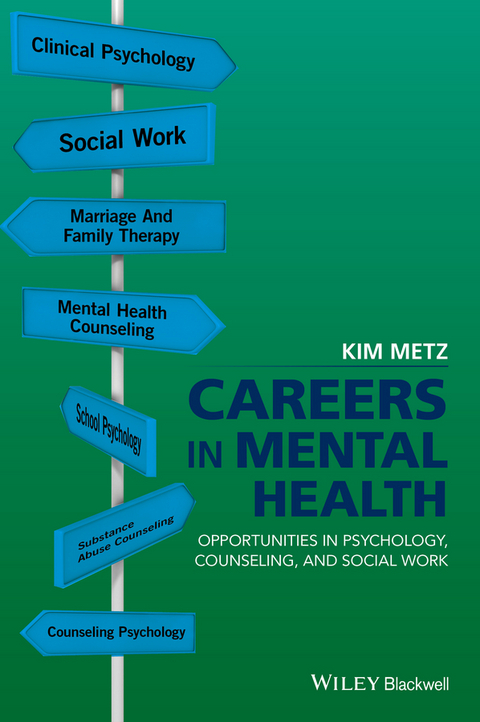
Careers in Mental Health (eBook)

Accessible and unbiased, Careers in Mental Health introduces upper-level high school students and beginning undergraduates to the different aspects of various mental health professions.
- Contains essential career advice for anyone considering an advanced degree in one of the 'helping' professions within mental health
- Covers clinical psychology, counseling psychology, social work, counseling, marriage and family therapy, substance abuse counseling, and school psychology
- Clarifies the distinctions between professions by discussing the history and philosophy of each field, requirements for advanced education, licensing, available jobs, salary potential, and more
- Includes a section with practical information applicable to all the professions, such as characteristics for success, ethical issues, the importance of critical thinking, applying to graduate school, and current issues affecting the field of mental health
Kim Metz is Professor of Psychology at Walsh University, USA. She also works as a Clinical Psychologist with children, adolescents, and adults at Avenues of Counseling and Mediation. Over the last 20 years, she has held a wide variety of positions as a psychologist, including positions in the forensic unit at a prison, a VA hospital, an outpatient clinic, an adolescent ward of an inpatient hospital, a community mental health agency and a private practice.
Accessible and unbiased, Careers in Mental Health introduces upper-level high school students and beginning undergraduates to the different aspects of various mental health professions. Contains essential career advice for anyone considering an advanced degree in one of the helping professions within mental health Covers clinical psychology, counseling psychology, social work, counseling, marriage and family therapy, substance abuse counseling, and school psychology Clarifies the distinctions between professions by discussing the history and philosophy of each field, requirements for advanced education, licensing, available jobs, salary potential, and more Includes a section with practical information applicable to all the professions, such as characteristics for success, ethical issues, the importance of critical thinking, applying to graduate school, and current issues affecting the field of mental health
Kim Metz is Professor of Psychology at Walsh University, USA. She also works as a Clinical Psychologist with children, adolescents, and adults at Avenues of Counseling and Mediation. Over the last 20 years, she has held a wide variety of positions as a psychologist, including positions in the forensic unit at a prison, a VA hospital, an outpatient clinic, an adolescent ward of an inpatient hospital, a community mental health agency and a private practice.
Acknowledgments ix
Introduction xi
Unit 1: Career Essentials 1
1 Ph.D. or Psy.D. in Clinical Psychology 3
Overall History and Philosophy of the Profession 3
Education 10
Licensing 17
Types of Jobs for which the Degree will Qualify You 19
Earning Potential 24
Types of Clients Served 25
What about Getting a Master's Degree in Psychology? 26
2 Ph.D. or Psy.D. in Counseling Psychology 29
Overall History and Philosophy of the Profession 29
Education 34
Licensing 35
Types of Jobs for which the Degree will Qualify You 35
Earning Potential 39
3 Master's in Social Work (MSW) 41
Overall History and Philosophy of the Profession 41
Education 46
Types of Jobs for which the Degree will Qualify You 50
Earning Potential 54
4 Master's in Counseling 57
Overall History and Philosophy of the Profession 57
Education 62
Licensing 66
Types of Jobs for which the Degree will Qualify You 67
Earning Potential 68
5 Master's in Marriage and Family Therapy 69
Overall History and Philosophy of the Profession 69
Education 75
Licensing 75
Types of Jobs for which the Degree will Qualify You 76
Earning Potential 77
6 Substance Abuse/Chemical Dependency Counselor 79
Overall History and Philosophy of the Profession 79
Education 83
Licensing 84
Types of Jobs for which the Degree will Qualify You 88
Earning Potential 89
7 School Psychologist 91
Overall History and Philosophy of the Profession 91
School Psychologist versus School Counselor 98
Education 99
Licensing 102
Types of Jobs for which the Degree will Qualify You 103
Earning Potential 104
Unit 2: Strategies and Skills 107
8 Why (and Why Not) to Pursue a Mental Health Professional Career 109
Why TO Pursue a Mental Health Career 109
Why NOT to Pursue a Mental Health Career 115
9 Critical Thinking 123
Distinguish between Real Science and Psychobabble 124
Always Ask Questions 126
Pay Attention to the Way Terms are Operationalized when Evaluating Information 127
Examine the Evidence - Both Sides of the Evidence 128
Analyze Assumptions and Biases of Those Making Claims 129
Avoid Emotional Reasoning 130
Consider Other Interpretations 132
Tolerate Uncertainty 133
10 Ethics: A Primer on Mental Health Profession Guidelines 137
Confidentiality 138
Boundaries 141
Record-Keeping 144
11 How to Increase Your Chance of Getting into Graduate School 147
GPA and GRE Scores 148
Research Experience 149
Volunteering 150
Internships 151
Personal Statement 151
Letters of Recommendation 153
Vita or Resume 154
Interview 155
Attend to Deadlines 156
12 After You Have Earned Your Degree 157
Continuing Education 157
Malpractice Insurance 159
Telehealth/Telepsychology/Online Support Groups 161
Prescription Privileges 162
Conclusion 167
Index 169
"Careers in Mental Health was written for undergraduate psychology students and
students in other mental health fields and provides a strong introduction to the most
frequently entered mental health fields. It quickly outlines each field?s philosophical origins,
educational requirements, and opportunities for licensure, typical work settings, and
average salaries by people in the field.It is too narrow for a careers course, but since it
solely focuses on the mental health professions that require graduate school and culminate
in licensure or certification, it could be a good supplementary text for either that course or
an Introduction to Counseling course.
Careers in Mental Health could also be a good resource for faculty advising students about
graduate school but confused by the variety of apparently similar professions out
there?clinical, counseling, and school psychology; guidance counseling; social work; and
licensed professional counseling. I am a clinical psychologist, have worked in the field for 25
years, and have advised students about these fields for most of that time, yet as a result of
reading this book, I better understand issues I?ve talked about and taught for years. For
example, why do these similar fields go by different names? Metz argues that this is at least
in part because these are homologous fields, appearing similar but having different
philosophical roots...
Much of the information in Careers in Mental Health is available on the Internet, but Metz
provides it in a simple and available manner that allows students?and faculty?to compare
apples with apples. She filters the information about fields in a straightforward manner that
makes their comparisons easy." (PsycCRITIQUES
January 16, 2017, Vol. 62, No. 3, Article 6)
Introduction
Advisor: Hello, Jane Student. I see that you have your next semester’s classes all chosen and you seem to be on track with all of your requirements. Let’s talk about what I think is the more important part of advising. What exactly do you want to do with your degree in psychology (or counseling or social work)?
Jane Student: (smiling dreamily) I really want to help people.
After, “I’ve been closed out of a class” (and I can’t write a book to fix THAT problem), the preceding is probably the most common dialogue I have with my advisees. Now, please don’t think I’m mocking the exchange. I had the same one with my advisor when I was Jane Student. I begin with this conversation because it was the inspiration for writing this book. You see, I would typically struggle with what my next line in the conversation should be, as there are myriad ways to proceed in order to develop a career helping people with mental health issues.
First, full disclosure – I have a Ph.D. in clinical psychology. Over the last 20 years I have worked in various positions as a psychologist. During my internship I worked in a forensic unit in a prison, in a VA hospital, in an outpatient clinic, and on an adolescent ward of an inpatient hospital. After internship I was the staff psychologist at a juvenile justice facility and later at an adolescent group home. When I began having children of my own, I cut back my work hours and did clinical work part time at a community mental health agency and started teaching part time at a local college. I also achieved the Holy Grail of “helping people” and was an independent contractor at a private practice. I teach full time in a psychology department at a small liberal arts college and continue carrying a small client caseload at a private practice. I can say that I truly enjoyed all of these job opportunities and that I’m confident that I have been able to achieve my goal “helping people” many times over.
OK – back to what to say to Jane Student. Given my background, my first inclination when I began teaching (and advising) full time was to say “great, let’s get going on those applications for a Ph.D. clinical psychology graduate program.” I would also hand them a copy of one of the many “So You Want to be a Psychology Major” books I always have on my shelf. I’m also not mocking those books. They are very useful, and I referred to one when I was Jane Student as well. However, I quickly found that the books, as well as the Ph.D. in clinical psychology programs, were not appropriate for many of my students.
For example, some students, for family or financial reasons, did not envision at least four more years of school (plus a year-long internship) following college. Others had desire and time, but lacked the grades or the research experience it would take to get into what are very competitive clinical psychology graduate schools. Still others were dead set on not moving more than a few miles away from home, so their pickings of graduate programs in clinical psychology would be slim, to say the least.
Therefore, I wanted to find a more appropriate “next line” in my dialogue with my students. I began to do some research on the various degrees available to assist them in their quest to “help people” and in answer to some of their questions:
- What is the difference between a clinical and counseling psychologist?
- Is a Psy.D. a more appropriate degree than a Ph.D.?
- Mental health counseling? Is that different from what a counseling psychologist does?
- I think I want to do marriage counseling; should I just get a degree in marriage and family therapy?
- Does a social worker make more or less money than a counselor?
- What if I want to work in the schools? What does a school counselor do?
- What types of clients does a social worker help? Are they different from those that a psychologist helps?
I had hoped that I could just find a book on the topic and offer it to them. However, it appeared that any title on the subject dealt only with one type of degree. So, to examine all the alternatives, one would need to read through several books and try to synthesize the information. While I’m certainly not against students needing to synthesize information, I really thought there had to be a more succinct way to educate them about the various opportunities out there. Moreover, it is often difficult for students to get good “reads” on these things because each profession has a strong identity and strongly adheres to its own tenets. Therefore, when asked, many professors and/or professionals may be biased in favor of their own training. Further, many psychology professors who do not have a clinical or counseling background (such as social psychologists, cognitive psychologists, or experimental psychologists) are also in the dark about the various paths that students who desire a career in mental health can take. Their careers are more focused on research, and details of the clinical side of the profession are often not at their fingertips. This text can be helpful to those professors as well, since the majority of them will have advising responsibilities for psychology students who hope to “help people” by engaging in some type of counseling or therapy.
My goal is to delineate the similarities and differences in these helping professions in a nonbiased way. To make it easier to compare apples to apples, I have divided each chapter into the same sections:
- Overall philosophy and history of the profession (note that much of the history of the professions is intertwined. I have a section in each chapter for each profession but there may be some overlap.)
- Type of education needed
- The role that licensing plays in your chosen profession
- The types of jobs for which the degree will qualify you
- Earning potential
In this way, students can compare and contrast the various opportunities and decide which is right for them. This is an important endeavor because students spend several years in graduate work and are tied to the profession/license they achieve. It is in their best interest to understand thoroughly the field in which they are going to practice so that they can make the best decisions for themselves.
Now, having said that, let me make one significant notation. The general public (e.g., you right now) really has very little understanding of the distinctions between these professions. Indeed, the professionals in each discipline often do not understand the differences themselves. Further, the jobs that are available for each profession are often similar. Therefore, the choice you make as to which degree to obtain may not make as big a difference as you might expect. However, my experience with students is that they want to be informed and make choices about their careers, not just rely on some flip of a coin as to which direction they will chart a path.
One more caveat to the information we will be discussing is that I can really only give you a general overview of the information. You will have to take into consideration the specifics of each profession based on the state in which your reside and/or hope to practice. An example of this will be the information on licensing standards and salary, which will vary from state to state.
In the first part of the book I will examine each of the various professions you might choose. I will begin with psychology and discuss doctoral degrees in psychology; that is, Ph.D.s and Psy.D.s in both clinical and counseling psychology. Specifically, the distinctions and differences between these career paths will be discussed. Please understand that there are other specialties in which one can choose to earn a Ph.D. in psychology, such as industrial organizational, experimental, and social. While these specialties no doubt help people, it is typically not in the way that most undergraduates mean when they indicate an interest in helping people. If one of these might be your area of interest, please check out some other titles on graduate work in psychology, as there are several texts available. Next, a discussion of the social work profession and the various career options that exist within it will follow. Then the various types of counseling, including mental health counseling and marriage and, family therapy, will be examined. The specialty of substance abuse follows. Finally, a discussion of mental health professionals who work within the schools, school psychologists and school counselors, will follow.
Readers should also understand that there are career options for students who do not wish to attend graduate school. However, those options won’t be covered in this work. One can easily find other manuals written with the “undergraduate degree only” student in mind.
Finally, I will not be discussing psychiatry in this text. As you may know, many people confuse the professions of psychiatry and psychology. Both carry the title of “doctor,” but a psychiatrist is an M.D. and a psychologist is a Ph.D. A psychiatrist trains in the same way that every other M.D. trains, that is, 2 years of medical school, 2 years of supervised experience, and 4 years of residency. Psychiatrists will begin their training in the same way, with the same coursework and supervised experience as a pediatrician or a surgeon or an oncologist. It is during their residency that they specialize in their chosen area. For example, if someone chooses to be a...
| Erscheint lt. Verlag | 8.1.2016 |
|---|---|
| Sprache | englisch |
| Themenwelt | Geisteswissenschaften ► Psychologie ► Klinische Psychologie |
| Sozialwissenschaften ► Pädagogik ► Sozialpädagogik | |
| Sozialwissenschaften ► Soziologie | |
| Schlagworte | Clinical psychology • Counseling Psychology • Klinische Psychologie • marriage and family therapist • mental health careers • mental health counselor • mental health professions • Psychologie • Psychology • school counselor • school psychologist • social worker • substance abuse counselor |
| ISBN-13 | 9781118768440 / 9781118768440 |
| Informationen gemäß Produktsicherheitsverordnung (GPSR) | |
| Haben Sie eine Frage zum Produkt? |
 EPUB (Adobe DRM)
Kopierschutz: Adobe-DRM
Adobe-DRM ist ein Kopierschutz, der das eBook vor Mißbrauch schützen soll. Dabei wird das eBook bereits beim Download auf Ihre persönliche Adobe-ID autorisiert. Lesen können Sie das eBook dann nur auf den Geräten, welche ebenfalls auf Ihre Adobe-ID registriert sind.
Details zum Adobe-DRM
Dateiformat: EPUB (Electronic Publication)
EPUB ist ein offener Standard für eBooks und eignet sich besonders zur Darstellung von Belletristik und Sachbüchern. Der Fließtext wird dynamisch an die Display- und Schriftgröße angepasst. Auch für mobile Lesegeräte ist EPUB daher gut geeignet.
Systemvoraussetzungen:
PC/Mac: Mit einem PC oder Mac können Sie dieses eBook lesen. Sie benötigen eine
eReader: Dieses eBook kann mit (fast) allen eBook-Readern gelesen werden. Mit dem amazon-Kindle ist es aber nicht kompatibel.
Smartphone/Tablet: Egal ob Apple oder Android, dieses eBook können Sie lesen. Sie benötigen eine
Geräteliste und zusätzliche Hinweise
Buying eBooks from abroad
For tax law reasons we can sell eBooks just within Germany and Switzerland. Regrettably we cannot fulfill eBook-orders from other countries.
aus dem Bereich