


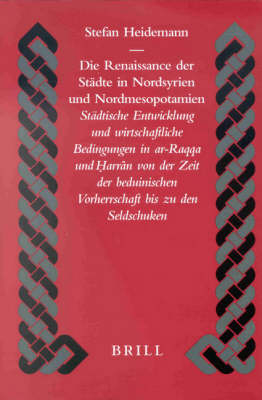
Die Renaissance der Städte in Nordsyrien und Nordmesopotamien
Städtische Entwicklung und wirtschaftliche Bedingungen in ar-Raqqa und Ḥ̣arrān von der Zeit der beduinischen Vorherrschaft bis zu den Seldschuken
Seiten
2002
Brill (Verlag)
978-90-04-12274-1 (ISBN)
Brill (Verlag)
978-90-04-12274-1 (ISBN)
The period between 950 and 1150 AD is regarded as a turning point in the history of Islamic culture. This work examines what led to the urban decline in these years and the later recovery. Harran and al-Raqqa serve as paradigms for the development in northern Syria and northern Mesopotamia.
The period between 950 and 1150 A.D. is regarded as "turning point in the history of the Islamic Culture" from the Early Islamic to the Late Medieval civilization. What led to the urban decline in between and the later recovery? Ḥ̣arrān and al-Raqqa serve as paradigma for the development in Northern Syria and Northern Mesopotamia.
The collapse of the ʿAbbasid state left the region cornered between Buyids, Fatimids and Byzantines to the nomadic tribes not acquainted with urban culture. After 1086 A.D., measures undertaken by the Seljuqs in order to safeguard their hegemony led to a renaissance of cities inspite of permanent power struggles and the crusades. They based their rule on fortified places. The financing of the army led to the distribution of land as fiefs (iqtaʿ) and subsequently to a dislodgement of nomads and a recultivation of former agricultural land. Cash money for the treasury was generated by skimming long distance trade; this in turn required public security on the roads. An analysis of the monetary circulation according to archaeological and literal evidence serves as measure for the economic recovery. A corpus of the coin production in al-Raqqa, ḥarrān and al-Ruha'/Edessa supplements the textual sources.
The period between 950 and 1150 A.D. is regarded as "turning point in the history of the Islamic Culture" from the Early Islamic to the Late Medieval civilization. What led to the urban decline in between and the later recovery? Ḥ̣arrān and al-Raqqa serve as paradigma for the development in Northern Syria and Northern Mesopotamia.
The collapse of the ʿAbbasid state left the region cornered between Buyids, Fatimids and Byzantines to the nomadic tribes not acquainted with urban culture. After 1086 A.D., measures undertaken by the Seljuqs in order to safeguard their hegemony led to a renaissance of cities inspite of permanent power struggles and the crusades. They based their rule on fortified places. The financing of the army led to the distribution of land as fiefs (iqtaʿ) and subsequently to a dislodgement of nomads and a recultivation of former agricultural land. Cash money for the treasury was generated by skimming long distance trade; this in turn required public security on the roads. An analysis of the monetary circulation according to archaeological and literal evidence serves as measure for the economic recovery. A corpus of the coin production in al-Raqqa, ḥarrān and al-Ruha'/Edessa supplements the textual sources.
Stefan Heidemann, Ph.D. (1993), Free University Berlin, Habilitation (2001) in Islamic Sciences, Friedrich-Schiller-University Jena. He publishes on Islamic history, Das Aleppiner Kalifat (Leiden 1994), and numismatics, Islamische Numismatik in Deutschland (Wiesbaden 2000), and took part in several excavations in Syria.
| Erscheint lt. Verlag | 26.4.2002 |
|---|---|
| Reihe/Serie | Islamic History and Civilization ; 40 |
| Verlagsort | Leiden |
| Sprache | deutsch |
| Maße | 155 x 235 mm |
| Gewicht | 1374 g |
| Einbandart | gebunden |
| Themenwelt | Geschichte ► Allgemeine Geschichte ► Mittelalter |
| Geisteswissenschaften ► Geschichte ► Regional- / Ländergeschichte | |
| Sozialwissenschaften ► Soziologie ► Spezielle Soziologien | |
| ISBN-10 | 90-04-12274-5 / 9004122745 |
| ISBN-13 | 978-90-04-12274-1 / 9789004122741 |
| Zustand | Neuware |
| Informationen gemäß Produktsicherheitsverordnung (GPSR) | |
| Haben Sie eine Frage zum Produkt? |
Mehr entdecken
aus dem Bereich



aus dem Bereich
Geschichte einer Augsburger Familie (1367-1650)
Buch | Softcover (2024)
Kohlhammer (Verlag)
CHF 47,60
der epische Kampf um das Heilige Land
Buch | Hardcover (2025)
C.H.Beck (Verlag)
CHF 49,95


