


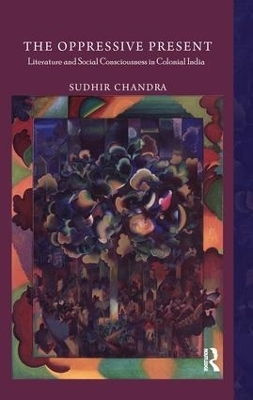
The Oppressive Present
Literature and Social Consciousness in Colonial India
Seiten
2016
Routledge India (Verlag)
978-1-138-66017-5 (ISBN)
Routledge India (Verlag)
978-1-138-66017-5 (ISBN)
This book attempts to understand the dominant structure of social consciousness in modern India through a comprehensive analysis of literary and social texts generated in late-nineteenth century. It examines responses to Western ideals that influenced concepts of the individual, the family, the position of women, religious/caste differences and social hierarchy in the colonial period.
Marking a departure from studies on history and literature in colonial India, The Oppressive Present explores the emergence of social consciousness as a result of and in response to the colonial mediation in the late nineteenth century. In focusing on contemporary literature in Hindi, Bengali, Gujarati, and Marathi, it charts an epochal change in the gradual loss of the old pre-colonial self and the configuration of a new, colonized self. It reveals that the ‘oppressive present’ of generations of subjugated Indians remains so for their freed descendants: the consciousness of those colonized generations continues to characterize the ‘modern educated Indian’. The book proposes ambivalence rather than binary categories — such as communalism and nationalism, communalism and secularism, modernity and tradition — as key to understanding the making of this consciousness.
This cross-disciplinary volume will prove essential to scholars and students of modern and contemporary Indian history and society, comparative literature and post-colonial studies.
Marking a departure from studies on history and literature in colonial India, The Oppressive Present explores the emergence of social consciousness as a result of and in response to the colonial mediation in the late nineteenth century. In focusing on contemporary literature in Hindi, Bengali, Gujarati, and Marathi, it charts an epochal change in the gradual loss of the old pre-colonial self and the configuration of a new, colonized self. It reveals that the ‘oppressive present’ of generations of subjugated Indians remains so for their freed descendants: the consciousness of those colonized generations continues to characterize the ‘modern educated Indian’. The book proposes ambivalence rather than binary categories — such as communalism and nationalism, communalism and secularism, modernity and tradition — as key to understanding the making of this consciousness.
This cross-disciplinary volume will prove essential to scholars and students of modern and contemporary Indian history and society, comparative literature and post-colonial studies.
Sudhir Chandra is currently Associate Fellow, Nantes Institute of Advanced Studies, France.
Prologue to this Edition. Acknowledgements. Introduction. 1. Crushed by English Poetry 2. Tradition: Orthodox and Heretical 3. Defining the Nation. Conclusion. Notes. About the Author. Index
| Erscheinungsdatum | 24.01.2016 |
|---|---|
| Verlagsort | London |
| Sprache | englisch |
| Maße | 138 x 216 mm |
| Gewicht | 453 g |
| Themenwelt | Geisteswissenschaften ► Geschichte |
| Geisteswissenschaften ► Sprach- / Literaturwissenschaft ► Anglistik / Amerikanistik | |
| Geisteswissenschaften ► Sprach- / Literaturwissenschaft ► Literaturwissenschaft | |
| Sozialwissenschaften ► Soziologie ► Makrosoziologie | |
| Sozialwissenschaften ► Soziologie ► Spezielle Soziologien | |
| ISBN-10 | 1-138-66017-5 / 1138660175 |
| ISBN-13 | 978-1-138-66017-5 / 9781138660175 |
| Zustand | Neuware |
| Informationen gemäß Produktsicherheitsverordnung (GPSR) | |
| Haben Sie eine Frage zum Produkt? |
Mehr entdecken
aus dem Bereich


aus dem Bereich
Poetik eines sozialen Urteils
Buch | Hardcover (2023)
De Gruyter (Verlag)
CHF 83,90


