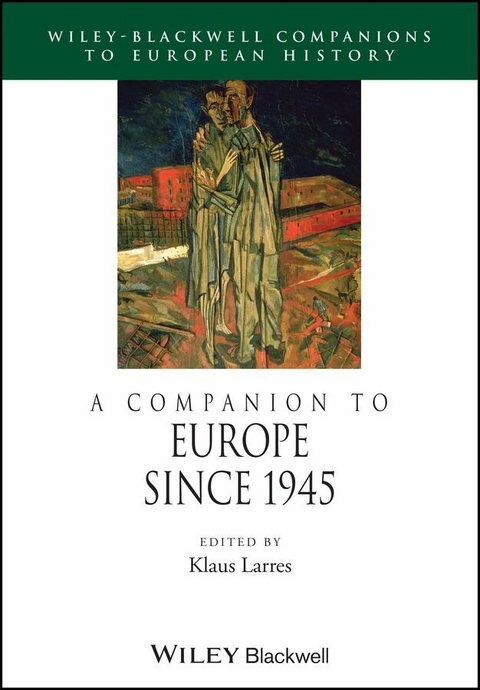
A Companion to Europe Since 1945 (eBook)
John Wiley & Sons (Verlag)
978-1-118-89024-0 (ISBN)
- Includes 22 original essays by an international team of expert scholars
- Examines the social, intellectual, economic, cultural, and political changes that took place throughout Europe in the Cold War and Post Cold War periods
- Discusses a wide range of topics including the Single Market, European-American relations, family life and employment, globalization, consumption, political parties, European decolonization, European identity, security and defence policies, and Europe's fight against international terrorism
- Presents Europe in a broad geographical conception, to give equal weighting to developments in the Eastern and Western European states
Klaus Larres is the Richard M Krasno Distinguished Professor of History and International Affairs at the University of North Carolina (UNC) at Chapel Hill in the U.S. He also is a Senior Fellow at the Center for Transatlantic Relations at the School of Advanced International Studies (SAIS) of Johns Hopkins University in Washington, DC.
A Companion to Europe Since 1945 provides a stimulating guide to numerous important developments which have influenced the political, economic, social, and cultural character of Europe during and since the Cold War. Includes 22 original essays by an international team of expert scholars Examines the social, intellectual, economic, cultural, and political changes that took place throughout Europe in the Cold War and Post Cold War periods Discusses a wide range of topics including the Single Market, European-American relations, family life and employment, globalization, consumption, political parties, European decolonization, European identity, security and defence policies, and Europe's fight against international terrorism Presents Europe in a broad geographical conception, to give equal weighting to developments in the Eastern and Western European states
Klaus Larres is the Richard M. Krasno Distinguished Professor of History and International Affairs at the University of North Carolina (UNC) at Chapel Hill in the U.S. He is also a Senior Fellow at the Center for Transatlantic Relations at the School of Advanced International Studies (SAIS) of Johns Hopkins University in Washington, DC.
Notes on Contributors ix
Acknowledgments xi
Maps xii-xiii
Introduction 1
Klaus Larres
Part I Europe in Transition: From War to Cold War 5
1 From War to Cold War 7
Mark Gilbert
2 Federalism and the Beginnings of European Union 25
John Pinder
Part II Europe and the Cold War World 45
3 The Cold War: The Western European Perspective 47
Ian Jackson
4 The Soviet Bloc and the Cold War in Europe 67
Mark Kramer
5 Economic Developments in Western and Eastern Europe since 1945 95
Ian Jackson
6 The End of Empires: Decolonization and Its Repercussions 113
David R. Devereux
7 European Integration: From the Common Market to the Single Market 133
Desmond Dinan
8 The United States and European Integration, 1945-1990 151
Klaus Larres
9 The Churches and Christianity in Cold War Europe 183
Dianne Kirby
10 The End of the Cold War and the Unifi cation of the European Continent 208
Carine Germond
Part III Europe Since 1990: Political and Economic Developments 229
11 Transatlantic Relations since the End of the Cold War: Permanent Alliance or Partnership in Peril? 231
Robert Hutchings
12 Europe and Economic Globalization since 1945 249
Alfred E. Eckes Jr.
13 Economic Integration since Maastricht 270
Christopher Flockton
14 Political Parties in Europe since 1945 302
Roger Eatwell
15 The Genesis of a European Security and Defence Policy 323
Ralph Dietl
16 Europe's Experience of Terrorism since 1945: A Brief Overview 355
Paul Wilkinson
Part IV Europe Since 1990: Social and Cultural Developments 367
17 The Quest for a European Identity: A Europe without Europeans? 369
Ruth Wittlinger
18 Europe and Post-Cold War Nationalism 387
Claire Sutherland
19 The Participatory Revolution: New Social Movements and Civil Society 407
Ingolfur Blühdorn
20 Postwar Europe: A Continent Built on Migration 432
Panikos Panayi
21 Changing Norms of Masculinity and Femininity: Development in Gender Relations and Family Structures in Europe 450
Laura den Dulk
22 Europe and the Welfare State since 1945 472
Steen P. Mangen
Index 501
Introduction
KLAUS LARRES
When World War II in Europe ended in early May 1945 the crushing defeat of the European continent became obvious. The entire continent lay in ruins, many of its people were homeless, severely wounded (both physically and mentally) or never returned from war service at all. The war provoked by Hitler’s Germany had not only brought misery and death to many millions of people, it also ensured that the once proud nations of the European continent would for years be preoccupied with physical survival, reconstruction, and political and social reconciliation.
Even the victorious British found that they had hugely overstretched their resources and would soon not only face austerity and economic deprivation at home but also witness the collapse of their global influence, economic prowess, and the ever faster disappearance of their empire. In a very short period of time even fewer overseas possessions would remain in the hands of the French, Italians, Portuguese, Dutch, and Belgians. The entire eastern part of the European continent would be swallowed up by the Soviet Union within three years. Once fully sovereign countries such as Poland, Czechoslovakia, Hungary, the Baltic states, Bulgaria, Romania were forcibly integrated into Moscow’s hugely expanded communist sphere of influence, which soon developed into a new sort of dictatorial and ideologically underpinned empire.
The only country which benefited from World War II, both economically and with regard to its global standing and immense military power, which included possession of the atomic secret, was the United States of America. Contrary to the expectations of many and contrary to America’s decision to withdraw from Europe after World War I, the US made a deliberate effort to learn from history. Not withdrawal but further participation in the affairs of Europe appeared to be the recipe for preventing yet another world war originating on the European continent. Economic reconstruction, democratic re-education in for example Germany, Austria, and Italy, and the creation of a Franco-German rapprochement as part of an overarching process of European integration were deemed vital.
The Truman and subsequent Eisenhower administrations embarked upon an “empire by invitation,” as Geir Lundestad has called it, and used Marshall Plan aid in the economic field and the North Atlantic Treaty Organization in the security and political areas to impose its will and ideas about the future shape of western Europe on the helpless European governments. Particular attention was paid to Germany, the divided nation, with the divided former capital Berlin at the frontline of the Cold War, to Franco–German relations and the economic revival of Europe to prevent the continent from once again becoming seduced by the promises of radical ideologies. The impetus to overcome the ingrained animosities of the past with the help of a process of European integration mostly came from British, French, and Italian thinkers who had first introduced such schemes in the 1920s and resuscitated and developed them during the most despairing times of World War II.
Within a mere decade most of the continent’s most pressing economic, social, and political problems had been overcome. Both outside help and the enormous energy, imagination, and sheer will for survival of the peoples of western Europe had transformed the continent from a helpless colossus to a democratic, fairly prosperous and well-functioning half-continent. Europe had again become a force to be reckoned with in the world, in particular in economic terms. European integration – though initially only advocated by the Schuman Plan “Six” for a limited number of economic sectors – had played a vital role in overcoming the economic deprivation and the political dislocation which had characterized the initial postwar years.
To a considerable extent this also applied to the years after the end of the Cold War in 1990/1991 and the resulting reunification of the European continent. The Maastricht Treaty, in particular, but also the Nice, Amsterdam, and Lisbon treaties as well as perhaps the Lisbon Reform Treaty of 2008 had a decisive influence on shaping the difficult transition from the Cold War era to the post-Cold War years and indeed to the post-9/11 era. Within Europe the creation of a single European market, the transformation of the European Community into the European Union (EU), the introduction of a common currency a decade later, the insistence on a normative process of democratization and not least the resulting waves of enlargement which led to the incorporation of the former communist states into the EU have dramatically changed the character of the European continent. Despite many difficulties and at times unnecessary complexities and stifling bureaucracies, Europe has certainly become a more coherent and more united continent which projects its influence, even power, increasingly beyond the confines of the European continent.
The enlargement of the EU and the integration of the former eastern European communist states preoccupied the EU to a substantial extent during the first decade and a half after the end of the Cold War. In the aftermath of the events of September 11, 2001 and the highly controversial US–British invasion of Iraq in March 2003 (which put an unprecedented strain on transatlantic and intra-European relations), it was above all international terrorism which engaged the EU. The EU countries were forced to respond to that threat and to the American-led “war against terror” with increasing domestic vigilance, that led to ever greater governmental meddling in the private lives of their citizens. They also felt it imperative to become much more involved than hitherto in peacekeeping and indeed peacemaking activities far beyond the borders of Europe. The EU also took the lead in facing up to the climate and energy crises that plague global affairs in the post-Cold War years; Brussels attempted to develop a strategic policy of international sustainability.
The failure of the “war on terror” in both Iraq and Afghanistan and the uneasy stalemate of Washington’s relations with important countries such as China, Russia, and Iran resulted in a deep political and – under the influence of the global “credit crunch” and other recessionary economic factors – financial crisis in the USA. Consequently there was increasing pressure on the EU to become a more active international player. The partial replacement of the dollar as the global reserve currency by the euro was not just of symbolic importance.
Towards the end of the first decade of the twenty-first century the EU appears to be on the threshold of becoming a global power and a crucially important international mediator. However, it is still an open question if the EU will accept this challenge and continue with the development of a streamlined institutional set-up, including the creation of an effective common foreign, security, and defense policy. Perhaps the EU will lose courage again and shrink away from the global responsibilities of the future; instead it may once again focus on intra-European squabbles, navelgazing and confine itself to largely dealing with common market and trade questions. Only the developments in the second decade of the twenty-first century can tell.
A Companion to Europe since 1945 has a two-fold objective. The many authors who have contributed to this volume look back and analyze the developments which took place on the European continent during the Cold War. They also consider present-day Europe, the Europe which has taken shape since the end of the Cold War in 1990/1991, and analyze current developments from a plethora of angles.
The book is divided into four major parts. Part I considers the transition from war to cold war. In the first chapter Mark Gilbert analyzes the political and military developments, in particular, the origins of the Cold War in Europe. In the following chapter John Pinder considers the roots of the ideas for European integration and how these ideas spread and developed into a proposal for the establishment of a federalist and united European state.
The seven chapters of Part II analyze developments in Europe during the Cold War. Ian Jackson considers the western European perspective while Mark Kramer views the developments from the Soviet and eastern European angle. In chapter three Ian Jackson compares the different economic developments and experiences in western and eastern Europe between 1945 and 1990. David Devereux considers the process of decolonization, that affected in particular Britain and France but also some other European countries, and looks at the impact huge-scale migration from the former colonies had on the home countries. Desmond Dinan then follows the development and execution of the European idea from the Schuman Plan of 1950 through to the establishment of the single market in the early 1990s. Klaus Larres looks at the role the United States played in shaping the process of European integration. The American insistence on their continued hegemony in transatlantic relations which in particular the Nixon and Reagan administrations pursued gave a decisive impetus to the European efforts in the 1970s and above all in the 1980s to create more coherent and effective federal European institutions. Subsequently Dianne Kirby analyzes the role of religion and the main churches in shaping the Cold War world, a theme which has been recognized only recently as a crucial factor of influence. Last but not least Carine Germond considers the impact of the sudden and entirely un-expected end...
| Erscheint lt. Verlag | 7.1.2014 |
|---|---|
| Reihe/Serie | Blackwell Companions to European History |
| Blackwell Companions to European History | Blackwell Companions to European History |
| Sprache | englisch |
| Themenwelt | Geschichte ► Allgemeine Geschichte ► Neuzeit (bis 1918) |
| Geschichte ► Allgemeine Geschichte ► 1918 bis 1945 | |
| Geschichte ► Allgemeine Geschichte ► Zeitgeschichte | |
| Geisteswissenschaften ► Geschichte ► Regional- / Ländergeschichte | |
| Geschichte ► Teilgebiete der Geschichte ► Militärgeschichte | |
| Sozialwissenschaften ► Politik / Verwaltung | |
| Schlagworte | 20th Century & Contemporary European History • Cold War • comparative politics • Contemporary • Europa /Geschichte, Politik 1945 ff • Europe • Geschichte • History • Political Science • Politikwissenschaft • postwar • reconstruction • Vergleichende Politik • Zeitgeschichte Europas im 20./21. Jhd. |
| ISBN-10 | 1-118-89024-8 / 1118890248 |
| ISBN-13 | 978-1-118-89024-0 / 9781118890240 |
| Informationen gemäß Produktsicherheitsverordnung (GPSR) | |
| Haben Sie eine Frage zum Produkt? |
 EPUB (Adobe DRM)
Kopierschutz: Adobe-DRM
Adobe-DRM ist ein Kopierschutz, der das eBook vor Mißbrauch schützen soll. Dabei wird das eBook bereits beim Download auf Ihre persönliche Adobe-ID autorisiert. Lesen können Sie das eBook dann nur auf den Geräten, welche ebenfalls auf Ihre Adobe-ID registriert sind.
Details zum Adobe-DRM
Dateiformat: EPUB (Electronic Publication)
EPUB ist ein offener Standard für eBooks und eignet sich besonders zur Darstellung von Belletristik und Sachbüchern. Der Fließtext wird dynamisch an die Display- und Schriftgröße angepasst. Auch für mobile Lesegeräte ist EPUB daher gut geeignet.
Systemvoraussetzungen:
PC/Mac: Mit einem PC oder Mac können Sie dieses eBook lesen. Sie benötigen eine
eReader: Dieses eBook kann mit (fast) allen eBook-Readern gelesen werden. Mit dem amazon-Kindle ist es aber nicht kompatibel.
Smartphone/Tablet: Egal ob Apple oder Android, dieses eBook können Sie lesen. Sie benötigen eine
Geräteliste und zusätzliche Hinweise
Buying eBooks from abroad
For tax law reasons we can sell eBooks just within Germany and Switzerland. Regrettably we cannot fulfill eBook-orders from other countries.
aus dem Bereich