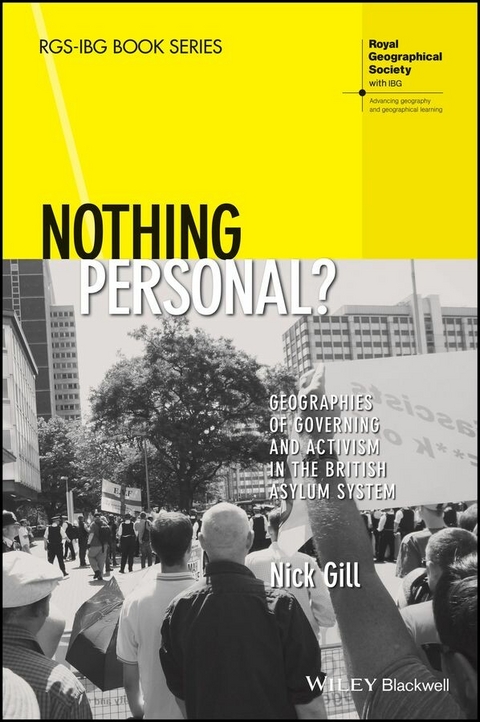
Nothing Personal? (eBook)
In this groundbreaking new study, Nick Gill provides a conceptually innovative account of the ways in which indifference to the desperation and hardship faced by thousands of migrants fleeing persecution and exploitation comes about.
- Features original, unpublished empirical material from four Economic and Social Research Council (ESRC) funded projects
- Challenges the consensus that border controls are necessary or desirable in contemporary society
- Demonstrates how immigration decision makers are immersed in a suffocating web of institutionalized processes that greatly hinder their objectivity and limit their access to alternative perspectives
- Theoretically informed throughout, drawing on the work of a range of social theorists, including Max Weber, Zygmunt Bauman, Emmanuel Levinas, and Georg Simmel
Nick Gill is Associate Professor of Human Geography at the University of Exeter. Co-editor of Carceral Spaces: Mobility and Agency in Imprisonment and Migration Detention (with D. Moran and D. Conlon, 2013) and Mobilities and Forced Migration (with J. Caletrio and V. Mason, 2013), Dr. Gill has published widely on forced migration, devolution, governance and activism. His current research, funded by the Economic and Social Research Council, focuses on activism around irregular migration and the legal geographies of border control.
In this groundbreaking new study, Nick Gill provides a conceptually innovative account of the ways in which indifference to the desperation and hardship faced by thousands of migrants fleeing persecution and exploitation comes about. Features original, unpublished empirical material from four Economic and Social Research Council (ESRC) funded projects Challenges the consensus that border controls are necessary or desirable in contemporary society Demonstrates how immigration decision makers are immersed in a suffocating web of institutionalized processes that greatly hinder their objectivity and limit their access to alternative perspectives Theoretically informed throughout, drawing on the work of a range of social theorists, including Max Weber, Zygmunt Bauman, Emmanuel Levinas, and Georg Simmel
Nick Gill is Associate Professor of Human Geography at the University of Exeter. Co-editor of Carceral Spaces: Mobility and Agency in Imprisonment and Migration Detention (with D. Moran and D. Conlon, 2013) and Mobilities and Forced Migration (with J. Caletrio and V. Mason, 2013), Dr. Gill has published widely on forced migration, devolution, governance and activism. His current research, funded by the Economic and Social Research Council, focuses on activism around irregular migration and the legal geographies of border control.
Series Editors' Preface viii
List of Figures ix
Acronyms xi
Acknowledgements xii
1 Introduction 1
2 Moral Distance and Bureaucracy 21
3 Distant Bureaucrats 48
4 Distance at Close Quarters 76
5 Indifference Towards Suffering Others During Sustained Contact 107
6 Indifference and Emotions 135
7 Examining Compassion 156
8 Conclusion 179
Methodological Appendix 191
References 196
Index 216
'In this important book, Gill puts morality, suffering and compassion at the heart of asylum politics and scholarship. Drawing on empirical research, he offers a damning account of how the British immigration system has created a culture of indifference towards asylum seekers and examines the compassionate, but 'risky', activisms that have arisen in response to the immorality of border controls.'
- Imogen Tyler, Lancaster University, UK
'Nothing Personal is personal: a thoughtful and timely analysis of the roles played by morality and indifference shaping detention in the UK. Gill insightfully explores spatial strategies such as dispersal, separation, buffering, and distance to better understand how people suffer (and die) in the custody of officials. This is an important read for anyone interested in understanding the people who run detention and asylum systems, and the politics of indifference at work there.'
- Alison Mountz, Wilfrid Laurier University, Canada
Chapter One
Introduction
Nothing personal, it’s just business: this is the new Satan of liquid modernity.
Bauman and Donskis (2013, p. 10)
Migrant Deaths
In 2013 an unannounced inspection of Harmondsworth Immigration Removal Centre revealed worrying instances of neglect. Harmondsworth is a British secure facility near London that incarcerates refused asylum seekers prior to their deportation. The inspection, undertaken by Her Majesty’s Chief Inspector of Prisons, reported that ‘on at least two occasions, elderly, vulnerable and incapacitated detainees, one of whom was terminally ill, were needlessly handcuffed in an excessive and unacceptable manner… These men were so ill that one died shortly after his handcuffs were removed and the other, an 84 year-old-man, died while still in restraints’ (HM Chief Inspector of Prisons, 2014, p. 5). Staff had ignored a doctor's report declaring the 84-year-old, Alois Dvorzac, unfit for detention and in need of medical care. ‘These are shocking cases where a sense of humanity was lost’ the report continued, ‘[n]either had been in any way resistant or posed any current specific individual risk’ (HM Chief Inspector of Prisons 2014, p. 13). Harmondsworth has the capacity to hold 615 detainees, making it the largest detention centre in Europe. It holds men only and the security in various wings is comparable to a high security prison. The report concluded that the centre displayed, ‘inadequate focus on the needs of the most vulnerable detainees, including elderly and sick men, those at risk of self harm through food refusal, and other people whose physical or mental health conditions made them potentially unfit for detention’ (HM Chief Inspector of Prisons, 2014, p. 5).
Mr Dvorzac’s specific case is not an isolated phenomenon. Deaths in immigration detention are part of a global pattern of migrant deaths that occur as a result of the combination of bureaucratic ineptitude, the desperation of migrants and the strengthening of border controls. What is more, is not just asylum seekers who face risks.1 For example, 58 Chinese stowaways who had suffocated in a container en route to the UK to work were discovered in Dover in 2001, together with just two survivors, almost suffocated amidst the putrid smell of rotting corpses (Hyland, 2000). The migrants had travelled from the southern Chinese province of Fujian on the Taiwan Strait and would have paid around £15,000 to get to Britain, most likely travelling on the strength of a deposit and facing the rest of the debt upon their arrival.2 Although widespread consternation was expressed at the time, no fundamental alterations were made to the border policies and control practices that are at least partly responsible for the high risks they took. Another 23 Chinese migrants died picking cockles on the sands of Morecambe Bay in Lancashire, United Kingdom, in 2004. They were employed illegally, paid well below the minimum wage, and were sent to work in dangerous conditions without safety equipment or the ability to call for help. When the tide suddenly came in they were swept out to sea and suffered ‘death in a cold, strange land’ (BBC, 2006a). Although their deaths prompted the adoption of the Gangmaster (Licensing) Act (GLA) 2004, there ‘is little direct evidence to suggest that the GLA has reduced worker exploitation, including long hours, lack of holiday and/or sick pay, unfair deductions, poor-quality tied housing, and restrictive contracts’ (Strauss, 2013, p. 190). More recently, one man died and another 34 others were found suffering from dehydration and hypothermia, in a shipping container in Tilbury Docks, Essex, in August 2014. In this case the group were Afghan Sikhs who were intending to claim asylum, and included 13 children; they had been trapped inside the container for at least 12 hours.
The moral claim made by asylum seekers is seen as different from that made by economic migrants even though both often experience hardship, uncertainty and discomfort. Asylum seekers are invoking their right to safety from persecution rather than their right to work. As such they do not offend the sensibilities of those who are concerned about ‘British jobs for British workers’ in quite the same way as economic migrants, although overstated suspicion about ‘bogus’ asylum seekers – i.e. asylum seekers who are really in pursuit of employment or other financial gains – is never far from view in the British context (see Zimmermann, 2014, for an exposition of the poverty of the notion of bogus asylum seeking). For the most part in this book I examine the situation of asylum seekers and not economic migrants, although I recognise that there are difficulties and sensitivities in distinguishing between the two.3
The British public’s attitude towards migrant deaths has been largely insensitive since at least the early 2000s. Occasionally, the magnitude of a disaster or the horrific circumstances that surround it will make the news and provoke a popular, although usually short-lived, sense of guilt, as in the case of the tragic drowning of the toddler Aylan Kurdi, washed up on a Turkish beach in 2015, which prompted a social media outcry and a flurry of grassroots activism, obliging the Prime Minister David Cameron to accept more Syrian refugees to Britain. But most migrant deaths make little impact on public consciousness. UNITED4 has kept a ‘List of Deaths’ since 1993, which includes all reported deaths that have occurred as a consequence of European border militarisation, asylum laws, poor accommodation conditions, detention, deportations and carrier sanctions. The fatality count stood at 22,394 by mid-June 2015, although the actual figure is likely to be much higher as a result of the number of unreported deaths (UNITED, 2015). The United National High Commission for Refugees (UNHCR) (2014) reported that 3,419 people lost their lives trying to cross the Mediterranean in 2014 alone, making it the deadliest sea crossing route in the world. Yet because these numbers accrue steadily they have little impact. Until recently, there had been no sustained outcry from the British public against the lethal consequences of the current management of border controls beyond the protestations of a small number of interest groups.
Although this lacklustre attitude might be uncomfortable to acknowledge, it is possible to understand how it originates. Reports of migrant deaths refer to migrant struggles and lives that seem alien to, and distant from, the lives of most citizens in Western developed countries. It is difficult to appreciate their experiences of loss and suffering, especially when the accounts reference far-flung places that are unfamiliar and carry little resonance for the majority of middle-class Westerners. While this should not be taken as an excuse for the persistence of highly securitised border controls that pose a threat to the lives of migrants, it does render intelligible public apathy in the face of the calamities that befall migrants.
The degree of neglect exhibited by the guards, medical personnel and centre managers responsible for Mr Dvorzac at the time of his death, however, goes beyond the more general listlessness of the British public towards migrant deaths. It displays a level of unconcern and a disregard for suffering that is qualitatively distinct from public indifference. Disconcertingly, Mr Dvorzac was well known to the authorities: guards did not ‘discover’ him in the same way that border control officers came across the migrants in shipping containers. Rather Mr Dvorzac died as a result of neglect by individuals who could see his discomfort, were acquainted with him, and had the power to alleviate his distress. Tragically, other deaths in British detention display similar symptoms. The Institute of Race Relations documents a series of deaths of detainees in British detention between 1989 and 2014, pointing toward the slowness of authorities to react to cries for help, the aggravating role of neglect when medical conditions are already being suffered, misplaced medical records, allegations of poor treatment and assaults by staff, referrals by medical staff that were never followed up, and insufficient care taken to prevent suicides (Athwal, 20145).
It is a gruesome feat to be able to engender, within employees, levels of indifference that allow them to overlook the suffering of subjects right before their eyes. I call this a feat because it must have been achieved despite our tendency to feel weaker empathy for people who are far away from us and stronger empathy for those close to us. The British public’s generally lacklustre response to migrants’ suffering can be explained by this tendency: the fact that most migrant struggles occur in settings, countries and situations unfamiliar to most Western citizens, including the ports, docks and vessels that form the backdrop of the deaths in shipping containers and at sea, means that news of migrant deaths seems decidedly removed from their everyday lives. Mr Dvorzac, however, died in full view of the authorities that were supposedly caring and responsible for him and he was not, at the time, attempting to dodge these authorities but was rather relying on them for his welfare. His death, and the deaths of others who have died in similar conditions in detention in the United Kingdom, provides a starting point for my exploration of the relationship between indifference, moral distance and proximity in this book. What...
| Erscheint lt. Verlag | 10.12.2015 |
|---|---|
| Reihe/Serie | RGS-IBG Book Series |
| RGS-IBG Book Series | RGS-IBG Book Series |
| Sprache | englisch |
| Themenwelt | Naturwissenschaften ► Geowissenschaften ► Geografie / Kartografie |
| Sozialwissenschaften ► Politik / Verwaltung | |
| Technik | |
| Schlagworte | Anthropogeographie • asylum seekers • Border Control • British politics • Bureaucracy • Emmanuel Levinas • Geographie • Geography • Georg Simmel • hmrc • Human geography • Immigration Control • immigration detention • <p>Immigration • Max Weber • Migration • Mobility • Political Geography • Political Science • Politik • Politik / GroÃbritannien • Politik / Großbritannien • Politikwissenschaft • Politische Geographie • Social Justice • Sociology • the state</p> • Zygmunt Bauman |
| ISBN-13 | 9781118316016 / 9781118316016 |
| Informationen gemäß Produktsicherheitsverordnung (GPSR) | |
| Haben Sie eine Frage zum Produkt? |
 EPUB (Adobe DRM)
Kopierschutz: Adobe-DRM
Adobe-DRM ist ein Kopierschutz, der das eBook vor Mißbrauch schützen soll. Dabei wird das eBook bereits beim Download auf Ihre persönliche Adobe-ID autorisiert. Lesen können Sie das eBook dann nur auf den Geräten, welche ebenfalls auf Ihre Adobe-ID registriert sind.
Details zum Adobe-DRM
Dateiformat: EPUB (Electronic Publication)
EPUB ist ein offener Standard für eBooks und eignet sich besonders zur Darstellung von Belletristik und Sachbüchern. Der Fließtext wird dynamisch an die Display- und Schriftgröße angepasst. Auch für mobile Lesegeräte ist EPUB daher gut geeignet.
Systemvoraussetzungen:
PC/Mac: Mit einem PC oder Mac können Sie dieses eBook lesen. Sie benötigen eine
eReader: Dieses eBook kann mit (fast) allen eBook-Readern gelesen werden. Mit dem amazon-Kindle ist es aber nicht kompatibel.
Smartphone/Tablet: Egal ob Apple oder Android, dieses eBook können Sie lesen. Sie benötigen eine
Geräteliste und zusätzliche Hinweise
Buying eBooks from abroad
For tax law reasons we can sell eBooks just within Germany and Switzerland. Regrettably we cannot fulfill eBook-orders from other countries.
aus dem Bereich