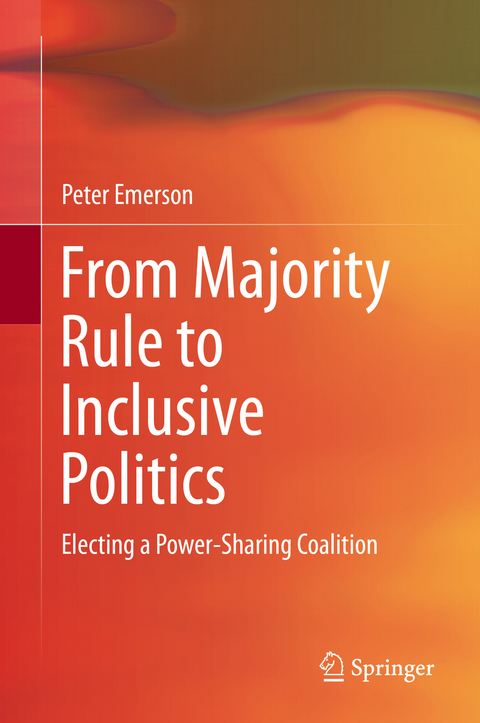
From Majority Rule to Inclusive Politics (eBook)
XXVI, 146 Seiten
Springer International Publishing (Verlag)
9783319235004 (ISBN)
This book discusses voting procedures in collective decision-making. Drawing on well-established election processes from all over the world, the author presents a voting procedure that allows for the speedy but fair election of a proportional, all-party coalition. The methodology - a matrix vote - is accurate, robust and ethno-color blind. In the vote, the counting procedure encourages all concerned to cross the gender as well as any party and/or sectarian divides. While in the resulting executive each party will be represented fairly and, at best, with the consensus of parliament, every minister will be the one most suited to his/her new portfolio. By using preferential voting and thus achieving consensus, the matrix vote will be fundamental to the resolution of conflicts.
The matrix vote can also be used when:
• two or more parliamentary parties elect a coalition government
• one parliamentary party elects a government or shadow cabinet, or organizations in civil society elect their governing boards or executive committees
• any group chooses a fixed number of individuals to form a team in which each member carries out a different function
Like Jean-Charles de Borda, Peter Emerson was initially a naval officer. After nine years in conventional submarines, he resigned his (British) commission to teach maths and physics in a school for the poor in Nairobi. It was here in Kenya, and later in Rwanda, that he questioned the basis of Western democratic structures: majority voting and majority rule. Then, in 1975, this son of an Irish Protestant father and English Catholic mother moved to Belfast, where, as in Africa, binary voting was seen to be both inaccurate and inadequate. He is now the Director of the de Borda Institute, working in conflict zones and developing countries: the Balkans, the Caucasus, East Africa and most recently, China.
Like Jean-Charles de Borda, Peter Emerson was initially a naval officer. After nine years in conventional submarines, he resigned his (British) commission to teach maths and physics in a school for the poor in Nairobi. It was here in Kenya, and later in Rwanda, that he questioned the basis of Western democratic structures: majority voting and majority rule. Then, in 1975, this son of an Irish Protestant father and English Catholic mother moved to Belfast, where, as in Africa, binary voting was seen to be both inaccurate and inadequate. He is now the Director of the de Borda Institute, working in conflict zones and developing countries: the Balkans, the Caucasus, East Africa and most recently, China.
Introduction.- 2. Majority Rule: The Right May Be Wrong.- 3. Majority Rule in the West.- 4. The New Democracies.- 5. The GOAT is a GNU.- 6. Electing a Proportional All-Party, Power-Sharing Executive.- 7. Will it Work?.- Annex I: The Rules for an MBC.- Annex II: The Rules for a Matrix Vote Election.- Annex III: Examples of Valid and Invalid Ballots.- Annex IV: Sample Forms Required for a Matrix Vote Paper Count.
| Erscheint lt. Verlag | 16.1.2016 |
|---|---|
| Zusatzinfo | XXVI, 146 p. 3 illus., 1 illus. in color. |
| Verlagsort | Cham |
| Sprache | englisch |
| Themenwelt | Recht / Steuern ► EU / Internationales Recht |
| Sozialwissenschaften ► Politik / Verwaltung ► Politische Theorie | |
| Wirtschaft ► Betriebswirtschaft / Management ► Finanzierung | |
| Schlagworte | Collective Decision-Making • Conflict Resolution • Matrix Vote • Peace-Making • Power-sharing • Preferential Voting |
| ISBN-13 | 9783319235004 / 9783319235004 |
| Informationen gemäß Produktsicherheitsverordnung (GPSR) | |
| Haben Sie eine Frage zum Produkt? |
 PDF (Wasserzeichen)
DRM: Digitales Wasserzeichen
Dieses eBook enthält ein digitales Wasserzeichen und ist damit für Sie personalisiert. Bei einer missbräuchlichen Weitergabe des eBooks an Dritte ist eine Rückverfolgung an die Quelle möglich.
Dateiformat: PDF (Portable Document Format)
Mit einem festen Seitenlayout eignet sich die PDF besonders für Fachbücher mit Spalten, Tabellen und Abbildungen. Eine PDF kann auf fast allen Geräten angezeigt werden, ist aber für kleine Displays (Smartphone, eReader) nur eingeschränkt geeignet.
Systemvoraussetzungen:
PC/Mac: Mit einem PC oder Mac können Sie dieses eBook lesen. Sie benötigen dafür einen PDF-Viewer - z.B. den Adobe Reader oder Adobe Digital Editions.
eReader: Dieses eBook kann mit (fast) allen eBook-Readern gelesen werden. Mit dem amazon-Kindle ist es aber nicht kompatibel.
Smartphone/Tablet: Egal ob Apple oder Android, dieses eBook können Sie lesen. Sie benötigen dafür einen PDF-Viewer - z.B. die kostenlose Adobe Digital Editions-App.
Buying eBooks from abroad
For tax law reasons we can sell eBooks just within Germany and Switzerland. Regrettably we cannot fulfill eBook-orders from other countries.
aus dem Bereich