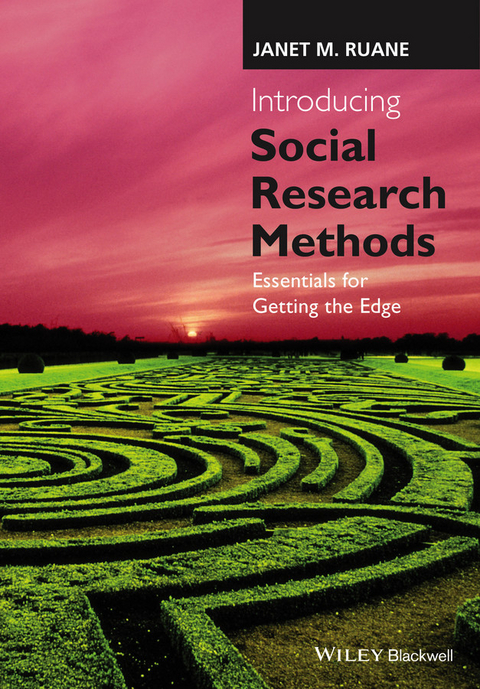
Introducing Social Research Methods (eBook)
John Wiley & Sons (Verlag)
978-1-118-87420-2 (ISBN)
- Explains complex, multi-faceted concepts and methodologies in straightforward prose
- Designed for students who are new to or skeptical of social science research methods as useful tools for approaching real-world challenges
- Persuasively argues that social scientific proficiency unlocks an array of personal and professional opportunities beyond the realms of academia
- A supplementary website features a glossary, test bank, Power Point presentations, a comprehensive list of web resources, a guide to relevant TED lectures and much more
Janet M. Ruane is a professor of sociology at Montclair State University. She is the author of Second Thoughts: Sociology Challenges Conventional Wisdom (with Karen Cerulo, 6th edition, 2014) and has published articles in an array of prestigious, peer-reviewed journals, including Social Psychology Quarterly, Sociological Forum, Sociological Inquiry, Law and Policy, Communication Research, Sociological Focus, and Science as Culture. With over 25 years of experience teaching research methods to undergraduates, Professor Ruane is an ardent supporter of education as a tool of empowerment.
Introducing Social Research Methods: Essentials for Getting the Edge is a concise and student-friendly introduction to research methods that uses examples from around the world to illustrate the centrality of social science research in our everyday lives. Explains complex, multi-faceted concepts and methodologies in straightforward prose Designed for students who are new to or skeptical of social science research methods as useful tools for approaching real-world challenges Persuasively argues that social scientific proficiency unlocks an array of personal and professional opportunities beyond the realms of academia A supplementary website features a glossary, test bank, Power Point presentations, a comprehensive list of web resources, a guide to relevant TED lectures and much more
Janet M. Ruane is a professor of sociology at Montclair State University. She is the author of Second Thoughts: Sociology Challenges Conventional Wisdom (with Karen Cerulo, 6th edition, 2014) and has published articles in an array of prestigious, peer-reviewed journals, including Social Psychology Quarterly, Sociological Forum, Sociological Inquiry, Law and Policy, Communication Research, Sociological Focus, and Science as Culture. With over 25 years of experience teaching research methods to undergraduates, Professor Ruane is an ardent supporter of education as a tool of empowerment.
About the Website ii
1 How Do We Know What We Know? Science as a Superior Way of Knowing 1
2 The Language of Science and Research: Learning to Talk the Talk and Walk the Walk 21
3 Ethics: It's the Right Thing To Do 45
4 Designing Ideas: What Do We Want to Know and How Can We Get There? 67
5 Measure by Measure: Developing Measures--Making the Abstract Concrete 93
6 All That Glitters Is Not Gold: Assessing the Validity and Reliability of Measures 117
7 One Thing Leads to Another ... or Does it? Tackling Causal Analysis 139
8 The Questionnaire: Would You Mind Taking the Time to Answer a Few Questions? 163
9 Having the Talk: Person to Person Information Exchanges 189
10 Field Research: Welcome to My World 209
11 Sample This! How Can So Few Tell Us About So Many? 231
12 Show Me the Numbers: Descriptive Statistics and Inferential Statistics 255
13 Pulling it Together: A Final Synthesis 283
Glossary 289
Index 295
"Introducing Research Methods: Essentials for Getting the Edge speaks the language of students! Ruane makes research methods painless with abundant use of truly up-to-date and engaging examples and a wonderfully inviting writing style. This text achieves the perfect balance between breadth and depth for teaching undergraduate research methods. I am confident that this text will give students "the edge", and that students will retain the knowledge because it is presented in a way that resonates with their world."
Keumjae Park, William Paterson University
"A down-to-earth approach to research methods written with both the instructor and student in mind. This text takes students on a journey, explaining why these tools are important, giving them the language to be able to understand those tools, and demonstrating with multiple current and real-world examples how powerful good research methods can be. The true gem here is how accessible Ruane has made it, through her use of everyday language and clear examples. This text will take the sting out of methods for both instructors and students alike."
Maureen Outlaw, Providence College
Chapter 1
How Do We Know What We Know? Science as a Superior Way of Knowing
FIRST TAKES
Be sure to take note of the following:
Scientific vs. Non-Scientific Knowledge
- Competing non-scientific ways of knowing
- Tradition
- Authority
- Common sense
- Intuition
- Rationalism
- Strict empiricism
- Science – a superior (less error prone) way of knowing
- A distinctive way of knowing
- - The defining traits of science
- A distinctive way of knowing
How do we know what we know? This is both a rather simple but also a rather complex philosophical question. Those who seek the path of least resistance are often willing to forgo the consideration of this question altogether. But in order to achieve a deeper appreciation of science and its distinctive edge in the production of knowledge, we need to take a moment and ponder this basic question. We need to explicitly acknowledge the common tendency of many to rely on competing non-scientific ways of knowing. These non-scientific ways of knowing are well established “go to” practices for many of us that help us cope with the dynamic nature of the social world and the flood of information we all must process every day.
To be sure, we live in an information-dominated world. Every day, like it or not, we are bombarded by facts, figures, news items, opinions, tweets, and blogs; we are connected to countless information sources about our local community, our society and our world. On any given day, Yahoo will present us with 100 or so “headlines” prompting us to click for more information. Many now go to bed with their electronic devices tucked under their pillows so as not to miss the latest tweets or news flashes. (Indeed sleep specialists worry that dependency on smartphones is creating vamps – i.e. youth who forgo sleep and stay connected all night long.) Those same devices travel with us throughout our days so we can stay connected 24/7. If you are old-fashioned enough to get your news from a TV screen, you nonetheless understand it is not your “father’s” news broadcast. As any one story is being aired, texts of other headlines are continuously scrolling across the bottom of the screen. If you rely on the Internet for your daily news, you will experience countless links that can quickly bring you more in-depth or totally different information.
In recent years, our information age has taken an alluring, perhaps compelling, “personal” turn. To a large extent, the personal computer and the Internet allow us (even encourage us) to customize the information that comes our way. Web browsers allow us to set up personal weather forecasts, stock quote pages, or alerts for news items of special interest. We can arrange for daily emails about our favorite sports teams, current topics and celebrities. And as we all know, today’s “search” on the Internet will deliver unsolicited ads and feeds courtesy of sites watching our every move or click.
Given all the ways of knowing that are available to us, and given our growing ability to get exactly the information that we want via cellphones and computers, students of research methods may wonder why we need to learn the methodical and labor-intensive procedures of science and research methods? Isn’t all the information we need readily at our fingertips? Given the wealth of information available on the Internet, can’t we be satisfied to just sit and click?
Perhaps a recent Internet banner ad for the New York Times offers the best answer to the question: “What’s the point of an information age without the right information?” Information is only useful if it is accurate. And if there is one hallmark of science, it is its penchant for accuracy.
The incredible amount of information that confronts us (and the relative ease of accessing it) makes us all the more vulnerable to misinformation. Indeed, Internet inaccuracies are so common there are several webpages devoted to detecting and debunking falsehoods and myths: Consider four “claims” that recently circulated on the Internet:
- The state of Kansas in caving to the religious right is introducing legislation to keep the newly updated science show Cosmos off Kansas television.
- Google Earth detected a British woman who was lost at sea signaling for help on a deserted island.
- The use of antiperspirants causes breast cancer.
- Bananas from Costa Rica (and more recently from South Africa) carry a flesh-eating bacteria.
All of these assertions grabbed a lot of attention (and no doubt clicks) on the Internet. Yet, not one of these statements is true. The news about Kansas originated on a satirical webpage but nonetheless started circulating as a “fact.” The Google Earth story was revealed to be a hoax but not before it traveled sea to sea. Both medical researchers and the National Cancer Institute assert that there is insufficient evidence to warrant linking antiperspirants to cancer. The flesh-eating banana bacteria story is a hoax that has been circulating on the Internet for many, many years. Internet rumors, however, are particularly hard to squelch because individuals are quite willing to believe anything they learn from the “all-knowing” computer. Though false, these rumors still exact a price. The International Banana Association has referred to the banana rumor as an incident in Internet terrorism.
The Competition: Non-Scientific Ways of Knowing
When confronted by an information glut, how are we to know which information is accurate? How are we to decide which information to trust? To answer these questions, we need to give some thought to the various sources of knowing that contribute to our “stock of knowledge” and drive our information society. We need also to consider if some sources of knowledge are more worthy of our trust than others. Hopefully, after reviewing several of the most popular ways of knowing, you will come to appreciate that not all ways of knowing are as worthy of trust as others.
Time-Based Knowing – Traditional Knowledge
Consider a popular “fact” asserted by many in today’s society: marital stability is compromised when wives earn more than husbands. This twist on the long-standing norm of males being primary breadwinners has been gaining more attention in the United States since the recession of 2007, a recession that took a bigger toll on male than on female workers. And early in 2015, economic forecasters maintained that middle-class job growth will be concentrated in workplaces more open to women (Aisch and Gebeloff 2015; Searcey, Porter and Gebeloff 2015). Some marital advisors suggest that when husbands earn less than their wives, special effort should be made to restore the husband’s importance in the family. Indeed, there is research to suggest that couples in these situations actually respond to the pay imbalance by embracing more rather than less traditional marital roles. And why not? Everyone knows that the male family role dictates that men should be heads of households. At least everyone “knows” this if they rely on traditional knowledge. (But it remains to be seen if this piece of traditional knowledge can survive the new economic reality of a changing job market.)
Traditional knowledge- knowledge based on the passing of time.
With traditional knowledge the mere passing of time provides the basis for claiming knowledge or making knowledgeable assertions about the world. Many of us know that all good things must end, but this knowledge is rooted in our learning this adage from parents who learned it from their parents who learned it from their parents and so on. Consequently, traditional knowledge can be particularly tenacious in its hold on us. Who are we to second guess what has been “known” for so very long? This tendency to defer to the “age” of an idea as the acid test of its veracity feeds the strength and influence of traditional knowledge. In surviving the test of time, long-standing ideas or enduring assertions about the world are automatically assumed to be true – indeed, if these assertions were not true, we ask, how could they still be around? One of the classic urban myths is the rumor about the FCC (Federal Communications Committee) banning God from TV. One of the reasons this falsehood still is given credence is because it has been circulating for the last 30 years! The same can be said about the flesh-eating banana story – it has been going strong for 15 years. Or think about the many “facts” you heard while growing up: eating carrots is good for eyesight; an apple a day keeps the doctor away; you catch cold by standing out in the cold or by getting caught in the rain; we lose the most body heat through our uncovered heads; Epsom salt baths are good for de-stressing; warm milk helps us fall asleep.
True or not (all of the before mentioned have been challenged as myths), these adages (and many, many more) are firmly planted in our everyday stock of knowledge. When we hear the same thing over and over, we frequently conclude that there simply must be some truth to it – after all everyone knows that where there is smoke, there is fire. But herein rests the major...
| Erscheint lt. Verlag | 8.12.2015 |
|---|---|
| Sprache | englisch |
| Themenwelt | Sozialwissenschaften ► Politik / Verwaltung |
| Sozialwissenschaften ► Soziologie ► Empirische Sozialforschung | |
| Schlagworte | Causality • Data • Data Analysis • data collection • descriptive statistics • ethics • experiment design • field research • Geographical Methodology & Techniques • Geographie • Geographie / Methoden u. Techniken • Geography • goals of research • inductive/deductive research • inferential statistics (Is there an “order” to this list?)</p> • Interviews • <p>Scientific mindset • non-experimental designs • non-scientific knowing • qualitative research • quantitative research • Questionnaires • Research Methodologies • Sampling • Social Science • Sociology • Soziologie • Soziologische Forschungsmethoden • Surveys |
| ISBN-10 | 1-118-87420-X / 111887420X |
| ISBN-13 | 978-1-118-87420-2 / 9781118874202 |
| Informationen gemäß Produktsicherheitsverordnung (GPSR) | |
| Haben Sie eine Frage zum Produkt? |
 EPUB (Adobe DRM)
Größe: 2,2 MB
Kopierschutz: Adobe-DRM
Adobe-DRM ist ein Kopierschutz, der das eBook vor Mißbrauch schützen soll. Dabei wird das eBook bereits beim Download auf Ihre persönliche Adobe-ID autorisiert. Lesen können Sie das eBook dann nur auf den Geräten, welche ebenfalls auf Ihre Adobe-ID registriert sind.
Details zum Adobe-DRM
Dateiformat: EPUB (Electronic Publication)
EPUB ist ein offener Standard für eBooks und eignet sich besonders zur Darstellung von Belletristik und Sachbüchern. Der Fließtext wird dynamisch an die Display- und Schriftgröße angepasst. Auch für mobile Lesegeräte ist EPUB daher gut geeignet.
Systemvoraussetzungen:
PC/Mac: Mit einem PC oder Mac können Sie dieses eBook lesen. Sie benötigen eine
eReader: Dieses eBook kann mit (fast) allen eBook-Readern gelesen werden. Mit dem amazon-Kindle ist es aber nicht kompatibel.
Smartphone/Tablet: Egal ob Apple oder Android, dieses eBook können Sie lesen. Sie benötigen eine
Geräteliste und zusätzliche Hinweise
Buying eBooks from abroad
For tax law reasons we can sell eBooks just within Germany and Switzerland. Regrettably we cannot fulfill eBook-orders from other countries.
 PDF (Adobe DRM)
Kopierschutz: Adobe-DRM
Adobe-DRM ist ein Kopierschutz, der das eBook vor Mißbrauch schützen soll. Dabei wird das eBook bereits beim Download auf Ihre persönliche Adobe-ID autorisiert. Lesen können Sie das eBook dann nur auf den Geräten, welche ebenfalls auf Ihre Adobe-ID registriert sind.
Details zum Adobe-DRM
Dateiformat: PDF (Portable Document Format)
Mit einem festen Seitenlayout eignet sich die PDF besonders für Fachbücher mit Spalten, Tabellen und Abbildungen. Eine PDF kann auf fast allen Geräten angezeigt werden, ist aber für kleine Displays (Smartphone, eReader) nur eingeschränkt geeignet.
Systemvoraussetzungen:
PC/Mac: Mit einem PC oder Mac können Sie dieses eBook lesen. Sie benötigen eine
eReader: Dieses eBook kann mit (fast) allen eBook-Readern gelesen werden. Mit dem amazon-Kindle ist es aber nicht kompatibel.
Smartphone/Tablet: Egal ob Apple oder Android, dieses eBook können Sie lesen. Sie benötigen eine
Geräteliste und zusätzliche Hinweise
Buying eBooks from abroad
For tax law reasons we can sell eBooks just within Germany and Switzerland. Regrettably we cannot fulfill eBook-orders from other countries.
aus dem Bereich