


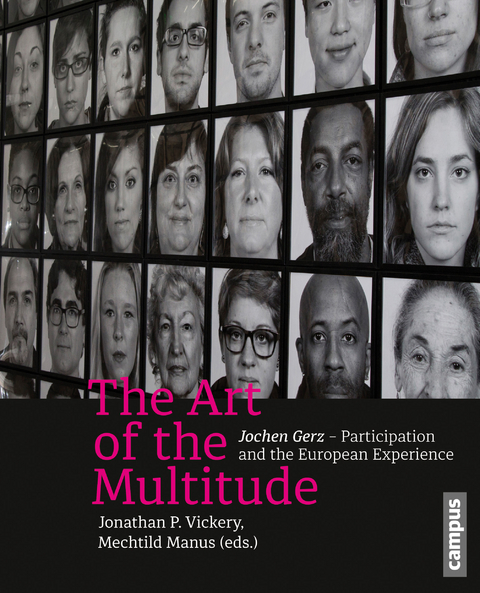
The Art of the Multitude
Jonathan P. Vickery forscht seit vielen Jahren zu Kunst, Stadtentwicklung und Kulturpolitik. Sein besonderes Interesse gilt den politischen und wirtschaftlichen Auswirkungen kultureller Entwicklung. Er lehrt am Centre for Cultural Policy Studies der Universität Warwick in Großbritannien und leitet dort das Masterprogramm Arts, Enterprise and Development. Mechtild Manus war für das Goethe-Institut in Lissabon, Alexandria, Jakarta, Montreal und Dublin tätig. Sie kuratierte partizipative Kunstprojekte in Indonesien, Kanada und Irland. Im November 2014 führte sie in Dublin am Irischen Museum für Moderne Kunst das erste internationale Symposium zu Jochen Gerz durch. Seit 2015 betreut sie den Schwerpunkt Kulturen der Partizipation in der Zentrale des Goethe-Instituts in München.
Contents
Introduction.7
Mechtild Manus and Jonathan P. Vickery
I. On Memory: Artists, Writing and Narratives, History and Testimony
The Artist as Facilitator of Civic Memory: Coventry's The Future Monument and The Public Bench.21
Jonathan P. Vickery
The Tiny Presence of Words.39
Philippe Mesnard
Countermonument in Europe: The Spatial Politics of Artistic Memory-Work.57
Zuzanna Dziuban
II. On Participation: Social Creativity, Culture and Democracy, Citizenship and Its Alternatives
As Art Disappears into Society.83
Hermann Pfütze
Public Authorship as a Multitude of Voices.103
Marion Hohlfeldt
Dissonant Memories and Subversive Memorialization Practices.117
Milena Dragi?evi? Sesi?
III. On Public Space: Cities, Architecture, and Politics
Taking People as They Are and Europe as It Might Be: The Controversy over the Square of the European Promise.137
Volker M. Heins
Civic Remembrance and the Politics of Place.153
Malcolm Miles
Absorbing Disturbances: The Heterotopia as a Model for Monumental Space.173
Niklas Maak
About the Authors.189
Acknowledgements .191
Copyright and Photography Credits.193
Index Works by Jochen Gerz.196
Index Names and Terms.197
Introduction
Mechtild Manus and Jonathan P. Vickery
Jochen Gerz is widely recognized today as one of the principal artists of the public realm in Europe. In this volume, ten authors of very different backgrounds explore the power of participation for the formation of public memory, examine conflicts at the intersection of art, politics, and civic life, and extend our understanding of Jochen Gerz's work to encompass questions on European identity, history, and unity.
This volume was initially inspired by a symposium on Jochen Gerz' work that took place in Dublin in the autumn of 2014. The symposium generated an intense debate on participation, commemoration, and public space, and was acutely relevant to issues facing the Republic of Ireland at the time and continue to face Europe. What do we commemorate, and how? What role does democracy play in memory-making? How does the public participate in official decision-making on commemoration and memorialization in public space?
In this volume we have used the term multitude in the title of the book-a biblical term meaning the many, the undefined, a heterogeneous mixed society-and we use it as a conceptual marker for the public, which for Jochen Gerz is subject, partner, participant, collaborator, contributor, artistic material, and always a contested term. Mobilized by the process of collaborative production that Jochen Gerz offers with his artworks, new forms of agency and identity emerge (Kester 2011), if always outside any preconceived template on what constitutes a politically acceptable or representative public. The term multitude, therefore, serves to evoke a more plural and experiential means of defining collective agency within social life (Virno 2004). We do not use it in the prevailing meaning, defined by Antonio Negri as the masses, the working class, the community, or the revolutionary elite: only in one sense can we agree with Negri when he claims that "each subjectivity...realizes itself in its singularity, through the acting of the multitude." (Negri 2001, 97)
The participants, collaborators and observers in Gerz's projects are characterized by social diversity (but where social diversity is never one unproblematic category that achieves a guaranteed democratic legitimacy). The graffiti of the Monument Against Fascism (Mahnmal gegen Faschismus, 1986) in Hamburg-Harburg (Germany) showed the antifascist next to the Neo-Nazi; the inscriptions of The Public Bench (1999-2004) in Coventry (UK) brought together citizens that would otherwise never speak to each other; random passers-by in the pedestrian zone in Bochum (Germany) subscribed to the Square of the European Promise (Platz des europäischen Versprechens, 2004-2015); the 78 participants of 2-3 Streets: An Exhibition in Cities of the Ruhr Area (2-3 Straßen. Eine Ausstellung in Städten des Ruhrgebiets, 2008-2010) consisted of young men and women searching for meaning of life, along with a rebellious curator, a philo-muslim critic of Islam and all kinds of other people, regardless of nationality, religion, political affiliation or class. Jochen Gerz is facilitator and orchestrator who co-joins them in ways that demand that each subject confronts her own social agency, as well as ingrained patterns of thought and prejudices (Rebentisch 2014, 71).
All the essays in this volume are concerned with the art of Jochen Gerz, but necessarily extend to examples of related works by artists in other European countries, and as contemporary art is now a global economy of meaning, beyond Europe. The volume is divided into three sections, where the section on participation is deliberately framed between memory and public space. Participation is thus central but not as a political principle of mobilization in support of pre-packaged or partisan choices. Participation in this volume features as a collective commitment to facing and determining questions, learning how to generate public dialogue, and
| Erscheinungsdatum | 06.06.2016 |
|---|---|
| Co-Autor | Söke Dinkla, Milena Dragicevic Sesic, Zuzanna Dziuban, Volker M. Heins, Marion Hohlfeldt, Niklas Maak, Philippe Mesnard, Malcolm Miles, Krzysztof Nawratek |
| Zusatzinfo | ca. 50 farbige Abbildungen |
| Verlagsort | Weinheim |
| Sprache | englisch |
| Maße | 172 x 212 mm |
| Gewicht | 466 g |
| Themenwelt | Kunst / Musik / Theater ► Allgemeines / Lexika |
| Sozialwissenschaften | |
| Schlagworte | Demokratie • Europa • Gerz, Jochen • Intervention • Jochen Gerz • Kultursoziologie (Cultural Studies) • Kunst • Kunst im öffentlichen Raum • Kunst im öffentlichen Raum / Urban Art • Öffentlicher Raum • Öffentlichkeit • Partizipation • urbaner Raum |
| ISBN-10 | 3-593-50564-9 / 3593505649 |
| ISBN-13 | 978-3-593-50564-0 / 9783593505640 |
| Zustand | Neuware |
| Informationen gemäß Produktsicherheitsverordnung (GPSR) | |
| Haben Sie eine Frage zum Produkt? |
aus dem Bereich


