


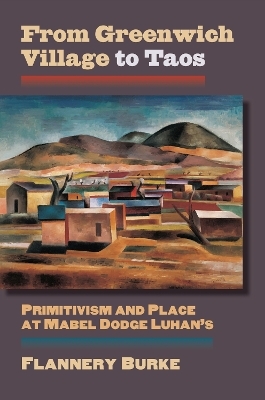
From Greenwich Village to Taos
Primitivism and Place at Mabel Dodge Luhan's
Seiten
2016
University Press of Kansas (Verlag)
978-0-7006-2236-8 (ISBN)
University Press of Kansas (Verlag)
978-0-7006-2236-8 (ISBN)
They all came to Taos: Georgia O'Keefe, D. H. Lawrence, Carl Van Vechten, and other expatriates of New York City. Fleeing urban ugliness, they moved west between 1917 and 1929 to join the community that art patron Mabel Dodge created in her Taos salon and to draw inspiration from New Mexico's mountain desert and ""primitive"" peoples. As they settled, their quest for the primitive forged a link between ""authentic"" places and those who called them home.
In this first book to consider Dodge and her visitors from a New Mexican perspective, Flannery Burke shows how these cultural mavens drew on modernist concepts of primitivism to construct their personal visions and cultural agendas. In each chapter she presents a place as it took shape for a different individual within Dodge's orbit. From this kaleidoscope of places emerges a vision of what place meant to modernist artists—as well as a narrative of what happened in the real place of New Mexico when visitors decided it was where they belonged. Expanding the picture of early American modernism beyond New York's dominance, she shows that these newcomers believed Taos was the place they had set out to find—and that when Taos failed to meet their expectations, they changed Taos.
Throughout, Burke examines the ways notions of primitivism unfolded as Dodge's salon attracted artists of varying ethnicities and the ways that patronage was perceived-by African American writers seeking publication, Anglos seeking ""authentic"" material, Native American artists seeking patronage, or Nuevomexicanos simply seeking respect. She considers the notion of ""competitive primitivism,"" especially regarding Carl Van Vechten, and offers nuanced analyses of divisions within northern New Mexico's arts communities over land issues and of the ways in which Pueblo Indians spoke on their own behalf.
Burke's book offers a portrait of a place as it took shape both aesthetically in the imaginations of Dodge's visitors and materially in the lives of everyday New Mexicans. It clearly shows that no people or places stand outside the modern world—and that when we pretend otherwise, those people and places inevitably suffer.
In this first book to consider Dodge and her visitors from a New Mexican perspective, Flannery Burke shows how these cultural mavens drew on modernist concepts of primitivism to construct their personal visions and cultural agendas. In each chapter she presents a place as it took shape for a different individual within Dodge's orbit. From this kaleidoscope of places emerges a vision of what place meant to modernist artists—as well as a narrative of what happened in the real place of New Mexico when visitors decided it was where they belonged. Expanding the picture of early American modernism beyond New York's dominance, she shows that these newcomers believed Taos was the place they had set out to find—and that when Taos failed to meet their expectations, they changed Taos.
Throughout, Burke examines the ways notions of primitivism unfolded as Dodge's salon attracted artists of varying ethnicities and the ways that patronage was perceived-by African American writers seeking publication, Anglos seeking ""authentic"" material, Native American artists seeking patronage, or Nuevomexicanos simply seeking respect. She considers the notion of ""competitive primitivism,"" especially regarding Carl Van Vechten, and offers nuanced analyses of divisions within northern New Mexico's arts communities over land issues and of the ways in which Pueblo Indians spoke on their own behalf.
Burke's book offers a portrait of a place as it took shape both aesthetically in the imaginations of Dodge's visitors and materially in the lives of everyday New Mexicans. It clearly shows that no people or places stand outside the modern world—and that when we pretend otherwise, those people and places inevitably suffer.
Flannery Burke is associate professor of history at St. Louis University.
| Erscheinungsdatum | 01.03.2016 |
|---|---|
| Reihe/Serie | CultureAmerica |
| Zusatzinfo | 8 page color insert |
| Verlagsort | Kansas |
| Sprache | englisch |
| Maße | 152 x 228 mm |
| Gewicht | 378 g |
| Themenwelt | Literatur ► Biografien / Erfahrungsberichte |
| Kunst / Musik / Theater ► Kunstgeschichte / Kunststile | |
| Geisteswissenschaften ► Geschichte ► Regional- / Ländergeschichte | |
| Geschichte ► Teilgebiete der Geschichte ► Kulturgeschichte | |
| Sozialwissenschaften ► Soziologie | |
| ISBN-10 | 0-7006-2236-5 / 0700622365 |
| ISBN-13 | 978-0-7006-2236-8 / 9780700622368 |
| Zustand | Neuware |
| Informationen gemäß Produktsicherheitsverordnung (GPSR) | |
| Haben Sie eine Frage zum Produkt? |
Mehr entdecken
aus dem Bereich


aus dem Bereich
Die Revolution des Gemeinen Mannes
Buch | Softcover (2024)
C.H.Beck (Verlag)
CHF 16,80
Eine Geschichte des Geschmacks
Buch | Hardcover (2025)
C.H.Beck (Verlag)
CHF 49,95


