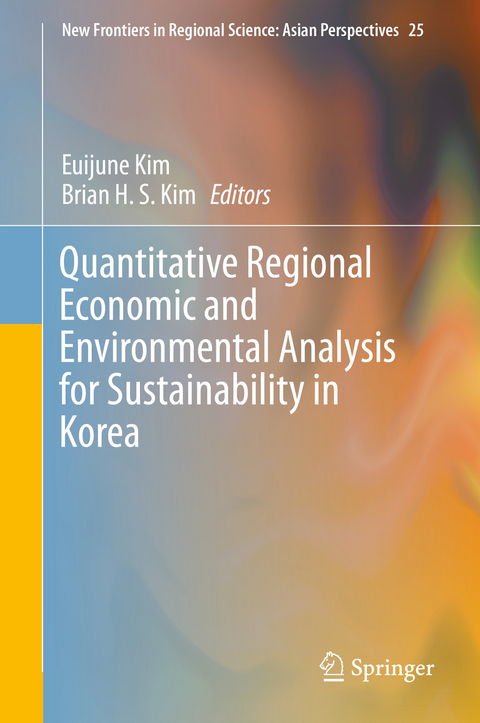
Quantitative Regional Economic and Environmental Analysis for Sustainability in Korea
Springer Verlag, Singapore
978-981-10-0298-4 (ISBN)
Euijune Kim is a Professor in the Department of Agricultural Economics and Rural Development, Seoul National University. He received his PhD in Regional Science at Cornell University in 1991. He specializes in the areas of Regional Economics, Infrastructure Policy, and CGE modelling. He has received numerous awards with his extensive research publications in journals, research monographs and edited volumes. He also served as an editor for several journals, including the Annals of Regional Science and International Journal of Urban Sciences and as the President of the Korean Regional Science Association. Brian Hong Sok Kim is a Professor in the Department of Agricultural Economics and Rural Development, Seoul National University. He received his PhD in Regional Science at Cornell University in 2003. He specializes in the areas of Sustainable Regional Development, Environment Economics, Economic Valuation, Agricultural and Environmental Risk Assessment, andEconometric Theory and Application. He has published numerous research articles, in both English and Korean, at highly ranked scholarly journals. He currently serves as an associate editor at International Journal of Urban Science and vice president at the Korean Regional Science Association and the Korean Society of Rural Planning.
Part 1. Sustainability and Regional labor Market.- 1. The Role of Cities in Sustainability Transitions: New Perspectives for Science and Policy.- 2. Exploring the Geography of Educational Segregation in Seoul, Korea.- 3. Labor Market Distortion with Discouraged Worker Effects in Korea.- Part 2. Industrial Agglomeration and Regional Policies.- 4Innovation of ICT Manufacturing and Agglomeration Economies: Evolution over the Life Cycle.- 5. Spatial Agglomeration and Firm Performance.- 6. Impact of Local Government Monetary and Fiscal Policies on Output Growth of Firms.- Part 3. Disaster and Impact Analysis.- 7. Assessment of Community Vulnerability to Natural Disasters in Korea by using GIS and Machine Learning Techniques.- 8.Indirect Impact of Nuclear Power Plant Accidents Using an Integrated Spatial Computable-General Equilibrium Model with a Microsimulation Module on the Korean Transportation Network.- 9. A New Framework to Quantifying the Economic Impacts of Cyber-Attacks on Aviation Systems: A Korean Game-Theoretic Interregional Economic Model.- Part 4. Environmental Sustainability and Policies.- 10. Effects of Urban Spatial structure on Travel Behavior and Transportation Energy Efficiency in Korea.- 11. Need for Coordination between Greenhouse Gas and Pollution Abatement Regulations: China’s Case and Its Implications for Korea.- 12. Effects of the Project Investments and Valuation of the Water Quality Improvement of the River Taehwa in Ulsan, Korea.- 13. Trade and Environmental Responsibility for Greenhouse Gas Emissions: The Case of South Korea.
| Erscheinungsdatum | 26.11.2016 |
|---|---|
| Reihe/Serie | New Frontiers in Regional Science: Asian Perspectives ; 25 |
| Zusatzinfo | 14 Illustrations, color; 28 Illustrations, black and white; X, 243 p. 42 illus., 14 illus. in color. |
| Verlagsort | Singapore |
| Sprache | englisch |
| Maße | 155 x 235 mm |
| Themenwelt | Naturwissenschaften ► Biologie ► Ökologie / Naturschutz |
| Sozialwissenschaften ► Soziologie ► Spezielle Soziologien | |
| Technik ► Umwelttechnik / Biotechnologie | |
| Wirtschaft ► Volkswirtschaftslehre ► Wirtschaftspolitik | |
| Schlagworte | Development and Environment • Economic valuation • Human Capital • Regional economic analysis • sustainable development |
| ISBN-10 | 981-10-0298-3 / 9811002983 |
| ISBN-13 | 978-981-10-0298-4 / 9789811002984 |
| Zustand | Neuware |
| Informationen gemäß Produktsicherheitsverordnung (GPSR) | |
| Haben Sie eine Frage zum Produkt? |
aus dem Bereich