


How Germany Unified and the EU Enlarged (eBook)
XVIII, 235 Seiten
Palgrave Macmillan UK (Verlag)
978-1-137-47761-3 (ISBN)
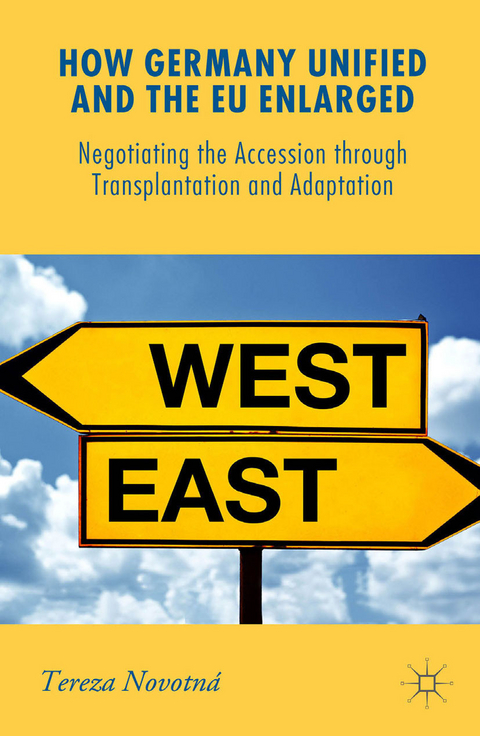
Based on original empirical research that includes 90 interviews with key leaders, this book compares and contrasts negotiations during the processes of German unification and Eastern enlargement of the EU, with particular attention to the Czech Republic. It develops two models of political integration and suggests that such integration can take place by means of a take-over (Transplantation), or by the joining entity adjusting to the norms and institutions of the accepting party (Adaptation). In addition to an exploration of these two different models and a detailed examination of the two cases, the book points to other historical examples of Transplantation and Adaptation and formulates lessons for where future research might travel, temporarily and geographically, in the cases of other political integrations. Providing new insights into German unification and European integration, this text is key reading for academics, advanced undergraduate and graduate students in EU Politics,as well as policy-makers and the wider public.
Tereza Novotná is an FNRS Post-Doctoral Researcher at Université Libre de Bruxelles, Belgium. She received her doctorate from Boston University and has held various visiting fellowships in the US, UK, Germany and Austria. She has widely published on various aspects of EU politics, especially EU foreign policy, transatlantic relations and the politics of Germany and Central and Eastern Europe.
TABLE OF CONTENTS LIST OF TABLES LIST OF FIGURES ACKNOWLEDGEMENTS LIST OF ABBREVIATIONS 1 CHAPTER 1: POLITICAL INTEGRATION IN EUROPE AFTER 1989: AN INTRODUCTION 1.1 MAIN AIMS AND THEMES OF THE BOOK 1.2 NATURE OF THE RESEARCH AND METHODOLOGY OF THE BOOK 1.3 STRUCTURE OF THE BOOK 2 CHAPTER 2: TRANSPLANTATION AND ADAPTATION MODELS OF POLITICAL INTEGRATION: A THEORETICAL FRAMEWORK 2.1 THEORETICAL FRAMEWORK I: GENERAL CHARACTERISTICS OF TWO MODELS OF POLITICAL INTEGRATION 11 2.1.1 Speed and Timing of the Transplantation Model of Political Integration 2.1.2 Strong Leadership and Procedural Character of the Transplantation Model of Political Integration 2.1.3 Speed and Conditionality of the Adaptation Model of Political Integration 2.1.4 Bureaucratic Leadership and Consensual Character of the Adaptation Model of Political Integration 2.2 THEORETICAL FRAMEWORK II: PROCESSES OF TWO MODELS OF POLITICAL INTEGRATION 2.2.1 Institutional, Economic, and Elite Transfers as the Basis for Implementing the Transplantation Model of Political Integration 2.2.2 Institutional, Economic, and Elite Building as the Basis for Implementing the Adaptation Model of Political Integration 2.3 SPEED AND IMPACT OF THE DOMESTIC ACTORS: TWO MAIN DISTINGUISHING FEATURES OF THE TWO MODELS OF POLITICAL INTEGRATION 2.4 CONCLUSION 3 CHAPTER 3: THE UNIFICATION OF GERMANY: A CASE OF THE TRANSPLANTATION MODEL OF POLITICAL INTEGRATION 3.1 THE TRANSPLANTATION MODEL OF POLITICAL INTEGRATION CLARIFIED: SPEED AND IMPACT OF THE DOMESTIC ACTORS DURING THE UNIFICATION OF GERMANY 3.2 TEARING DOWN THE BERLIN WALL: DEMOCRATIZATION VS. INTEGRATION 3.2.1 Local Actors I: Masses 3.2.2 Local Actors II: The Reform Communists 3.2.3 The Wall and Kohl: the External Actors 3.2.4 Local Actors III: The Opposition 3.2.5 'Vor der Einheit kam die Freiheit' (Gauck) 3.3 THE 10 POINT PROGRAM ENTER KOHL : A STRONG LEADER IN CHARGE 3.4 THE MARCH 1990 VOLKSKAMMER ELECTIONS: TRANSPLANTING THE PARTY SYSTEM 3.4.1 The Unification of the CDU and the Allianz für Deutschland 3.4.2 Campaign 3.4.3 Results 3.4.4 Formation of the New East German Government 3.5 ECONOMIC AND MONETARY UNION AND THE STATE TREATY PUTTING THE FOOT ON THE GAS: TRANSPLANTING THE ECONOMICS 3.5.1 Key drivers of the process 3.5.2 Key Decisions 3.5.3 The Consequences of the Economic Transplantation 3.6 GERMAN UNIFICATION ACT I: CONCLUSION 4 CHAPTER 4: NEGOTIATING THE EAST GERMAN ACCESSION: ACT II OF GERMAN UNIFICATION 4.1 ELECTIONS AND UNIFICATION: DISPUTES OVER DATES AND LAWS 4.2 NEGOTIATIONS 4.3 MISSED AND TAKEN OPPORTUNITIES: THE IMPACT OF THE EAST ON THE NEGOTIATIONS 4.4 MORE INTERNATIONAL NEGOTIATIONS, EVEN LESS IMPACT 4.5 GERMAN UNIFICATION ACT II: CONCLUSION 5 CHAPTER 5: EASTERN ENLARGEMENT OF THE EU: A CASE OF THE ADAPTATION MODEL OF POLITICAL INTEGRATION 5.1 THE ADAPTATION MODEL OF POLITICAL INTEGRATION CLARIFIED: A SLOWER AND VARIABLE SPEED AND HIGHER IMPACT OF THE DOMESTIC ACTORS DURING THE EASTERN ENLARGEMENT OF THE EU 5.2 THE WINDS OF CHANGE AND RETURN TO EUROPE: AN OVERTURE TO THE ENLARGEMENT 5.3 COPENHAGEN CRITERIA: A FOUR-POINT PROGRAM OF POLITICAL CONDITIONALITY 5.4 FROM COPENHAGEN TO NICE VIA LUXEMBOURG AND HELSINKI: ADAPTING TO THE PROSPECT OF ENLARGEMENT 5.5 THE COMMISSION AND PRE-ACCESSION PROGRAMS: FINANCING AND ASSESSING THE INSTITUTION BUILDING 5.6 EU EASTERN ENLARGEMENT ACT I: CONCLUSION 6 CHAPTER 6: NEGOTIATING THE CZECH ACCESSION TO THE EU: ACT II OF EU EASTERN ENLARGEMENT 6.1 THE NEGOTIATIONS, THEIR STRUCTURES, AND THE IMPACT OF THE ENTERING COUNTRIES 6.1.1 Power Asymmetry of the EU Accession Negotiations 6.1.2 Negotiations at the Accepting EU Side 6.1.3 Structure of Negotiations 6.1.4 Role of the Rotating Presidency and the Commission During Negotiations 6.1.5 The Applicants' Chief Negotiators 6.1.6 Negotiating Tactics 6.2 COORDINATING THE CZECH POSITION AT HOME AND ABROAD 6.2.1 Coordination at Home 6.2.2 Coordination Abroad 6.3 POLITICAL VS. TECHNICAL ISSUES 6.3.1 Negotiating the Technical Issues: Chapters and Transition Periods 6.3.2 Negotiating the Political Issues: Temelín and Bene Decrees 6.4 THE COPENHAGEN SUMMIT AND ITS AFTERMATH 6.4.1 Negotiating at the Copenhagen Summit 6.4.2 Negotiating the EU Accession at Home 6.5 EU EASTERN ENLARGEMENT ACT II: CONCLUSION 7 CHAPTER 7: EVALUATING THE UNIFICATION OF GERMANY AND THE EASTERN ENLARGEMENT OF THE EU 7.1 WE THE PEOPLE: THE PUBLIC'S EVALUATION OF POLITICAL INTEGRATION 7.2 THE VIEW FROM THE TOP: THE ELITES' EVALUATION OF POLITICAL INTEGRATION 7.3 CONCLUSION 8 CHAPTER 8: LESSONS LEARNED FROM THE TRANSPLANTATION AND ADAPTATION MODELS OF POLITICAL INTEGRATION: A CONCLUSION LIST OF INTERVIEWS: THE UNIFICATION OF GERMANY EASTERN ENLARGEMENT OF THE EU BIBLIOGRAPHY
| Erscheint lt. Verlag | 5.10.2015 |
|---|---|
| Reihe/Serie | New Perspectives in German Political Studies | New Perspectives in German Political Studies |
| Zusatzinfo | XVIII, 235 p. |
| Verlagsort | London |
| Sprache | englisch |
| Themenwelt | Sozialwissenschaften ► Politik / Verwaltung ► Europäische / Internationale Politik |
| Sozialwissenschaften ► Politik / Verwaltung ► Politische Systeme | |
| Sozialwissenschaften ► Politik / Verwaltung ► Staat / Verwaltung | |
| Schlagworte | communism • Democracy • Democratization • desegregation • EU Accession • EU Eastern Enlargement • Europe • European Union (EU) • European Union Politics • Germany • Government • Institution • Integration • International Negotiation • Policy • Volkskammer |
| ISBN-10 | 1-137-47761-X / 113747761X |
| ISBN-13 | 978-1-137-47761-3 / 9781137477613 |
| Informationen gemäß Produktsicherheitsverordnung (GPSR) | |
| Haben Sie eine Frage zum Produkt? |
 PDF (Wasserzeichen)
DRM: Digitales Wasserzeichen
Dieses eBook enthält ein digitales Wasserzeichen und ist damit für Sie personalisiert. Bei einer missbräuchlichen Weitergabe des eBooks an Dritte ist eine Rückverfolgung an die Quelle möglich.
Dateiformat: PDF (Portable Document Format)
Mit einem festen Seitenlayout eignet sich die PDF besonders für Fachbücher mit Spalten, Tabellen und Abbildungen. Eine PDF kann auf fast allen Geräten angezeigt werden, ist aber für kleine Displays (Smartphone, eReader) nur eingeschränkt geeignet.
Systemvoraussetzungen:
PC/Mac: Mit einem PC oder Mac können Sie dieses eBook lesen. Sie benötigen dafür einen PDF-Viewer - z.B. den Adobe Reader oder Adobe Digital Editions.
eReader: Dieses eBook kann mit (fast) allen eBook-Readern gelesen werden. Mit dem amazon-Kindle ist es aber nicht kompatibel.
Smartphone/Tablet: Egal ob Apple oder Android, dieses eBook können Sie lesen. Sie benötigen dafür einen PDF-Viewer - z.B. die kostenlose Adobe Digital Editions-App.
Buying eBooks from abroad
For tax law reasons we can sell eBooks just within Germany and Switzerland. Regrettably we cannot fulfill eBook-orders from other countries.


