Zum Hauptinhalt springen
Nicht aus der Schweiz? Besuchen Sie lehmanns.de
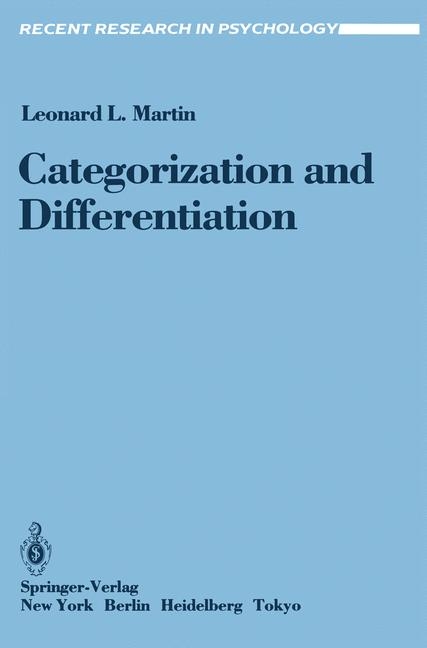
Categorization and Differentiation -  Leonard L. Martin

Categorization and Differentiation (eBook)

A Set, Re-Set, Comparison Analysis of the Effects of Context on Person Perception
eBook Download: PDF
2012
Springer New York (Verlag)
9781461251224 (ISBN)
Systemvoraussetzungen
109,34 inkl. MwSt
(CHF 106,80)
Der eBook-Verkauf erfolgt durch die Lehmanns Media GmbH (Berlin) zum Preis in Euro inkl. MwSt.
  • Download sofort lieferbar
  • Zahlungsarten anzeigen
In the context of interpersonal interaction, it is possible to characterize human beings as complex sources of information. When interacting with one another, people in- tentionally, as well as unintentionally, emit cues which other people can use as a basis for generating inferences and forming impressions about them. As a rule, the informa- tion that one receives about another person is complex, mutable, and multidimensional. Often, it is contradictory. One of the more enduring lines of investigation in social psychology has been concerned with understanding the processes whereby people mold such diverse information into a single, unified impression. The linear approach The most influential approach to this issue in recent years has been Anderson's information integration theory (e. g. , Anderson, 1974). The goal of this approach to im- pression formation is the formulation of an algebraic model which describes the relation between stimulus input charac- teristics and reported judgments. According to information integration theory, a stimulus is characterized hy two parameters: scale value and weight. The scale value of a stimulus represents the perceiver's subjective response to the information on the dimension of judgment (e. g. , good-bad, light-heavy, like-dislike). The weight of a stimulus is its importance or relevance to the judgment. It is perhaps best conceptualized as the proportion that each element of a compound stimulus contributes to the overall evaluation of the compound.
PDFPDF (Adobe DRM)

Kopierschutz: Adobe-DRM
Adobe-DRM ist ein Kopierschutz, der das eBook vor Mißbrauch schützen soll. Dabei wird das eBook bereits beim Download auf Ihre persönliche Adobe-ID autorisiert. Lesen können Sie das eBook dann nur auf den Geräten, welche ebenfalls auf Ihre Adobe-ID registriert sind.
Details zum Adobe-DRM

Dateiformat: PDF (Portable Document Format)
Mit einem festen Seiten­layout eignet sich die PDF besonders für Fach­bücher mit Spalten, Tabellen und Abbild­ungen. Eine PDF kann auf fast allen Geräten ange­zeigt werden, ist aber für kleine Displays (Smart­phone, eReader) nur einge­schränkt geeignet.

Systemvoraussetzungen:
PC/Mac: Mit einem PC oder Mac können Sie dieses eBook lesen. Sie benötigen eine Adobe-ID und die Software Adobe Digital Editions (kostenlos). Von der Benutzung der OverDrive Media Console raten wir Ihnen ab. Erfahrungsgemäß treten hier gehäuft Probleme mit dem Adobe DRM auf.
eReader: Dieses eBook kann mit (fast) allen eBook-Readern gelesen werden. Mit dem amazon-Kindle ist es aber nicht kompatibel.
Smartphone/Tablet: Egal ob Apple oder Android, dieses eBook können Sie lesen. Sie benötigen eine Adobe-ID sowie eine kostenlose App.
Geräteliste und zusätzliche Hinweise

Buying eBooks from abroad
For tax law reasons we can sell eBooks just within Germany and Switzerland. Regrettably we cannot fulfill eBook-orders from other countries.

Mehr entdecken
aus dem Bereich