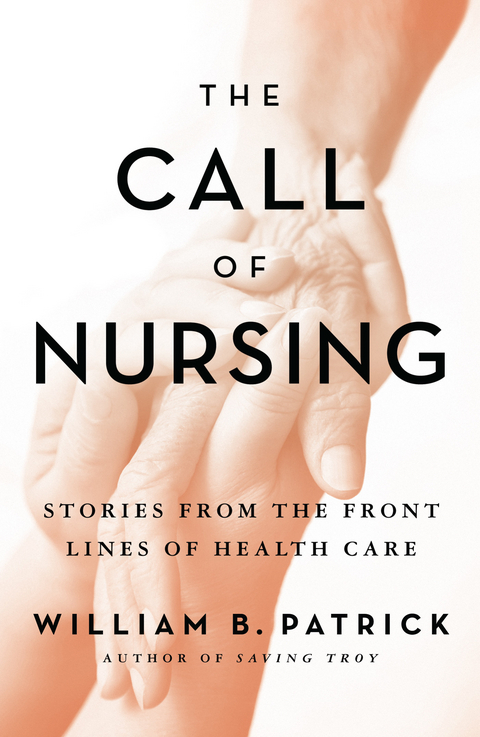
The Call of Nursing : Stories from the Front Lines of Health Care (eBook)
234 Seiten
Hudson Whitman/ Excelsior College Press (Verlag)
978-0-9898451-9-9 (ISBN)
The Call of Nursing is not your typical book about nurses. In it, we go behind the curtain of silence that hangs across the profession. It lets us hear why nurses today do what they do, and allows those nurses to show us-in their own words-what has mattered most to them in their professional careers. A hospice nurse reveals the connection she develops to dying people. A medical missionary talks about using her skills as an RN, RT, and translator in Peru with CardioStart International. A labor & delivery nurse shares the rewards and challenges of caring for high-risk mothers and babies. A flight nurse describes the rigors of training in critical care and managing emotions, especially those that accompany pediatric trauma. An emergency and critical care nurse describes 9/11 as a rookie paramedic. A Navy nurse officer recalls caring for troops and villagers while serving in Iraq as a medic and nursing student. Also included are descriptions of the nontraditional routes each nurse took to achieve her or his educational and professional goals. The twenty-three intimate self-portraits in The Call of Nursing help us see more clearly the kinds of challenges nurses face and accept on a routine basis, and offer a rare glimpse into lives of women and men committed to care and service.
DR. COLLEEN WALSH
I have worked as a nurse on orthopedic units at Level I trauma centers in Boston, in Albany, New York, in Charlottesville, Virginia, and in Ann Arbor, Michigan, among other places, for over thirty years. I have also completed four nursing degrees while I was working full time and raising a family. In 2011, I earned my doctorate of nursing practice from the University of Southern Indiana, in Evansville, where I am currently an assistant professor of nursing.
I always knew I was going to be a nurse. There was never a time during my early schooling, elementary through high school, when I didn’t want to be one. There were absolutely no medical people in my family, so I don’t know where my inspiration came from. It was just something I innately felt I wanted to do, and I never wavered from that course. I guess I was born that way.
However, I was also born with knock knees. Knock knees are when your knees rub together but your feet point out. It’s the opposite of bowlegged. To make it worse, I was your typical chubby kid, and weight exacerbates that problem. My kneecaps would dislocate and at times it was very painful to walk. I had my first cast on when I was seven, and I went through my first major procedure in 1963, when I was only eleven. Over the course of my lifetime, I have undergone seven more surgical procedures to correct the problem. So I possessed a natural affinity for orthopedics because I knew what it was like to be on the other side of the cast.
When I was sixteen, after my second major procedure, a Nurse Ratched type took care of me. She made me cry every single day I was in the hospital. Now that I look back on it, though, she was probably doing what she was supposed to do. But it was the manner in which she did it. She was mean. She made fun of me and called me a baby. Even with that, I still wanted to join the profession, and I swore I would do everything I could to become the antithesis of that nurse.
On my first orthopedic rotation during nursing school, I immediately empathized with the patients. I understood the sheer magnitude of being stuck in that bed. I had experienced some of the mechanics of orthopedics, in terms of traction and weights and how they kept bones in place, and that certainly helped. I definitely knew what it felt like having little plaster crumbs under my butt, and getting a rash that drove me crazy, and how much it meant to have clean sheets. Those small things might sound unimportant, but they’re magnified into an incessant form of daily torture when you’re a patient.
There weren’t too many of us who specialized in orthopedics when I started working. As an orthopedic nurse, I was dedicated to alleviating pain and restoring function due to musculoskeletal injuries or disorders – anything related to a bone or a joint. I have taken care of the full spectrum, from someone with a simple broken finger to someone who was completely paralyzed and on a ventilator for five years. I also treated many people, whom we called multiple-trauma patients, who suffered a combination of fractures, chest injuries, and internal injuries. Usually the other injuries healed faster than the orthopedic ones. After they passed the crisis phase in the ICU, they would come to us. I had patients who rode motorcycles and hit guardrails and left part of their shinbones behind. Their shinbones hit so hard that they just splintered into pieces and we would have to rebuild them. That was a common injury.
Orthopedic practice is very different now. We have procedures and materials we didn’t have back then. We can insert artificial bone, or move bone from another part of the patient’s body to fill a defect. But back in the seventies and eighties, patients with severe orthopedic injuries stayed in the hospital for months. Then, more often than not, we would see them back many times over the course of several years because of complications from the original injury. In the early days, I got to know my patients pretty well.
Now we have new orthopedic pins and rods that can actually immobilize a fracture so well that patients don’t have to stay in a hospital for three or four months. They can go home in three or four days. The titanium rods we put in essentially do the job of the bone until it can heal naturally. Biologically, titanium is an inert compound, so it doesn’t cause allergic reactions and isn’t perceived by the body as a transplant. But normally these things are ultra-sterile. Unless there’s an infection present, patients tolerate them very well. If the titanium doesn’t bother a patient, we just leave it in there.
For my entire bedside career, I was fortunate enough to have worked exclusively at level I trauma centers where the sickest of the sick are found. I had exposure, every single day, to the most complex orthopedic injuries. I particularly remember one patient in Charlottesville, Virginia, in 1983. He was a twenty-five-year-old African American male who was working under his car when the blocks slipped. The engine shaft fell on his neck and severed his spinal cord at a point just below his brain. Luckily, he was close to a hospital when it happened, so he got immediate care and was placed on a ventilator. Back then, there was absolutely no nursing home or facility in the Commonwealth of Virginia that would take a patient on a ventilator. We couldn’t transfer him anywhere, and he remained on my floor for five years.
From day one, we knew his condition was static – that he would always remain the way he was. He was completely paralyzed from the neck down. He couldn’t breathe on his own. He couldn’t speak. He only had about one square inch of skin on his neck where he could still feel any sensation at all. He was totally dependent, under our care 24/7, and the key factor in nursing him was anticipation. If, for instance, he was sitting in a chair for an hour, he couldn’t feel that his butt was getting numb and pressure was building on his skin. We had to anticipate that and change his position. One of the things that we took pride in as nurses was that, for five years, this totally paralyzed man never once suffered from a bedsore.
I had been promoted to clinical head nurse on that ward and I was in charge of orienting all the new nurses. Every spring I would walk into that patient’s room and say, “Listen, Phil, I’ve got five newbies coming this summer. Do you mind if I let them take care of you to learn how a ventilator works?” He would just look at me and cluck, and that was his okay. He was so agreeable. I trained a legion of nurses on how to manage a patient like him. I also felt it was important to recognize him as a person who still possessed a measure of autonomy – that there was nothing wrong with his head, and that he could still make decisions.
After five years, he was actually transferred to a state facility in the Virginia Beach area, and he lived another four years there. Unfortunately, he suffered an acute episode of high blood pressure that caused a cerebral hemorrhage and he died. Now I can remember dozens of patients and very specific scenarios at different hospitals. I can even recall specific room numbers for certain patients. But to this day, Phil sticks in my mind as special.
My husband and I were still living in Charlottesville when I had our first child in 1985. I had been an orthopedic nurse for thirteen years at that point, and I loved my work, but I wanted some options in my career. I wanted to be able to walk into a good hospital and say I was qualified for a high-level clinical nursing job, Monday through Friday, with no work on weekends or holidays. So I went back to school. I found that studying independently was ideal for me, and I also discovered that I was good at distance education because I was focused and self-directed. I finished all of the requirements for my bachelor’s degree in April of 1988, but I couldn’t attend graduation because I had just given birth to our second child.
My husband was a surgeon, and he had received a cardiothoracic surgery fellowship at the University of Michigan. He was scheduled to start that in 1989, and we moved from Charlottesville to Ann Arbor that year. With my new BSN in hand, I really did walk in and say that I wanted a clinical nurse job, Monday through Friday. Well, the Chairman of Orthopedics in Virginia knew the Chairman of Orthopedics in Ann Arbor, and they conspired to help me. I was the first nurse who ever held a jointly funded appointment. I only had to work a Christmas holiday once, and I was on call just one weekend every six months.
When I was Clinical Care Coordinator in Trauma/Orthopedics at the University of Michigan Medical Center, we had a remarkable patient. I ended up publishing an article about him in a nursing journal and identified him by a pseudonym – Mr. Michael. He was sixty-three years old, with a twenty-year history of rheumatoid arthritis, and he was admitted with a debilitating neck deformity and venous stasis ulcers. Over the course of time, his neck had become so deformed that his right ear literally sat on his shoulder. We could lift his head about two inches, but he demonstrated no active cervical motion, and the change had occurred so gradually that his eyes had actually adjusted. If I had put my ear on my right shoulder, I would have been looking sideways. Mr. Michael’s eyes had moved so that, even with a cervical spine deformity clinically measuring ninety degrees, he was looking straight at us. That was a little unnerving, to say the least.
He obviously had a lot of problems swallowing, eating, and breathing, so we evaluated him to help straighten out...
| Erscheint lt. Verlag | 24.8.2013 |
|---|---|
| Sprache | englisch |
| Themenwelt | Geisteswissenschaften |
| Sozialwissenschaften ► Pädagogik ► Erwachsenenbildung | |
| ISBN-10 | 0-9898451-9-2 / 0989845192 |
| ISBN-13 | 978-0-9898451-9-9 / 9780989845199 |
| Informationen gemäß Produktsicherheitsverordnung (GPSR) | |
| Haben Sie eine Frage zum Produkt? |
 EPUB (Ohne DRM)
Größe: 1,8 MB
Digital Rights Management: ohne DRM
Dieses eBook enthält kein DRM oder Kopierschutz. Eine Weitergabe an Dritte ist jedoch rechtlich nicht zulässig, weil Sie beim Kauf nur die Rechte an der persönlichen Nutzung erwerben.
Dateiformat: EPUB (Electronic Publication)
EPUB ist ein offener Standard für eBooks und eignet sich besonders zur Darstellung von Belletristik und Sachbüchern. Der Fließtext wird dynamisch an die Display- und Schriftgröße angepasst. Auch für mobile Lesegeräte ist EPUB daher gut geeignet.
Systemvoraussetzungen:
PC/Mac: Mit einem PC oder Mac können Sie dieses eBook lesen. Sie benötigen dafür die kostenlose Software Adobe Digital Editions.
eReader: Dieses eBook kann mit (fast) allen eBook-Readern gelesen werden. Mit dem amazon-Kindle ist es aber nicht kompatibel.
Smartphone/Tablet: Egal ob Apple oder Android, dieses eBook können Sie lesen. Sie benötigen dafür eine kostenlose App.
Geräteliste und zusätzliche Hinweise
Buying eBooks from abroad
For tax law reasons we can sell eBooks just within Germany and Switzerland. Regrettably we cannot fulfill eBook-orders from other countries.
aus dem Bereich