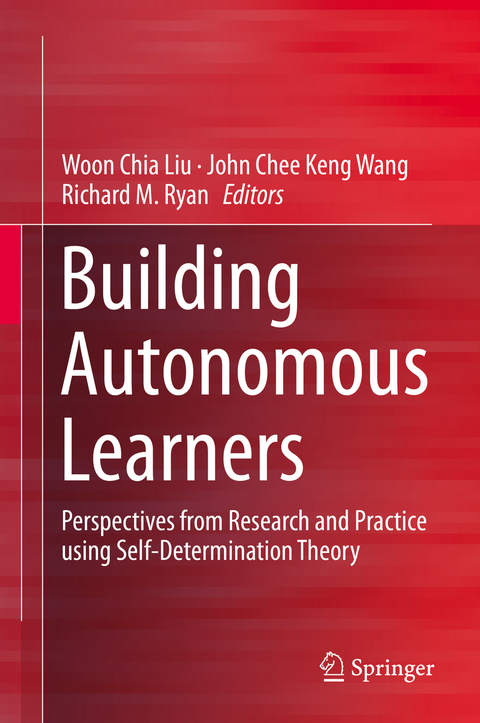
Building Autonomous Learners (eBook)
XVII, 302 Seiten
Springer Singapore (Verlag)
978-981-287-630-0 (ISBN)
A total of 15 chapters include some of the latest findings on theory and practical applications alike, prepared by internationally respected researchers in the field of motivation research in education. Each author provides his/her perspective and practical strategies on how to maximize motivation in the classroom. Individual chapters focus on theoretical and practical considerations, parental involvement, teachers' motivation, ways to create a self-motivating classroom, use of ICT, and nurturing a passion for learning.
The book will appeal to several different audiences: firstly, policymakers in education, school leaders and teachers will find it a valuable resource. Secondly, it offers a helpful guide for researchers and teacher educators in pre-service and postgraduate teacher education programmes. And thirdly, parents who want to help their children pursue lifelong learning will benefit from reading this book.
C. K. John Wang, Ph.D. is a Professor in the Physical Education and Sports Science Academic Group at the National Institute of Education, Nanyang Technological University in Singapore. He received his Ph.D. (Sport and Exercise Psychology) in 2001 from Loughborough University. Dr Wang is a Chartered Psychologist and an associate fellow of British Psychological Society. He is registered with the Health Professions Council of UK as a Sport and Exercise Psychologist. He leads the Motivation in Educational Research Lab (MERL) in NIE. His areas of research lie in the area of achievement motivation, talent development environment, self-regulation, and statistical analyses.
Woon-Chia Liu is the Dean of Teacher Education at the National Institute of Education, Singapore. She is also an associate professor with the Psychological Studies Academic Group and a founding member of NIE's Motivation in Educational Research Laboratory. Currently, she is the President of the Educational Research Association of Singapore. She represents Singapore in the World Education Research Association (WERA) Council. Her research interests include motivation, clinical practice, mentoring, e-portfolio, as well as innovative teaching strategies such as problem-based learning.
Richard M. Ryan, Ph.D., is Professor at the Institute for Positive Psychology and Education at the Australian Catholic University and a Research Professor in Psychology at the University of Rochester. Ryan is a widely published researcher and theorist with over three hundred papers and books in the areas of human motivation, personality, and psychological well-being. He is co-developer of Self-Determination Theory, a theory of human motivation that has been internationally researched and applied. He is a Fellow of the American Psychological Association, the American Educational Research Association, and an Honorary Member of the German Psychological Society (DGP).
This edited work presents a collection of papers on motivation research in education around the globe. Pursuing a uniquely international approach, it also features selected research studies conducted in Singapore under the auspices of the Motivation in Educational Research Lab, National Institute of Education, Singapore.A total of 15 chapters include some of the latest findings on theory and practical applications alike, prepared by internationally respected researchers in the field of motivation research in education. Each author provides his/her perspective and practical strategies on how to maximize motivation in the classroom. Individual chapters focus on theoretical and practical considerations, parental involvement, teachers' motivation, ways to create a self-motivating classroom, use of ICT, and nurturing a passion for learning.The book will appeal to several different audiences: firstly, policymakers in education, school leaders and teachers will find it a valuable resource. Secondly, it offers a helpful guide for researchers and teacher educators in pre-service and postgraduate teacher education programmes. And thirdly, parents who want to help their children pursue lifelong learning will benefit from reading this book.
C. K. John Wang, Ph.D. is a Professor in the Physical Education and Sports Science Academic Group at the National Institute of Education, Nanyang Technological University in Singapore. He received his Ph.D. (Sport and Exercise Psychology) in 2001 from Loughborough University. Dr Wang is a Chartered Psychologist and an associate fellow of British Psychological Society. He is registered with the Health Professions Council of UK as a Sport and Exercise Psychologist. He leads the Motivation in Educational Research Lab (MERL) in NIE. His areas of research lie in the area of achievement motivation, talent development environment, self-regulation, and statistical analyses. Woon-Chia Liu is the Dean of Teacher Education at the National Institute of Education, Singapore. She is also an associate professor with the Psychological Studies Academic Group and a founding member of NIE’s Motivation in Educational Research Laboratory. Currently, she is the President of the Educational Research Association of Singapore. She represents Singapore in the World Education Research Association (WERA) Council. Her research interests include motivation, clinical practice, mentoring, e-portfolio, as well as innovative teaching strategies such as problem-based learning.Richard M. Ryan, Ph.D., is Professor at the Institute for Positive Psychology and Education at the Australian Catholic University and a Research Professor in Psychology at the University of Rochester. Ryan is a widely published researcher and theorist with over three hundred papers and books in the areas of human motivation, personality, and psychological well-being. He is co-developer of Self-Determination Theory, a theory of human motivation that has been internationally researched and applied. He is a Fellow of the American Psychological Association, the American Educational Research Association, and an Honorary Member of the German Psychological Society (DGP).
Foreword 6
Acknowledgement 8
Contents 10
Contributors 12
About the Editors 18
Chapter 1: Understanding Motivation in Education: Theoretical and Practical Considerations 19
Chapter 2: Optimizing Students’ Motivation in the Era of Testing and Pressure: A Self-Determination Theory Perspective 26
An Autonomy-Supportive Approach 27
Intrinsic Motivation 29
Classroom Climates 29
Autonomous Extrinsic Motivation 31
Basic Needs, Integration, and Autonomy 32
Need Satisfaction, Autonomous Motivation, Learning, and Wellness 33
Goals and Motives 34
Achievement Goals and Autonomous Motives 35
Intrinsic and Extrinsic Goals 36
SDT in the Classroom: Supporting Basic Psychological Needs 37
What Teachers Need 39
Conclusion 41
References 42
Chapter 3: The Dualistic Model of Passion: Theory, Research, and Implications for the Field of Education 47
On the Concept of Passion 48
The Dualistic Model of Passion 49
Research on Passion 51
Initial Research on the Concept of Passion and the DMP 51
Passion and Psychological Well-Being 53
Passion and Physical Health 57
Passion and Performance 60
Passion and Interpersonal Relationships 62
On the Development of Passion 65
Conclusions 69
References 70
Chapter 4: Toward a Systematic Study of the Dark Side of Student Motivation: Antecedents and Consequences of Teachers’ Controlling Behaviors 75
Understanding the Processes Underlying Students’ Maladaptive Motivational Functioning 76
Distinguishing Between Need Satisfaction and Need Frustration 76
The Distinct Role of Experiences of Need Frustration 77
Need-Thwarting Teaching 78
Conceptualization 78
Effects of Controlling Teaching 80
Observing Controlling Teaching 83
Antecedents of Controlling Teaching 86
Controlling Teaching: Future Directions 89
Conclusion: A Helicopter View 91
Practical Recommendations 91
References 93
Chapter 5: How Can We Create Better Learning Contexts for Children? Promoting Students’ Autonomous Motivation as a Way to Foster Enhanced Educational Outcomes 98
Measuring School Motivation 99
Fostering Learning and Academic Achievement 102
Behavioral Outcomes 102
Cognitive Outcomes 105
Affective Outcomes 106
Academic Motivation: A Student-Centered Approach 106
Determinants of Academic Motivation: The Role of Parents, Teachers, and Peers 107
Autonomy Support Provided by Parents 108
Autonomy Support Provided by Teachers 109
Combined Assessment of Autonomy Support Provided by Parents and Teachers 110
Autonomy Support Provided by Peers 111
School Intervention Programs 111
Conclusion: Practical Implications for Teachers and Future Perspectives 114
References 115
Chapter 6: Teachers’ Motivation in the Classroom 122
Introduction 122
Putting the Educational Context in Context 123
Self-Determination Theory: A Brief Overview 124
Contextual Motivation for Teaching 124
Antecedents of Teachers’ Motivation 128
Administrative Pressure 128
Principals 130
Students’ Motivation 130
Outcomes of Teachers’ Motivation 131
Behavioral Outcomes 132
Social Contagion of Motivation 133
Psychological 133
Discussion and Future Directions 134
Practical Suggestions 136
Summary of Practical Implications 137
References 138
Chapter 7: Autonomy-Supportive Teaching: What It Is, How to Do It 143
Motivating Style 143
Motivating Style: What It Is 144
Motivating Style: Why It Is Important 146
Two Goals of Autonomy Support 147
Autonomy-Supportive Teaching in Practice 149
Pre-lesson Reflection: Preparing and Planning 150
Lesson Begins: Inviting Students to Engage in the Learning Activity 152
In-Lesson: Addressing and Solving Students’ Problems 157
How Do I Know If I Am Becoming More Autonomy Supportive? 162
Conclusion 163
References 163
Chapter 8: An Instruction Sequence Promoting Autonomous Motivation for Coping with Challenging Learning Subjects 167
Why Do Students Avoid Coping with Challenging Subjects? 168
A Detailed Description of an Instruction Sequence Promoting Autonomous Motivation for Learning and Coping with Challenging Tasks 170
Classroom Preparation: Creating a Class Culture Supporting a Constructive Theory of Success and Autonomous Adherence to Classroom Rules While Teacher Is Not Paying Attention 171
Class Discussions and Activities Promoting Learning and Valuing of the Notions of Constructive and Harmful Success Theories 172
Class Discussions and Activities Promoting Autonomous Internalization of and Adherence to Norms of Consideration for Others and Acceptance of Class Rules and Procedures 172
Activities Promoting the Learning of SDT-Based Concepts of Four Motivation Types (Autonomous, Controlled, Amotivation, and Defiance) and the Needs Underlying Them 173
Application of the Sequence in Individual and Group Work 173
Joint Student-Teacher Setting of a General Learning Objective 173
Joint Formation of a Work and Evaluation Plan 173
Structured Ongoing Student Work 174
Bidirectional Summary 177
Joint Setting of a New General Learning Objective 178
All-Classroom Interim and Summary Activities and Discussions 178
Summary Comments 179
References 180
Chapter 9: Parental Involvement and Children’s Academic Motivation and Achievement 183
A Self-Determination Theory Perspective on Parental Involvement 184
Types of Parent Involvement: Not All Behaviors Are Equally Effective 185
How Involvement Is Conveyed Matters 186
Involvement: Autonomy Supportive vs. Controlling 186
When Parents Provide Structure 188
Predictors of Involvement 189
Factors Affecting Parents’ Level of Involvement 189
What Affects the How of Involvement? 192
Implications and Recommendations 194
References 196
Chapter 10: Parental Influence and Students’ Outcomes and Well-Being 198
Importance of Sports Pursuits in the Education Process 199
Key Patterns of Parental Behaviours 199
Parenting Styles 200
Parenting Dimensions of Authoritative Parenting Style 201
Parenting Dimensions Based on SDT 203
Core Parenting Dimensions 207
Parental Influence and Child Outcomes in the Sports Domain 209
Implications for Parents and School Leaders 213
Conclusion 214
References 215
Chapter 11: Creating an Autonomy-Supportive Physical Education (PE) Learning Environment 219
Introduction 219
“What” Makes a Good PE Lesson: The Learning Environment in Effective PE Teaching 220
“Why” the Learning Environment Is Important (Part 1): Creating a Facilitating Environment Through the Satisfaction of Psychological Needs in PE 222
“Why” the Learning Environment Is Important (Part 2): Autonomy Support in Learning Environments 225
Autonomy-Support Versus Controlling Motivational Style 225
Effectiveness of Autonomy Support in PE 226
Structure and Engagement in the Learning Environment 227
The Role of Autonomy Support and Structure in Fostering Engagement in PE 227
“How” to Create an Autonomy-Supportive Learning Environment: Five Instructional Behaviours to Support Students’ Autonomy 229
1. Fostering Intrinsic Motivation 230
2. Offer Rationale for Tasks 230
3. Use Informational/Non-controlling Language 231
4. Display Patience for Student Learning 231
5. Dealing with Negative Affect/Misbehaviour 232
Conclusion 232
References 233
Chapter 12: Can Being Autonomy-Supportive in Teaching Improve Students’ Self-Regulation and Performance? 238
Introduction 238
SDT-Based Educational Research 239
Determinants of Motivation and Self-Regulated Learning 239
Autonomy-Supportive Interventions 240
The Present Study 241
Method 242
Participants 242
Procedure 242
Measures 243
Learning Climate Questionnaire (LCQ) 243
Academic Self-Regulation Questionnaire (SRQ-A) 243
Basic Psychological Needs Scale 243
Motivated Strategies for Learning Questionnaire 244
Intrinsic Motivation Inventory (IMI) 244
Grades 244
Data Analysis 244
Results 245
Perceived Autonomy Support, Basic Needs and RAI 245
MSLQ Variables 245
IMI Variables and Grade 246
Discussion 247
Changes in Students’ Perceived Autonomy Support, Needs and Relative Autonomy 247
Changes in Student Motivational-Cognitive Measures 248
Changes in Student Effort, Interest and Achievement 249
Practical Implications 250
Limitations and Conclusion 250
References 251
Chapter 13: Translating Motivational Theory into Application of Information Technology in the Classroom 255
Introduction 255
Theoretical Constructs 256
Self Determination 256
Self-Regulation 257
Using Technology to Enhance Autonomous Learning 258
Blogs 258
E-portfolios 260
YouTube 262
Integrating Web 2.0 Tools in Computer Assisted Learning 263
Challenges and Concerns 264
Conclusion 265
References 266
Chapter 14: Focus on Competing for Performance or Mastering New Knowledge? Insights from Discovering the Relations Between Classroom Goal Structures and Students’ Learning in Singapore Secondary Schools 269
Classroom Goal Structures: Classroom Climate from Achievement Goal Theory Perspective 269
Conduct Classroom Goal Structure Research in Asian’s Competitive Educational Contexts 270
Need to Link Classroom Goal Structures with Multiple Student Outcomes 271
The Present Study 272
Method 273
Sampling Design and Participants 273
Measures 274
Results 276
Descriptive Statistics and Zero-Order Correlations 276
Hierarchical Linear Modeling 276
Discussion 277
Classroom Mastery Goal Structure and Classroom Performance Goal Structure 277
Classroom Goal Structures and Students’ Learning Outcomes 277
Limitations 281
Implications for Classroom Practices 281
Appendix 282
Sample Items for Self-Report Scales 282
References 284
Chapter 15: Promoting Mastery-Approach Goals to Support the Success of the “Teach Less, Learn More” Educational Initiative 286
“Teach Less, Learn More” 286
Achievement Goal Theory 288
Early Achievement Goal Perspectives 288
Revised Achievement Goal Model 288
Recent Development of Elliot’s Achievement Goal Model 290
Effects of Achievement Goals 290
Behavioral Outcomes 291
Cognitive Outcomes 293
Emotional and Psychological Well-Being Outcomes 295
Social Outcomes 296
Achievement Outcomes 298
Reinforcing Mastery-Approach Goals: The TARGET Framework 300
“TARGET”-ing Mastery-Approach Goals 301
Conclusion 305
References 305
| Erscheint lt. Verlag | 29.9.2015 |
|---|---|
| Zusatzinfo | XVII, 302 p. |
| Verlagsort | Singapore |
| Sprache | englisch |
| Themenwelt | Geisteswissenschaften ► Psychologie ► Pädagogische Psychologie |
| Medizin / Pharmazie ► Medizinische Fachgebiete ► Psychiatrie / Psychotherapie | |
| Sozialwissenschaften ► Pädagogik ► Bildungstheorie | |
| Schlagworte | Autonomous motivation • Autonomy-Supportive Teaching • Children’s Academic Motivation • Intrinsic Motivation and Lifelong Learning • Motivation and technology • Motivation in classroom • Motivation in Educational Research • parental involvement • Students’ Motivation • Teachers’ Motivation |
| ISBN-10 | 981-287-630-8 / 9812876308 |
| ISBN-13 | 978-981-287-630-0 / 9789812876300 |
| Informationen gemäß Produktsicherheitsverordnung (GPSR) | |
| Haben Sie eine Frage zum Produkt? |
 PDF (Wasserzeichen)
DRM: Digitales Wasserzeichen
Dieses eBook enthält ein digitales Wasserzeichen und ist damit für Sie personalisiert. Bei einer missbräuchlichen Weitergabe des eBooks an Dritte ist eine Rückverfolgung an die Quelle möglich.
Dateiformat: PDF (Portable Document Format)
Mit einem festen Seitenlayout eignet sich die PDF besonders für Fachbücher mit Spalten, Tabellen und Abbildungen. Eine PDF kann auf fast allen Geräten angezeigt werden, ist aber für kleine Displays (Smartphone, eReader) nur eingeschränkt geeignet.
Systemvoraussetzungen:
PC/Mac: Mit einem PC oder Mac können Sie dieses eBook lesen. Sie benötigen dafür einen PDF-Viewer - z.B. den Adobe Reader oder Adobe Digital Editions.
eReader: Dieses eBook kann mit (fast) allen eBook-Readern gelesen werden. Mit dem amazon-Kindle ist es aber nicht kompatibel.
Smartphone/Tablet: Egal ob Apple oder Android, dieses eBook können Sie lesen. Sie benötigen dafür einen PDF-Viewer - z.B. die kostenlose Adobe Digital Editions-App.
Buying eBooks from abroad
For tax law reasons we can sell eBooks just within Germany and Switzerland. Regrettably we cannot fulfill eBook-orders from other countries.
aus dem Bereich