


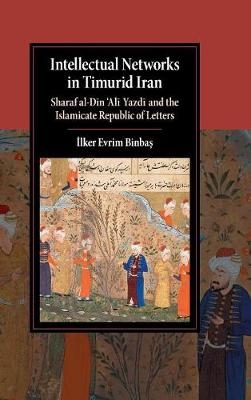
Intellectual Networks in Timurid Iran
Sharaf al-Dīn ‘Alī Yazdī and the Islamicate Republic of Letters
Seiten
2016
Cambridge University Press (Verlag)
978-1-107-05424-0 (ISBN)
Cambridge University Press (Verlag)
978-1-107-05424-0 (ISBN)
Discusses the importance of informal intellectual networks and the formation of the republic of letters in Islamic history. The book focuses on the fifteenth century Timurid, Ottoman, and Mamluk empires, and traces the connections between intellectuals in these three early modern Islamic polities.
By focusing on the works and intellectual network of the Timurid historian Sharaf al Dīn 'Alī Yazdī (d.1454), this book presents a holistic view of intellectual life in fifteenth century Iran. İlker Evrim Binbaş argues that the intellectuals in this period formed informal networks which transcended political and linguistic boundaries, and spanned an area from the western fringes of the Ottoman State to bustling late medieval metropolises such as Cairo, Shiraz, and Samarkand. The network included an Ottoman revolutionary, a Mamluk prophet, and a Timurid occultist, as well as physicians, astronomers, devotees of the secret sciences, and those political figures who believed that the network was a force to be taken seriously. Also discussing the formation of an early modern Islamicate republic of letters, this book offers fresh insights on the study of intellectual history beyond the limitations imposed by nationalist methodologies, established genres, and recognized literary traditions.
By focusing on the works and intellectual network of the Timurid historian Sharaf al Dīn 'Alī Yazdī (d.1454), this book presents a holistic view of intellectual life in fifteenth century Iran. İlker Evrim Binbaş argues that the intellectuals in this period formed informal networks which transcended political and linguistic boundaries, and spanned an area from the western fringes of the Ottoman State to bustling late medieval metropolises such as Cairo, Shiraz, and Samarkand. The network included an Ottoman revolutionary, a Mamluk prophet, and a Timurid occultist, as well as physicians, astronomers, devotees of the secret sciences, and those political figures who believed that the network was a force to be taken seriously. Also discussing the formation of an early modern Islamicate republic of letters, this book offers fresh insights on the study of intellectual history beyond the limitations imposed by nationalist methodologies, established genres, and recognized literary traditions.
İlker Evrim Binbaş is a lecturer in Early Modern Asian Empires in the Department of History at Royal Holloway, University of London.
1. Introduction; 2. The making of a Timurid intellectual; 3. Informal intellectual networks in Timurid Iran; 4. The prophet of Cairo and the master of Isfahan; 5. The articulation of a princely political discourse; 6. Writing the past; 7. The king's two lineages: the evolution of a politico-theological idea; 8. Epilogue.
| Erscheinungsdatum | 27.05.2016 |
|---|---|
| Reihe/Serie | Cambridge Studies in Islamic Civilization |
| Zusatzinfo | 1 Maps; 1 Halftones, black and white; 18 Line drawings, black and white |
| Verlagsort | Cambridge |
| Sprache | englisch |
| Maße | 154 x 238 mm |
| Gewicht | 620 g |
| Themenwelt | Geschichte ► Allgemeine Geschichte ► Mittelalter |
| Geschichte ► Allgemeine Geschichte ► Neuzeit (bis 1918) | |
| Geisteswissenschaften ► Geschichte ► Regional- / Ländergeschichte | |
| Geschichte ► Teilgebiete der Geschichte ► Kulturgeschichte | |
| Sozialwissenschaften | |
| ISBN-10 | 1-107-05424-9 / 1107054249 |
| ISBN-13 | 978-1-107-05424-0 / 9781107054240 |
| Zustand | Neuware |
| Informationen gemäß Produktsicherheitsverordnung (GPSR) | |
| Haben Sie eine Frage zum Produkt? |
Mehr entdecken
aus dem Bereich


aus dem Bereich
Geschichte einer Augsburger Familie (1367-1650)
Buch | Softcover (2024)
Kohlhammer (Verlag)
CHF 47,60


