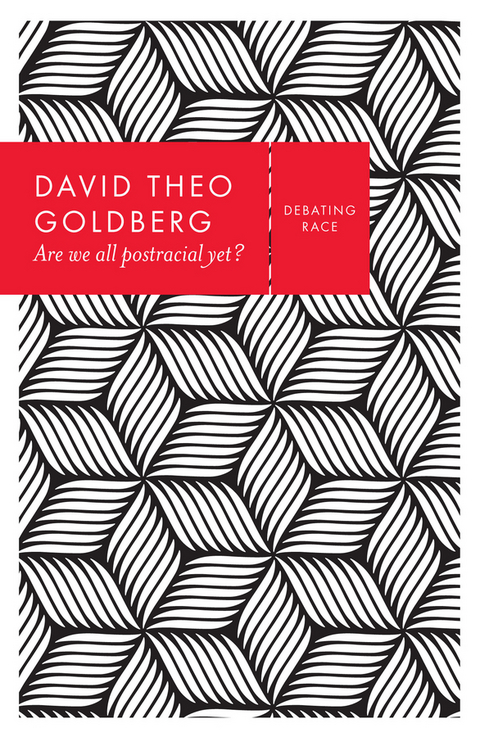
Are We All Postracial Yet? (eBook)
John Wiley & Sons (Verlag)
978-0-7456-8975-3 (ISBN)

However, as Ferguson, MO, and countless social statistics show, beneath such claims lurk more sinister shadows of the racial everyday, institutional, and structural racisms persist and renew themselves beneath the polish of nonraciality. A conundrum lies at its very heart as seen when the election of a Black President was taken to be the pinnacle of postraciality.
In this sparkling essay, David Theo Goldberg seeks to explain this conundrum, and reveals how the postracial is merely the afterlife of race, not its demise. Postraciality is the new logic of raciality.
David Theo Goldberg is Director of the University of California Humanities Research Institute and Professor of Comparative Literature at the University of California, Irvine.
We hear much talk about the advent of a postracial age. The election of Barack Obama as President of the U.S. was held by many to be proof that we have once and for all moved beyond race. The Swedish government has even gone so far as to erase all references to race from its legislative documents.However, as Ferguson, MO, and countless social statistics show, beneath such claims lurk more sinister shadows of the racial everyday, institutional, and structural racisms persist and renew themselves beneath the polish of nonraciality. A conundrum lies at its very heart as seen when the election of a Black President was taken to be the pinnacle of postraciality. In this sparkling essay, David Theo Goldberg seeks to explain this conundrum, and reveals how the postracial is merely the afterlife of race, not its demise. Postraciality is the new logic of raciality.
David Theo Goldberg is Director of the University of California Humanities Research Institute and Professor of Comparative Literature at the University of California, Irvine.
Preface
1 The pasts of the postracial
2 Postracial conditons
3 Postracial logics
4 Postracial subjects
5 Are we all postracial yet?
"It would be tempting to assume that there is a yes or no answer to this work's titular question, however, it soon shows its complexity as the mind ponders over and over it: are we really postracial? What does 'postraciality' evoke? Is this the end to racism? We demand answers and David Theo Goldberg - as part of Polity's Debating Race series - leaves no stone unturned in this distinctive essay on race."
Inky Needles
"This pointed, thoughtful and readable book is a bold intervention in the politics of undoing racial hierarchy. For too long, anti-racism has been inhibited by the difficulties involved in moving beyond critique. David Goldberg has risen to the cosmopolitan challenge involved in breaking that logjam. With characteristic rigor and wit, he shows how antiracist politics can be reconfigured in combative, practical and affirmative forms."
Paul Gilroy, King's College London
"This Book reveals the neo-raciality masked by the claims of the post-racial. The underlying structures of economic, political, and social inequalities have seen the afterlife of racism in police uniforms walk the streets of America openly amidst the cries of 'I can't breathe' from its victims. A must read."
wa Thiong'o Ng g , University of California, Irvine
"David Theo Goldberg's trenchant meditation on the challenges to anti-racist remediation reveals a structured cultural silence about deep social shape-shifting forms of inequality. The very term 'post-racial' places racism's harms beyond critical analysis, rendered unreachable because located in the past, indecipherable because erased from language; and ungovernable because assigned to private rather than collective address. This excellent study explores the limits of 'post-racialism' in an epoch of denial, unsparingly dissecting the common attributes of interesting forms of prejudice."
Patricia Williams, Columbia Law School
"Goldberg's Are We All Postracial Yet? provocatively and powerfully interrogates the idea of the Postracial as something more than an aspiration, but in fact the basis for a new phase of racial arrangements, shaped by shifts in the political economy, domestic and international law, and geopolitics. The work is theoretically rich and probing with both global and local implications. It deepens race critical theory, and furthers our understanding of the ongoing significance of race."
Imani Perry Hughes Rogers Professor of African American Studies, Princeton University and author of More Beautiful and More Terrible: The Embrace and Transcendence of Racial Inequality in the U.S. (2011)
"Are we all postracial yet? David Theo Goldberg in answering this question with a resounding "yes" explores the postracial as a logic and condition that enables racism to persist and proliferate. This book offers a sharp, wise and unflinching critique of the racism of the postracial. It is also a deeply optimistic book: there is no better way of demanding an alternative than by demonstrating its necessity."
Sara Ahmed, Goldsmiths
ONE
The pasts of the postracial
Race today is supposed to be a thing of the past. And yet all we do, seemingly, is to talk about it. We talk (about) race when not talking (about) it; and we don't talk (about) it when (we should be) talking (about) it. “The postracial,” as filmmaker Michael Oblowitz recently put it to me with his characteristic rap-rhetoricality, “is the most racial.” Such is the condition, the paradox, of postraciality.
A postracial paradox
The postracial is all about us. It was born – or in a sense raciality was born again, anew – when Barack Obama got elected in 2008. With America's first black President, postraciality went public, pronouncing itself the prevailing state of being, at least aspirationally. This quickly opened up a frenzied media discussion about whether America, in particular, and other once racially predicated societies globally, had become postracial. It seems that all it takes for a (once) self-proclaimed white country's racial history to be wiped clean is for a black man-hero – an Obama or Mandela – to get elected President. The Great Man version of history takes a new turn on stage.
The claim that we today inhabit – or have come close(r) to inhabiting – a postracial society embeds the insistence that key conditions of social life are less and less now predicated on racial preferences, choices, and resources. These include residential location, educational possibility and institutional access, employment opportunities, social networks and interaction – in short, life's chances overall. Postraciality amounts to the claim that we are, or are close to, or ought to be living outside of debilitating racial reference. In particular, it presumes that people (ought to) have similar life chances irrespective of their assigned race in societies such as the United States and South Africa. It presumes that effort, energy, and inherent ability will determine individuals' life prospects. It insists that the legacy of racial discrimination and disadvantage has been waning over time, reaching a point today where, if existing at all, such discrimination is anomalous and individually expressed. It is not structural or socially mandated. Postracial racial outbursts – the awkwardness of the characterization itself revealing of their anomaly – are taken to be occasional not systemic or systematic, with diminishing impact. They are supposedly to be treated like curses on the road: roll up the window and drive on by.
Postraciality, accordingly, is both assertion and aspiration (Steele 2008; Hollinger 2011). It is both descriptive or factual and normative. Why, then, the popularity of the “postracial” now, not just in America but pretty much wherever race has (had) significant resonance? The argument that follows in this book offers one line of under-remarked response to this pressing question.
As with racialities and racisms generally, postracial conditions and articulations will differ across societies, given their contrasting racial histories. There is a notable contrast between the explicit, if sometimes banal, discussions in the United States regarding the realization of postraciality, the sometime aspirational expression in South Africa, and the virtual silence about the postracial in Brazil.
So why has public racist expression generally become far more virile and vicious in the name of the postracial than it has been since the 1960s? Examples abound: in the United States, widespread racially charged comments about Obama, the killings of Trayvon Martin in Sanford, Florida, Michael Brown in Ferguson, Missouri, and Eric Garner in New York, discussions about police brutality and about Dreamers; across Europe, the connected resurgence of anti-Semitism, Islamophobia, and anti-immigration sentiment; in Israel, the explosion of explicitly racist sensibilities regarding both Palestinians and African migrants. What (and who), in the face of this reality, is the postracial actually for? And again, what racial work is the postracial doing, what racist expression is it enabling, legitimating, rationalizing? Is it just, as Lipsitz (2012: 1) argues, that postraciality was “created to mask the effects of white privilege”?
It's not that there has been no “progress” on racial matters. We can all point to the visible markers of formal and experiential shifts: 1954, 1964, and 1965, and again 2008 in the United States; 1990 and 1994 in South Africa; and so on. But progress in some areas, even importantly the election of the first black President, doesn't preclude regression or extended and new forms of racist expression in others. Racism here means the curtailment of life and life's prospects, of social standing and rights, of personal dignity and social possibility because of one's perceived race. The question is whether these new and renewed racist expressions are stand-alone events, anomalies, or part of a larger emergent pattern, a novel structure of raciological articulation. I will be arguing that they are definitively the latter.
Postraciality, it could be said, then, is the end of race as we have known it.
Before Fox News runs with this as its headline, now confirmed by an academic critic they would love to hate, note what this does not say. It emphatically does not declare that race, let alone racism, has reached its end. Dinesh D'Souza (1996) and others have continued to arrogate that untenable claim even while awkwardly advancing its contrary in film and print so as to dismiss Barack Obama as driven by anti-colonial commitments (D'Souza 2011; Scott 2014). Similarly, conservative commentator John McWhorter (2008) insisted immediately following Obama's election that “Racism is over…. It is not a moral duty to keep it front and center.” He added two years later that “Obama's first year has shown us again and again that race does not matter in America in the way it used to. We've come more than a mere long way – we're almost there” (McWhorter 2010). Shelby Steele (2007) initially predicted Obama's unelectability to the Presidency. Confronted by the electoral counter-factual in November 2008, he unapologetically dismissed it as the racially charged victory of America's hollowed-out civil rights legacy (Steele 2008). Driven by white guilt, Obama's election supposedly wasn't postracial enough!
What the claim about postraciality as the end of race suggests, rather, is simply that a certain way of thinking about race, and implicitly of racist expression, has been giving way to novel understandings, orders, and arrangements of racial designation and racist expression. Race (as we have known it) may be over. But racism lives on unmarked, even unrecognized, potentially for ever.
Racisms across history
Race swept across the worlds of modernity, making and unmaking states and societies in its terms. Racial articulation and configuration have shaped modern worlds in ways proving challenging, if not impossible to undo as the modern gives way to its various “post”-formations and formulations. As a dominating mode of command throughout modernity, race has ordered the prevailing definitions and structures of the social, the state, and its subjects. Indeed, the enduring conditions made and marked by the racial continue to structure society. This is so regardless of the fact that its various explicit manifestations may now be rejected, rendered implicit, silenced, or denied. Racism has been declared over, an antique relic, and a banal state of the postracial is deemed now to pervade.
How is it that race has so broadly impacted modern lifeworlds, its remains still reverberating (Amin 2010), still proving so commanding and intractable even in its afterlife, its eruptions still haunting? Race materialized as an expression of “dehumanization” as the geography of modern Europe took form. Race established the lines of belonging and estrangement for modern European social life. This “racialization,” as Fanon (1968) would later characterize the mode of dehumanizing at work in the name of race, was fashioned and elaborated as the modern idea of Europe was shaped from the Renaissance onwards. Race was invoked to delineate a European “we” in defining contrast with those considered its constitutive outsiders: not just Jews and Muslims subjected to conversion and expulsion, but blacks too. This, then, constitutes the haunting trinity of non-belonging shadowing Europe's founding at the onset of European globalization (Goldberg 2002).
So racial configuration is knotted from the outset of its formulation and social fashioning with religious resonance: Jews and Muslims, black and Indian heathens as Europe's formative non-belonging. Differentiating origins, kinship, and lineage from the outset tied color to culture, bodies to behavioral projections, incipient biology to ascribed mentalities. And as race, in its ever-morphing and cementing significance, was adopted increasingly as a central technology of modern state constitution and reason, it assumed its defining power by absorbing some of the remaining theological resonances it is taken to have displaced.
Once the purview of the religious, these defining features became racial. They included the narrative of human origins; the passion and force of kinship commitment; and the naturalizing of...
| Erscheint lt. Verlag | 9.9.2015 |
|---|---|
| Reihe/Serie | Debating Race |
| Debating Race | Debating Race |
| Sprache | englisch |
| Themenwelt | Sozialwissenschaften ► Ethnologie ► Völkerkunde (Naturvölker) |
| Sozialwissenschaften ► Politik / Verwaltung | |
| Sozialwissenschaften ► Soziologie | |
| Schlagworte | Cultural Studies • Gesellschaftstheorie • Kulturwissenschaften • Race & Ethnicity Studies • race, political theory, social theory, raciality, ethnicity, racism, multiculturalism, color-blind • Rassen • Rassen- u. Ethnienforschung • Social Theory • Sociology • Soziologie |
| ISBN-10 | 0-7456-8975-2 / 0745689752 |
| ISBN-13 | 978-0-7456-8975-3 / 9780745689753 |
| Informationen gemäß Produktsicherheitsverordnung (GPSR) | |
| Haben Sie eine Frage zum Produkt? |
 EPUB (Adobe DRM)
Kopierschutz: Adobe-DRM
Adobe-DRM ist ein Kopierschutz, der das eBook vor Mißbrauch schützen soll. Dabei wird das eBook bereits beim Download auf Ihre persönliche Adobe-ID autorisiert. Lesen können Sie das eBook dann nur auf den Geräten, welche ebenfalls auf Ihre Adobe-ID registriert sind.
Details zum Adobe-DRM
Dateiformat: EPUB (Electronic Publication)
EPUB ist ein offener Standard für eBooks und eignet sich besonders zur Darstellung von Belletristik und Sachbüchern. Der Fließtext wird dynamisch an die Display- und Schriftgröße angepasst. Auch für mobile Lesegeräte ist EPUB daher gut geeignet.
Systemvoraussetzungen:
PC/Mac: Mit einem PC oder Mac können Sie dieses eBook lesen. Sie benötigen eine
eReader: Dieses eBook kann mit (fast) allen eBook-Readern gelesen werden. Mit dem amazon-Kindle ist es aber nicht kompatibel.
Smartphone/Tablet: Egal ob Apple oder Android, dieses eBook können Sie lesen. Sie benötigen eine
Geräteliste und zusätzliche Hinweise
Buying eBooks from abroad
For tax law reasons we can sell eBooks just within Germany and Switzerland. Regrettably we cannot fulfill eBook-orders from other countries.
aus dem Bereich