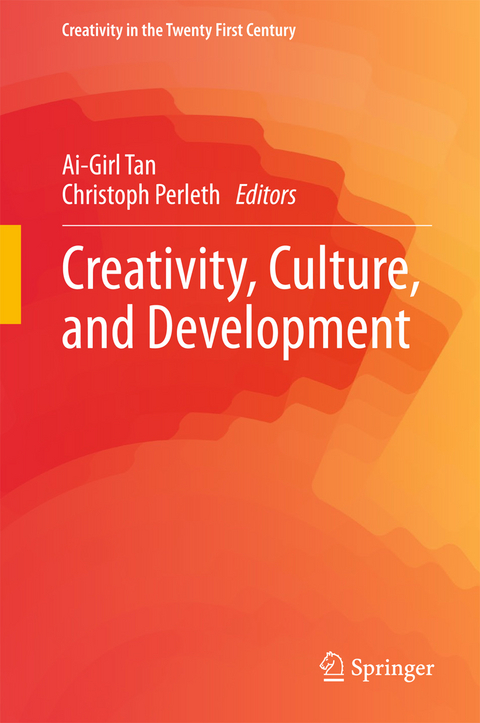
Creativity, Culture, and Development (eBook)
XVIII, 256 Seiten
Springer Singapore (Verlag)
978-981-287-636-2 (ISBN)
This volume presents a collection of writings on the relations among creativity, culture and development. The editors invited 'like-minded' researchers of creativity from around the world to share their respective notions of creativity. Given that human creativity is a potential that can and should be nurtured in the course of lifespan development and across all cultural backgrounds, the volume emphasizes the importance of promoting creativity in all cultures and through societal-educational opportunities, and offers a venue for the authors to make conceptual, empirical and practical inquiries into the relations among creativity, development and culture. The authors represent a varied 'mix' of contemporary and emerging creativity researchers who use different methodologies to investigate the importance of culture in creativity development and the reciprocal role of developing creativity and cultural enrichment. The volume represents an attempt on the part of the editors and the authors to broaden our current understanding of creativity in the contexts of human and cultural development, and in so doing to enhance our understanding of creativity, culture and development in the contexts of flourishing human and societal activities. As the first volume in a book series on 'Creativity in the Twenty-First Century', the book invites readers and researchers to engage in future interdisciplinary and intercultural discourses and dialogues on the importance of creativity for human and cultural development.
This volume presents a collection of writings on the relations among creativity, culture and development. The editors invited "e;like-minded"e; researchers of creativity from around the world to share their respective notions of creativity. Given that human creativity is a potential that can and should be nurtured in the course of lifespan development and across all cultural backgrounds, the volume emphasizes the importance of promoting creativity in all cultures and through societal-educational opportunities, and offers a venue for the authors to make conceptual, empirical and practical inquiries into the relations among creativity, development and culture. The authors represent a varied "e;mix"e; of contemporary and emerging creativity researchers who use different methodologies to investigate the importance of culture in creativity development and the reciprocal role of developing creativity and cultural enrichment. The volume represents an attempt on the part of the editors and the authors to broaden our current understanding of creativity in the contexts of human and cultural development, and in so doing to enhance our understanding of creativity, culture and development in the contexts of flourishing human and societal activities. As the first volume in a book series on "e;Creativity in the Twenty-First Century"e;, the book invites readers and researchers to engage in future interdisciplinary and intercultural discourses and dialogues on the importance of creativity for human and cultural development.
Chapter 1 An Introduction to the Volume of Creativity, Culture and Development.- Part 1 Conceptions of Creativity, Culture and Development.- Chapter 2 Unpacking the Triad of Creativity, Culture, and Development: An Exercise in Relational Thinking.- Chapter 3 Indigenous Chinese Epistemologies as a Source of Creativity.- Chapter 4 The Person in Creativity, Development and Culture from the Perspective of William Stern (1871-1938).- Chapter 5 Affect and Creativity: An Old Topic and New Direction.- Part 2 Empirical Evidence and Practice.- Chapter 6 Gender Differences in Means and Variability on Creative Thinking: Patterns in Childhood, Adolescence and Emerging Adulthood.- Chapter 7 A Case Study to Explore Creativity in Preschoolers through Chinese Reading.- Chapter 8 Children's Affectivity and Efficacies.- Chapter 9 How to Develop Children's Creativity and Intercultural Sensitivity: Around Creativity Compass Program.- Chapter 10 Assessing Schools on Creativity: A Toolbox for U.S. Teachers and Policymakers and a To-Do List for Researchers Worldwide.- Chapter 11 Is Relational Theory a Better Answer to the Psychology of Creativity?.- Part 3 Valuing Creativity.- Chapter 12 Developing Society: Reflections on the Notion of Societal Creativity.- Chapter 13 Organizational Creativity as an Approach towards Leveraging on the Networking and Caring Capacity on the Networking and Caring Capacity of (Vision Rehabilitation) Services.- Chapter 14 Creativity in Musical Performance: Musicians' Notion of Tradition, Originality and Value of Performance.- Chapter 15 Team Processing and Creative Self Efficacy in Professionals from Creative and Non-creative Industries.
| Erscheint lt. Verlag | 27.8.2015 |
|---|---|
| Reihe/Serie | Creativity in the Twenty First Century | Creativity in the Twenty First Century |
| Zusatzinfo | XVIII, 256 p. 14 illus. |
| Verlagsort | Singapore |
| Sprache | englisch |
| Themenwelt | Geisteswissenschaften ► Psychologie ► Pädagogische Psychologie |
| Medizin / Pharmazie ► Medizinische Fachgebiete ► Psychiatrie / Psychotherapie | |
| Sozialwissenschaften ► Pädagogik ► Allgemeines / Lexika | |
| Sozialwissenschaften ► Pädagogik ► Bildungstheorie | |
| Schlagworte | Assess Schools Creativity • Creativity and Culture • Creativity assessment • cross-cultural psychology • Cultural and Cross-disciplinary Research • culture in creativity development • Musical Creativity • Psychology for Creativity • Talent Development • Talented Education |
| ISBN-10 | 981-287-636-7 / 9812876367 |
| ISBN-13 | 978-981-287-636-2 / 9789812876362 |
| Informationen gemäß Produktsicherheitsverordnung (GPSR) | |
| Haben Sie eine Frage zum Produkt? |
 PDF (Wasserzeichen)
DRM: Digitales Wasserzeichen
Dieses eBook enthält ein digitales Wasserzeichen und ist damit für Sie personalisiert. Bei einer missbräuchlichen Weitergabe des eBooks an Dritte ist eine Rückverfolgung an die Quelle möglich.
Dateiformat: PDF (Portable Document Format)
Mit einem festen Seitenlayout eignet sich die PDF besonders für Fachbücher mit Spalten, Tabellen und Abbildungen. Eine PDF kann auf fast allen Geräten angezeigt werden, ist aber für kleine Displays (Smartphone, eReader) nur eingeschränkt geeignet.
Systemvoraussetzungen:
PC/Mac: Mit einem PC oder Mac können Sie dieses eBook lesen. Sie benötigen dafür einen PDF-Viewer - z.B. den Adobe Reader oder Adobe Digital Editions.
eReader: Dieses eBook kann mit (fast) allen eBook-Readern gelesen werden. Mit dem amazon-Kindle ist es aber nicht kompatibel.
Smartphone/Tablet: Egal ob Apple oder Android, dieses eBook können Sie lesen. Sie benötigen dafür einen PDF-Viewer - z.B. die kostenlose Adobe Digital Editions-App.
Buying eBooks from abroad
For tax law reasons we can sell eBooks just within Germany and Switzerland. Regrettably we cannot fulfill eBook-orders from other countries.
aus dem Bereich