Agent-Based Simulation of Organizational Behavior (eBook)
VIII, 348 Seiten
Springer International Publishing (Verlag)
978-3-319-18153-0 (ISBN)
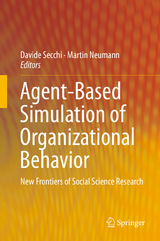
The aim of this book is to demonstrate how Agent-Based Modelling (ABM) can be used to enhance the study of social agency, organizational behavior and organizational management. It derives from a workshop, sponsored by the Society for the Study of Artificial Intelligence and the Simulation of Behavior (AISB), held at Bournemouth University Business School in 2014 on 'Modelling Organizational Behavior and Social Agency'. The contents of this book are divided into four themes: Perspectives, Modeling Organizational Behavior, Philosophical and Methodological Perspective, and Modeling Organized Crime and Macro-Organizational Phenomena.
ABM is a particular and advanced type of computer simulation where the focus of modeling shifts to the agent rather than to the system. This allows for complex and more realistic representations of reality, facilitating an innovative socio-cognitive perspective on organizational studies. The editors and contributing authors claim that the use of ABM may dramatically expand our understanding of human behavior in organizations. This is made possible because of (a) the computational power made available by technological advancements, (b) the relative ease of the programming, (c) the ability to borrow simulation practices from other disciplines, and (d) the ability to demonstrate how the ABM approach clearly enables a socio-cognitive perspective on organizational complexity.
Showcasing contributions from academics and researchers of various backgrounds and discipline, this volumes provides a global, interdisciplinary perspective.
Preface 6
Contents 8
1 Exploring the New Frontier: Computational Studies of Organizational Behavior 10
1.1 A Misleading Divide: Cross-Disciplinary Fertilizationvs. Specialization 10
1.2 The Impact of Agent-Based Modeling for Studying Organizational Behavior 13
1.2.1 A Novel Approach: Interaction and Cognition 15
1.3 Overview of the Volume 16
1.4 Mapping the New Frontier 21
1.4.1 Building a Common Ground 21
1.4.2 Drawing the Map 23
References 24
Part I Perspectives 26
2 Emergent Organizations 27
2.1 Introduction 27
2.2 A Few ABMs in Organization Science 30
2.2.1 The GCM of Organizational Choice 31
2.2.2 Cellular Automata and the NK as Models of Organizational Interdependencies 32
2.2.3 ABMs of Agile Productive Plants 34
2.3 Concepts and Theories for New Applications 35
2.3.1 Unsupervised Neural Networks and Organizational Routines 37
2.3.2 Organizational Ecologies and Evolutionary Theory 42
2.4 Conclusions 46
References 46
3 Cognition Beyond the Body: Using ABM to Explore Cultural Ecosystems 50
3.1 On the Outer Reaches of Science 51
3.2 Observing and Diachrony: A Challenge for Science 52
3.3 Towards a Sociocognitive View of Cognitive Science 55
3.4 Investigating Ecosystemically Embedded Agents 56
3.5 The Northern Cities Shift 57
3.6 Premature Theorization and Social Science 60
3.7 Modeling: Life and Cognition 62
3.8 Cognition Beyond the Body 63
References 65
Part II Modeling Organizational Behavior 68
4 The Effects of Disorganization on Goals and Problem Solving 69
4.1 Introduction 69
4.2 Theoretical Framework 71
4.2.1 Disorganization 71
4.2.2 Operationalizing the Concept 73
4.2.3 Goal Setting 74
4.3 The Model 75
4.3.1 Space and Agents 76
4.3.2 Movement 78
4.3.3 Decision Rules 79
4.3.4 Motivation 80
4.3.5 Testing 81
4.4 Findings 81
4.5 Discussion and Conclusions 83
4.5.1 Limitations and Prospects for Further Research 86
4.5.2 Conclusions 87
References 88
5 Constructing Agent-Based Models of Organizational Routines 91
5.1 Introduction 91
5.2 Conceptualizing Organizational Routines 93
5.3 Contemporary Agent-Based Models of Organizational Routines 97
5.3.1 Overview of Models 98
5.3.2 Comparison of Models 100
5.3.3 Reflections on Constructing Simulations of Organizational Routines 104
5.4 Conclusion 107
5.4.1 Limitations 107
5.4.2 Future Research 108
References 109
6 CoopNet: A Social, P2P-Like Simulation Model to Explore Knowledge-Based Production Processes 114
6.1 Introduction 114
6.2 Hierarchy and Reciprocity 116
6.3 Computer Simulation Models as Theoretical Laboratories 118
6.4 Model 119
6.5 Individual Decision Making Algorithm 120
6.5.1 Play Phase 120
6.5.2 Rewire and Copy Phase 122
6.6 Human Resource Management Processes Algorithm 124
6.6.1 Reward Phase 124
6.6.2 Firing Phase 126
6.7 Experiments 127
6.7.1 Experimental Setup 127
6.7.2 Experimental Results 130
6.8 Discussion on Related Work and Contribution 134
6.9 Conclusions and Future Work 137
References 138
7 Conceptualizing and Modeling Multi-Level Organizational Co-evolution 142
7.1 Introduction 143
7.2 Conceptualizing Organizational Co-evolution 144
7.2.1 From Entity to Practice: Implicationsfor the Conceptualization of Co-evolution 147
7.3 Modeling Organizational Co-evolution 150
7.4 Implications for Empirical Investigations 154
7.4.1 Model Inputs 154
7.4.2 Model Outputs and Validation 156
7.5 Conclusions 158
References 158
8 Exploring Aspects of Coordination by Mutual Adjustment in Fluid Teams: An Agent-Based Modeling Approach 163
8.1 Introduction 164
8.2 Literature Review 165
8.2.1 Team Coordination Defined 165
8.2.2 How Teams Achieve Coordination 166
8.2.3 Antecedents to Team Coordination 167
8.2.4 Team Composition 167
8.2.5 Summarizing the Reviewed Literature 168
8.3 Methodological Issues 168
8.4 The Agent-Based Model of Team Coordination 169
8.5 Experiments and Results 171
8.5.1 Homogenous Teams 171
8.5.2 Heterogeneous Teams 172
8.5.3 Summing Up the Results 173
8.6 Discussion and Conclusion 173
8.6.1 Managerial Implications 174
8.7 Limitations and Suggestions for Future Research 175
References 175
9 Boundary Conditions for the Emergence of ``Docility'' in Organizations: Agent-Based Model and Simulation 178
9.1 Introduction and Problem Statement 178
9.1.1 Rationale for the Study 179
9.1.1.1 Timeliness and Fitness 179
9.1.1.2 Distributed Processes 181
9.1.1.3 Not Just Altruism 182
9.1.1.4 Range 183
9.2 The Model: Agents and Docility 183
9.2.1 Types of Individuals 184
9.2.2 Costs of Prosocial Behavior 185
9.2.3 Range of Interaction 186
9.2.4 Impact of Docility 187
9.2.5 Adaptation 187
9.2.6 Procedural Note and Expected Outcomes 188
9.3 Results 189
9.3.1 Negative Docility Impact 189
9.3.2 Range and Cost 191
9.3.3 The Docility Effect 192
9.4 Implications and Conclusions 194
9.4.1 Ideas for Future Research and Concluding Remarks 198
Appendix 199
Impact = -0.1 199
Impact = 0.1 200
References 200
Part III Philosophical and Methodological Perspectives 204
10 Intervening via Chance-Seeking 205
10.1 Introduction 205
10.2 Abduction and Intervention 206
10.2.1 Abduction and Hypothesis Generation 206
10.2.2 Intervention and Its Puzzles 209
10.2.3 Intervention and Its Logic 211
10.3 Intervention via Chance-Seeking 214
10.3.1 The Role of Chance Events 214
10.3.2 Environmental Unanticipatedness as a Resource for Action 216
10.3.3 Chance-Seeking as Tinkering with Chance Events 217
10.3.4 Chance-Seeking as a Phronetic Activity 219
10.4 Conclusions 220
References 221
11 Exploring Social and Asocial Agency in Agent-Based Systems 223
11.1 Introduction 223
11.2 Varieties of Agent-Based Systems 225
11.3 Potentiality and Actuality of Agent-Based Approaches 227
11.4 A Multidimensional Gradual Framework for Evaluating Socio-Technical Systems 228
11.5 Emergence in Agent-Based Systems 232
11.6 The Potential for Social and Asocial Agency in Agent-Based Modeling 234
11.7 Conclusions and Future Directions 235
References 236
12 Towards Nonlocal Field-Like Social Interactions: Oscillating Agent Based Conceptual and Simulation Framework 239
12.1 Introduction 239
12.2 Oscillation-Based Paradigm and Experimental Validation Framework 244
12.3 Oscillating Agent Model: Phonons and Quantum Mechanical Approach 251
12.4 Agent-Based Simulation: Excitation Propagation in Social Mediums 255
12.5 Concluding Remarks and Discussion 259
References 262
13 Analytical Approaches to Agent-Based Models 266
13.1 Introduction 266
13.2 The Original Process 269
13.3 The Deterministic Limit 272
13.4 The Stochastic Limit 275
13.4.1 The Diffusion Approximation 276
13.4.2 The Central Limit Theorem Approximation 277
13.5 Conclusions 282
Appendix: Technical Conditions 282
References 285
Part IV Macro Aspects of Organizational Behavior 288
14 Modeling Social Agency Using Diachronic Cognition: Learning from the Mafia 289
14.1 Human Modes of Organizing 290
14.2 Cognition: History and Time 291
14.3 Criminal Organizations as a Social Laboratory 294
14.4 Evolution of Cosa Nostra 295
14.4.1 Enaction of Organizational Norms 297
14.4.2 Socio-Cultural Embedding of the Organization 298
14.5 Lessons for Modeling 301
14.5.1 Intra-Agent Processes: A Computational Socio-Cognitive Theory of Social Agency 302
14.5.2 Inter-Agent Processes: Diachronic Co-evolution 306
14.6 Outlook: Modeling Diachronic Cognition 307
References 308
15 Water Controversies Between Conflict and Cooperation: Agent-Based Models for Non-traditional Security 311
15.1 ABM in Social Sciences and Conflict Studies 311
15.2 Water as Object of Security: The Case of Mekong Dams 313
15.3 The Model 317
15.4 Modelisation, Testing and Some Preliminary Conclusions: Ideas for Future Works 322
References 325
16 Open Innovation Networks and the Role of Intermediaries: An Agent-Based Simulation 328
16.1 Introduction 328
16.2 Literature Review 330
16.2.1 Open Innovation 330
16.2.2 Strategic Roles in Innovation Networks 331
16.3 Model 333
16.3.1 Modeling Strategy 333
16.3.2 Model Implementation 335
16.4 Results 336
16.5 Conclusions and Limitations 339
Appendix 341
References 342
Index 344
| Erscheint lt. Verlag | 25.8.2015 |
|---|---|
| Zusatzinfo | VIII, 348 p. 50 illus., 21 illus. in color. |
| Verlagsort | Cham |
| Sprache | englisch |
| Themenwelt | Sozialwissenschaften ► Politik / Verwaltung |
| Sozialwissenschaften ► Soziologie | |
| Wirtschaft ► Allgemeines / Lexika | |
| Wirtschaft ► Betriebswirtschaft / Management ► Logistik / Produktion | |
| Wirtschaft ► Betriebswirtschaft / Management ► Unternehmensführung / Management | |
| Schlagworte | Agent-based Modeling (ABM) • Computer-aided decision • computer simulation • Decision-Making • Organizational Behavior • Social Agency • Social Cognition • Social Psychology |
| ISBN-10 | 3-319-18153-X / 331918153X |
| ISBN-13 | 978-3-319-18153-0 / 9783319181530 |
| Informationen gemäß Produktsicherheitsverordnung (GPSR) | |
| Haben Sie eine Frage zum Produkt? |
 PDF (Wasserzeichen)
DRM: Digitales Wasserzeichen
Dieses eBook enthält ein digitales Wasserzeichen und ist damit für Sie personalisiert. Bei einer missbräuchlichen Weitergabe des eBooks an Dritte ist eine Rückverfolgung an die Quelle möglich.
Dateiformat: PDF (Portable Document Format)
Mit einem festen Seitenlayout eignet sich die PDF besonders für Fachbücher mit Spalten, Tabellen und Abbildungen. Eine PDF kann auf fast allen Geräten angezeigt werden, ist aber für kleine Displays (Smartphone, eReader) nur eingeschränkt geeignet.
Systemvoraussetzungen:
PC/Mac: Mit einem PC oder Mac können Sie dieses eBook lesen. Sie benötigen dafür einen PDF-Viewer - z.B. den Adobe Reader oder Adobe Digital Editions.
eReader: Dieses eBook kann mit (fast) allen eBook-Readern gelesen werden. Mit dem amazon-Kindle ist es aber nicht kompatibel.
Smartphone/Tablet: Egal ob Apple oder Android, dieses eBook können Sie lesen. Sie benötigen dafür einen PDF-Viewer - z.B. die kostenlose Adobe Digital Editions-App.
Buying eBooks from abroad
For tax law reasons we can sell eBooks just within Germany and Switzerland. Regrettably we cannot fulfill eBook-orders from other countries.
aus dem Bereich