


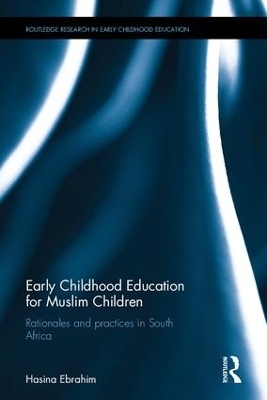
Early Childhood Education for Muslim Children
Rationales and practices in South Africa
Seiten
2016
Routledge (Verlag)
978-1-138-90969-4 (ISBN)
Routledge (Verlag)
978-1-138-90969-4 (ISBN)
This book explores how Muslim children are educated for an Islamic way of life in a minority context. Grounded in detailed research from six preschools for Muslim children in South Africa, first-hand interviews with parents and staff capture the complexities that arise when passing on religion in the formative years.
Early Childhood Education for Muslim Children foregrounds the marginalised perspective of Muslim children aged three to five and examines how they are cared for and educated in centre-based provision in two provinces in post-apartheid South Africa. Both theological and social science perspectives are carefully interwoven to make sense of the construction of service provision for Muslims as a minority group in a secular democracy.
This book uses a qualitative, reflexive approach to amplify the voices of mothers, managers and teachers as the community of agents who shape priorities for young children in the context of a rapidly transforming society. The research demonstrates that the quest to establish an appropriate care network and a sound educative environment for Muslim children is riddled with complexities, struggles and tensions. In the light of changes in the home-based network for early education, centre-based provision has become an important infrastructure for Muslim communities seeking one-stop academic and Islamic education. The internal struggles encountered in this form of provision include inequities in access, struggles to package an appropriate curriculum, and dealing with nurturance specific to the faith and for cultural formations supportive of citizenship.
This book calls for critical engagement with issues of religious education in early childhood, social cohesion, formal systematic teacher education for Muslim teachers, curriculum development and parental support. It will contribute not only to the development of early education from an Islamic perspective, but will also demonstrate how to expand discourses and practices to deal with diversity and faith development in early years. As such, it will appeal to academics, researchers and postgraduate students in the fields of early childhood education, religious studies, race and ethnic studies, and childhood studies
Early Childhood Education for Muslim Children foregrounds the marginalised perspective of Muslim children aged three to five and examines how they are cared for and educated in centre-based provision in two provinces in post-apartheid South Africa. Both theological and social science perspectives are carefully interwoven to make sense of the construction of service provision for Muslims as a minority group in a secular democracy.
This book uses a qualitative, reflexive approach to amplify the voices of mothers, managers and teachers as the community of agents who shape priorities for young children in the context of a rapidly transforming society. The research demonstrates that the quest to establish an appropriate care network and a sound educative environment for Muslim children is riddled with complexities, struggles and tensions. In the light of changes in the home-based network for early education, centre-based provision has become an important infrastructure for Muslim communities seeking one-stop academic and Islamic education. The internal struggles encountered in this form of provision include inequities in access, struggles to package an appropriate curriculum, and dealing with nurturance specific to the faith and for cultural formations supportive of citizenship.
This book calls for critical engagement with issues of religious education in early childhood, social cohesion, formal systematic teacher education for Muslim teachers, curriculum development and parental support. It will contribute not only to the development of early education from an Islamic perspective, but will also demonstrate how to expand discourses and practices to deal with diversity and faith development in early years. As such, it will appeal to academics, researchers and postgraduate students in the fields of early childhood education, religious studies, race and ethnic studies, and childhood studies
Hasina Banu Ebrahim is a Professor in Early Childhood Education at the University of South Africa. She is a rated researcher with the National Research Foundation in South Africa and her research focus in on Early Care and Education policy, practice and teacher education.
1. Contextualising early childhood education in South Africa 2. An Islamic perspective of (early childhood) education 3. Contemporary models of early childhood education for Muslim children 4. Qualitative research in centre-based early childhood education for Muslim children 5. Muslim mothers framing early childhood education 6.The social construction of centre-based early childhood education 7. The making of Muslim children in early childhood centres 8. Conclusion
| Erscheinungsdatum | 25.05.2016 |
|---|---|
| Reihe/Serie | Routledge Research in Early Childhood Education |
| Zusatzinfo | 3 Tables, black and white |
| Verlagsort | London |
| Sprache | englisch |
| Maße | 156 x 234 mm |
| Gewicht | 340 g |
| Themenwelt | Sozialwissenschaften ► Pädagogik ► Allgemeines / Lexika |
| Sozialwissenschaften ► Pädagogik ► Bildungstheorie | |
| Sozialwissenschaften ► Pädagogik ► Schulpädagogik / Grundschule | |
| Sozialwissenschaften ► Pädagogik ► Vorschulpädagogik | |
| Sozialwissenschaften ► Soziologie ► Spezielle Soziologien | |
| ISBN-10 | 1-138-90969-6 / 1138909696 |
| ISBN-13 | 978-1-138-90969-4 / 9781138909694 |
| Zustand | Neuware |
| Informationen gemäß Produktsicherheitsverordnung (GPSR) | |
| Haben Sie eine Frage zum Produkt? |
Mehr entdecken
aus dem Bereich

aus dem Bereich
ihr individueller Weg: von der Themensuche zum Doktortitel
Buch | Softcover (2025)
UTB (Verlag)
CHF 26,45
Einführung in die Theorie transformatorischer Bildungsprozesse
Buch | Softcover (2023)
Kohlhammer (Verlag)
CHF 47,60


