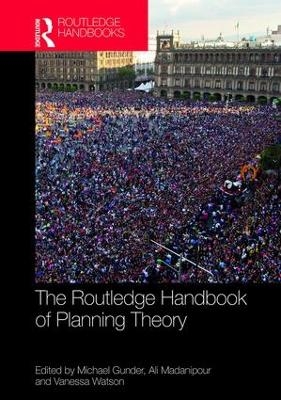
The Routledge Handbook of Planning Theory
Routledge (Verlag)
978-1-138-90501-6 (ISBN)
The Routledge Handbook of Planning Theory presents key contemporary themes in planning theory through the views of some of the most innovative thinkers in planning. They introduce and explore their own specialized areas of planning theory, to conceptualize their contemporary positions and to speculate how these positions are likely to evolve and change as new challenges emerge.
In a changing and often unpredictable globalized world, planning theory is core to understanding how planning and its practices both function and evolve. As illustrated in this book, planning and its many roles have changed profoundly over the recent decades; so have the theories, both critical and explanatory, about its practices, values and knowledges. In the context of these changes, and to contribute to the development of planning research, this handbook identifies and introduces the cutting edge, and the new emerging trajectories, of contemporary planning theory. The aim is to provide the reader with key insights into not just contemporary planning thought, but potential future directions of both planning theory and planning as a whole. This book is written for an international readership, and includes planning theories that address, or have emerged from, both the global North and parts of the world beyond.
Michael Gunder FNZPI is an Associate Professor at the School of Architecture and Planning, University of Auckland, New Zealand. From 2011–2015, he was Managing Editor of Planning Theory and remains an editor. His research draws on poststructuralism to analyse the ideological dimensions of built environment public policies and related narratives. Ali Madanipour is Professor of Urban Design and a founding member of the Global Urban Research Unit at the School of Architecture, Planning and Landscape, Newcastle University, UK. His four-volume edited collection, Planning Theory, was published in 2015 in Routledge’s Critical Concepts in Built Environment series. Vanessa Watson is Professor of Planning in the School of Architecture, Planning and Geomatics at the University of Cape Town, South Africa, holding a PhD from the University of Witwatersrand, and is a University Fellow. She is a founder and on the Board of the African Centre for Cities at UCT.
Planning Theory: An Introduction
Michael Gunder, Ali Madanipour, Vanessa Watson
Part I: Contemporary Planning Practices
Spatial Planning: The Promised Land or Rolled-Out Neoliberalism?
Simin Davoudi
Strategic Planning: Ontological and Epistemological Challenges
Louis Albrechts
Growth Management Theory: From the Garden City to Smart Growth
Jill L. Grant
Planning in the Anthropocene
William E. Rees
Part II: How Meaning/Values are Constructed in Planning
The Public Interest
Stefano Moroni
Rethinking Scholarship on Planning Ethics
Tanja Winkler
Communicative Planning
Tore Sager
Neoliberal Planning
Guy Baeten
Neo Pragmatist Planning Theory
Charles Hoch
Urban Planning and Social Justice
Susan S. Fainstein
The Grassroots of Planning: Poor People's Movements, Political Society, and the Question of Rights
Ananya Roy
The Dilemmas of Diversity: Gender, Race and Ethnicity in Planning Theory
Suzanne Speak and Ashok Kumar
Postcolonial Consequences and New Meanings
Libby Porter
Postpolitics and Planning
Jonathan Metzger
‘Cultural Work’ And the Remaking of Planning’s ‘Apparatus of Truth’
Andy Inch
Countering ‘The Dark Side’ of Planning: Power, Governmentality, Counter-Conduct
Margo Huxley
Co- Evolutionary Planning Theory: Evolutionary Governance Theory and Its Relatives
Kristof Van Assche, Raoul Beunen, Martijn Duineveld
Part III: Networks, Flows, Relationships and Institutions
Flexibly Networked, Yet Institutionally Grounded: The Governance of Planning
Raine Mäntysalo and Pia Bäcklund
New Institutionalism and Planning Theory
André Sorensen
Conflict and Agonism
John Pløger
Insurgent Practices and Decolonization of Future(s)
Faranak Miraftab
State Hegemonic Planning and the Marginalization and Oppression of People
Yosef Jabareen
Actor-Network Theory
Yvonne Rydin
Spatial Planning and the Complexity of Turbulent, Open Environments: About Purposeful Interventions in a World of Non-Linear Change
Gert de Roo
Assemblage Thinking in Planning Theory
Joris Van Wezemael
Lines of Becoming
Jean Hillier
| Erscheinungsdatum | 06.11.2017 |
|---|---|
| Zusatzinfo | 6 Tables, black and white; 4 Halftones, black and white |
| Verlagsort | London |
| Sprache | englisch |
| Maße | 174 x 246 mm |
| Gewicht | 756 g |
| Themenwelt | Naturwissenschaften ► Geowissenschaften ► Geografie / Kartografie |
| Sozialwissenschaften ► Soziologie | |
| Technik ► Architektur | |
| ISBN-10 | 1-138-90501-1 / 1138905011 |
| ISBN-13 | 978-1-138-90501-6 / 9781138905016 |
| Zustand | Neuware |
| Informationen gemäß Produktsicherheitsverordnung (GPSR) | |
| Haben Sie eine Frage zum Produkt? |
aus dem Bereich