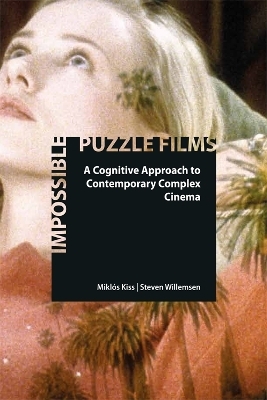
Impossible Puzzle Films
Edinburgh University Press (Verlag)
978-1-4744-0672-7 (ISBN)
Narrative complexity is a trend in contemporary cinema. Since the late 1990s there has been a palpable increase in complex storytelling in movies. But how and why do complex movies create perplexity and confusion? How do we engage with these challenges? And what makes complex stories so attractive? By blending film studies, narrative theory and cognitive sciences, Kiss and Wilemsen look into the relation between complex storytelling and the mind. Analysing the effects that different complex narratives have on viewers, the book addresses how films like Donnie Darko, Mulholland Drive and Primer strategically create complexity and confusion, using the specific category of the impossible puzzle film to examine movies that use baffling paradoxes, impossible loops, and unresolved ambiguities in their stories and storytelling. By looking at how these films play on our mind’s blind spots, this innovative book explains their viewing effects in terms of the mental state of cognitive dissonance that they evoke.
Miklós Kiss is Assistant Professor in Film and Media Studies at the University of Groningen, the Netherlands. His research focuses on contemporary audiovisual media, intersecting the fields of narrative and cognitive film theories. Steven Willemsen is a PhD-candidate and Junior Lecturer in Film Studies at the University of Groningen, the Netherlands. His research addresses the topic of story complexity from embodied-cognitive and narratological perspectives.
Acknowledgements Preface
1. Contemporary Complex Cinema1.1 Complex conditions: the resurgence of narrative complexity1.2 Complex cinema as brain-candy for the empowered viewer1.3 Narrative taxonomies: simple, complex, puzzle plots
2. Cognitive Approach to Contemporary Complex Cinema2.1 Why an (embodied-)cognitive approach?2.2 Various forms of complexity and their effects on sense making2.2.1 Problematizing narrative linearity2.2.2 Complicating narrative structures and ontologies2.2.3 Under-stimulation and cognitive overload2.2.4 Contradictions and unreliabilities2.3 A cognitive approach to classifying complexity2.3.1 Deceptive unreliability and the twist film2.3.2 Disorienting but solvable puzzle films2.3.3 Impossible puzzle films
3. Narrative Complexity and Dissonant Cognitions 3.1 The concept of cognitive dissonance3.2 Cognitions in dissonance: from social psychology to narrative engagement3.3 Types of dissonance in narrative comprehension3.3.1 Narrative incongruities3.3.2 Narrative impossibilities3.4 Cognitive access to impossible storyworlds: immersed and reflected operations3.5 ‘Impossibilities’ and embodied cognition3.5.1 Disrupting viewers’ reliance on image schemas by perceptual impossibility3.5.2 Disrupting viewers’ reliance on image schemas by formal impossibility
4. Taming Dissonance: Cognitive Operations and Interpretive Strategies4.1 Cognitive dissonance versus narrative coherence4.2. Reducing dissonance: interpretation and naturalization4.2.1 Foregrounding4.2.2 Narrating agency and authorship4.2.3 Artefact emotions and metareflexive appreciation4.2.4 Interpretation as dissonance reduction4.3 Coping with dissonance: frame-switches and poetic and aesthetic readings4.4 Frame-switching as hermeneutic play in impossible puzzle films4.4.1 Switching between narrative and symbolical readings: Enemy and Mulholland Drive4.4.2 Cognitive hesitation and the fantastic
5. Impossible Puzzle Films: Between Art-Cinema and (Post-) Classical Narration5.1 From art-cinema to puzzle films5.1.1 Art-cinema as a narrative mode5.1.2 Dissonance in modernist art-cinema5.1.3 Art-cinema as a cognitive reception frame5.1.4 Narrative complexity and meaning-making in art-cinema5.2 Impossible puzzle films and (post-)classical narration5.2.1 High degree of tellability5.2.2 Identification with goal-oriented characters5.2.3 Strong reliance on classical genre elements5.2.4 Adherence to classical narrative cohesion devices5.2.5 Inclusion of quasi-rational frames of naturalization
6. Wallowing in Dissonance: The Attractiveness of Impossible Puzzles 6.1 Hermeneutic play and interpretive multiplicity6.2 Orientation, navigation, mapping6.3 Game logic and the fascination in failure6.4 Effort justification6.5 Diegetization of decoupling6.6 Fascination in infinity6.7 Destabilized ontological certainty6.8. Eudaimonic motivations and intrinsic needs
References Filmography
| Erscheinungsdatum | 31.12.2016 |
|---|---|
| Zusatzinfo | 30 black and white illustrations |
| Verlagsort | Edinburgh |
| Sprache | englisch |
| Maße | 156 x 234 mm |
| Gewicht | 507 g |
| Themenwelt | Kunst / Musik / Theater ► Film / TV |
| Schulbuch / Wörterbuch ► Lexikon / Chroniken | |
| Sozialwissenschaften ► Kommunikation / Medien ► Medienwissenschaft | |
| ISBN-10 | 1-4744-0672-6 / 1474406726 |
| ISBN-13 | 978-1-4744-0672-7 / 9781474406727 |
| Zustand | Neuware |
| Informationen gemäß Produktsicherheitsverordnung (GPSR) | |
| Haben Sie eine Frage zum Produkt? |
aus dem Bereich