


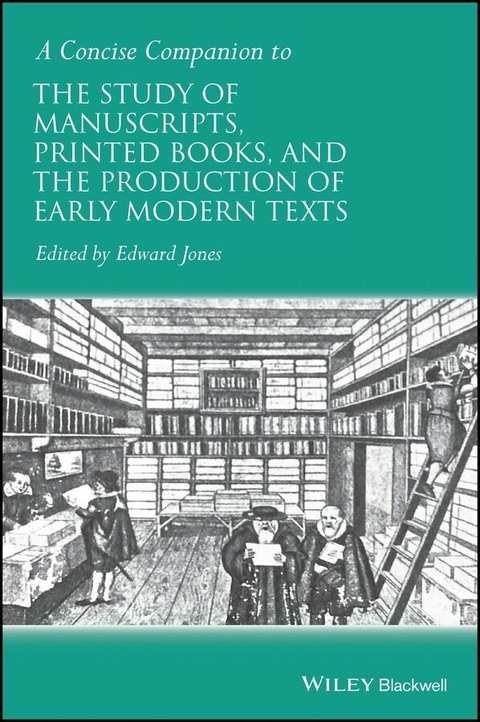
A Concise Companion to the Study of Manuscripts, Printed Books, and the Production of Early Modern Texts (eBook)
John Wiley & Sons (Verlag)
978-1-118-63528-5 (ISBN)

Bringing together a broad range of case studies written by a team of international scholars, this Concise Companion establishes how manuscripts and printed books met the needs of two different approaches to literacy in the early modern period.
- Features essays illustrating the particular ways a manuscript and a printed book reflect the different emphases of an elite, private and an egalitarian, public culture, both of which account for the literary achievements of the Renaissance
- Includes wide-ranging essays, from printing the Gospels in Arabic to a contemporary reconceptualization of Shakespeare's Titus Andronicus
- Increases accessibility through a rubric organized around archival and manuscript studies; the provenance of texts and the authority of editions; and studies of genre, religion and literary history
- Announces the recovery of archival documents, which in some instances are over four hundred years old
- Places translations of Milton's Latin, Greek, and Italian alongside the original texts to increase accessibility for a wide audience of students and scholars
- Provides an invaluable platform for highlighting on-going attention to the history of the book and its corollary subjects of reading and writing practices in the 1500s and 1600s
Edward Jones is a Regents Professor of English at Oklahoma State University and the Editor of Milton Quarterly. His research interests centre on seventeenth-century archival records created by the English state, church, and parish and how such documents inform the life and writings of John Milton. Book-length publications include Milton's Sonnets: An Annotated Bibliography, 1900-1992 and , Young Milton: The Emerging Author, 1620-1642. A selection of his essays can be found in RES, JEGP, A Concise Companion to Milton, The Oxford Handbook of Milton, and Milton in Context.
Bringing together a broad range of case studies written by a team of international scholars, this Concise Companion establishes how manuscripts and printed books met the needs of two different approaches to literacy in the early modern period. Features essays illustrating the particular ways a manuscript and a printed book reflect the different emphases of an elite, private and an egalitarian, public culture, both of which account for the literary achievements of the Renaissance Includes wide-ranging essays, from printing the Gospels in Arabic to a contemporary reconceptualization of Shakespeare's Titus Andronicus Increases accessibility through a rubric organized around archival and manuscript studies; the provenance of texts and the authority of editions; and studies of genre, religion and literary history Announces the recovery of archival documents, which in some instances are over four hundred years old Places translations of Milton's Latin, Greek, and Italian alongside the original texts to increase accessibility for a wide audience of students and scholars Provides an invaluable platform for highlighting on-going attention to the history of the book and its corollary subjects of reading and writing practices in the 1500s and 1600s
Edward Jones is a Regents Professor of English at Oklahoma State University and the Editor of Milton Quarterly. His research interests centre on seventeenth-century archival records created by the English state, church, and parish and how such documents inform the life and writings of John Milton. Book-length publications include Milton's Sonnets: An Annotated Bibliography, 1900-1992 and , Young Milton: The Emerging Author, 1620-1642. A selection of his essays can be found in RES, JEGP, A Concise Companion to Milton, The Oxford Handbook of Milton, and Milton in Context.
Notes on Contributors x
Acknowledgements xiv
Introduction xv
Edward Jones
Part I Manuscript Studies 1
1 Stanford University's Cavendish Manuscript: Wolsey, Elizabeth I, Shakespeare, and Milton 3
Elaine Treharne
2 Texts Presented to Elizabeth I on the University Progresses 21
Sarah Knight
3 Analysing a Private Library, with a Shelflist Attributable to John Hales of Eton, c.1624 41
William Poole
4 Young Milton in His Letters 66
John K. Hale
5 The Itinerant Sibling: Christopher Milton in London and Suffolk 87
Edward Jones
6 Milton, the Attentive Mr Skinner, and the Acts and Discourses of Friendship 106
Cedric C. Brown
Part II Printed Books 129
7 Printing the Gospels in Arabic in Rome in 1590 131
Neil Harris
8 Tyranny and Tragicomedy in Milton's Reading of The Tempest 150
Karen L. Edwards
9 The Earliest Miltonists: Patrick Hume and John Toland 171
Thomas N. Corns
10 The Ghost of Rhetoric: Milton's Logic and the Renaissance Trivium 188
Jameela Lares
Part III Production, Dissemination, Appropriation 207
11 Misprinting Bartholomew Fair: Jonson and 'The Absolute Knave' 209
John Creaser
12 Reliquiae Baxterianae and the Shaping of the Seventeenth Century 229
N.H. Keeble
13 Marvell and the Dutch in 1665 249
Martin Dzelzainis
14 Did Milton Read Selden? 266
Sharon Achinstein
15 Hands On 294
Neil Forsyth
16 Shakespeare with a Difference: Dismembering and Remembering Titus Andronicus in Heiner Müller's and Brigitte Maria Mayer's Anatomie Titus 322
Pascale Aebischer
By Ferry, Foot, and Fate: A Tour in the Hebrides 346
Andrew McNeillie
Index 354
Chapter 1
Stanford University’s Cavendish Manuscript: Wolsey, Elizabeth I, Shakespeare, and Milton
Elaine Treharne
Despite the emergence of print in the fifteenth century, and its rapid adoption throughout western Europe, manuscript culture remained, and still remains, just as significant a means of recording and transmitting texts and documents. In the social, cultural, and religious turmoil of the Tudor and Stuart periods, the production and reception of manuscripts often ensured some degree of permanence of important material, while maintaining privacy for the producers and owners of politically charged texts. Stanford University Libraries Manuscript M0385 CB is a late sixteenth-century manuscript containing a version of one such politically problematic work: George Cavendish’s Life and Death of Cardinal Wolsey.1 The manuscript also contains one other politically motivated text that has not been recognized at all to date, as well as later additions to blank pages in the codex that illustrate the financial affairs of the Harbord family in Worcestershire. The volume was acquired for Stanford’s collection in 1938 from David Magee, an antiquarian book-dealer in San Francisco. Described in the transaction paperwork as 'An original manuscript of Cavendish’s Life of Wolsey', the book had been purchased by Magee in 1937 at an unspecified auction, when he 'bid on it by mail', paying only $30 (Magee 1973, 129–31).2 Magee goes on:
I planned to ask $200.00 for the whole … I listed it in my next catalogue, giving it a full page description in the very front. I waited for the rush of orders. The first came the day after I mailed the catalogue. It was from Nathan van Patten, the librarian of Stanford University. I envisaged other librarians all over the country gnashing their teeth at missing my treasure. But there was very little gnashing – in fact there was none. I never got another order for it. Not one.
(1973, 131)
Why an experienced book-dealer like Magee should have been so excited about the manuscript has nothing to do with the Life of Wolsey per se. His enthusiasm was entirely bound up with the many pages of seventeenth-century accounts attributable to the Worcestershire Harbords. Among these are memoranda that mention not only a certain 'William Shakespeare', but also, and most fittingly for the honorand of this volume,3 one 'John Milton' dated to the year 1636: 'For account of John Milton the 24th Aprille, half years rent due at Lady Day last, £8.10.0.'
Perhaps unsurprisingly, Magee’s imagination ran amok on discovering these connections, particularly since the Harbords themselves lived 'near Stratford-on Avon' and:
Scholars acknowledge that it is more than likely Shakespeare had access to a manuscript copy of The Life and Death of Cardinal Wolsey when writing Henry VIII … Was I being absurd in imagining I might have the very copy of the Wolsey life that Shakespeare had borrowed from his neighbors, the Hardbords?
(1973, 130)
Whether or not this manuscript could be directly linked to Shakespeare is, as yet, unprovable,4 but that the key features associated with the volume were considered to be these famous names cited in the added accounts is evident from the Stanford University Libraries Catalogue entry for MS M0385 CB. It rather pre-emptively reads:
This copy is of particular interest on account of the family financial records (17th century) of the Harbords who originally owned the manuscript and which are to be found in the front and back of the volume. These records give values of commodities, rents, land holdings, wages of servants, labourers, etc. Also because the Harbords lived near Stratford-on-Avon and because one of the receipts is to a William Shakespeare, it is remotely possible that this was the copy Shakespeare used when writing Henry VIII. There is also a receipt to a John Milton.
(Stanford University Libraries Catalogue)
Quite how the Harbords acquired this manuscript is unclear, and it is doubtful they were the 'original' owners, but they certainly owned it by 1627, the year that the sequence of their accounts begins. After 1647, there are no further accounting items and the history of the manuscript is unknown until the nineteenth century, when it is apparent from both an ex libris and a small sticker at the bottom of the volume’s spine that the book had come into the hands of the famous book collector, Sir Thomas Phillipps (1792–1872), where it was numbered 'Phillipps MS 22392'.5
While the history of the manuscript can be partially reconstructed, then, and its misleadingly famous-name connections are of obvious interest, the manuscript’s real significance comes from elsewhere, both in terms of its original contents and in terms of the contents of the accounts: namely, included after the Life of Wolsey in the same hand is a text that seems unique, detailing the need for Elizabeth I to intervene in the Revolt of the Netherlands, possibly around the time of the Treaty of Nonsuch in 1585 (transcribed below); and included among the later Harbord accounts of amounts paid and owing is information about the quartering of soldiers during the English Civil War, not recorded in scholarship to date, a sample of which is partially transcribed below. All of these texts combine to form a manuscript volume that is of considerable importance from the perspective of early modern political and social history. While it comes to us incomplete, it is nevertheless, like so many of these early volumes in university libraries across the world, worthy of sustained scholarly attention, attention that this chapter seeks to encourage.
Stanford University Libraries MS M0385 CB: description and textual history
MS M0385 CB is a quarto-sized volume, covered in tanned brown leather with a gold embossed device on the front and back covers, surrounded by a gold frame with foliate corners. A pair of clasps has now been lost. The spine is labelled in gold tooling with 'Life of Cardinal Wolsey'. Toward the bottom of the spine, the small paper sticker associated with the Phillipps Library notes this is volume '22392' (AMARC Research Collections 2013). This provenance is supported by the Phillipps ex libris on the front pastedown, which is followed by a pencilled note, 'Lionel Hyatt / I gave him a book in exchange f […]'. The binding at the bottom and outer margins of the book is very worn, suggesting that this is the original sixteenth-century binding. Supporting this is the current state of what is now the whole book: many pages have been removed and reused or lost, including at least ten whole folios whose stubs remain prior to the first surviving leaf of The Life of Cardinal Wolsey, and many more excised from the end of the book. Moreover, individual pages and parts of pages have been torn out throughout the volume. As such, the relative slimness of the book-block in relation to its binding means the covers are now somewhat concave in the middle.
The book is comprised of 125 folios of paper, made up of quires that might have originally contained fourteen folios. The watermark is an elaborate-looking greyhound-type of dog with a single flower or four-leaf clover on a stem on its back; this is reminiscent of watermarks known in the 1570s and 1580s, similar to those of Jean Nivelle listed by Briquet as 3642 (Laboratoire de Médiévistique Occidentale de Paris 2013), and sometimes found in English legal manuscripts (see, for example, the watermarks listed at Warwick Centre for the Study of the Renaissance, LIMA: Watermark Databases).
Within the original sections of text, the leaves measure 167 mm × 216 mm, and the writing grid extends across the page towards the edge of the right margin, with lower margins of 19 mm and left margins of about 25 mm. Upper margins are minimal. There are thirty-six or thirty-seven lines of text per page, each page finishing with a catchword. The whole text is written out as a continuous block of prose with few paragraphs, though occasionally, in the Life of Wolsey, new sections do begin with a line-space and enlarged capital.
The manuscript’s contents are:
- Front pastedown 1–21, fols. 1–2v: financial accounts of the Harbord family (1635)
- fols. 3v–98v: Cavendish’s Life and Death of Cardinal Wolsey
- fols. 99–100: Harbord financial accounts
- fol. 101rv: blank
- fols. 102r–105r/18: Justification for English Intervention in the Dutch Revolt (1580s?)
- fols. 105v–25v: Harbord financial accounts, 1627–47 (fol. 123 blank)
- Back pastedown: various notes
The Life of Wolsey and Justification for English Intervention in the Dutch Revolt6 are written in the same later sixteenth-century accomplished secretary hand. Both appear to be fair copies of the text, devoid, for the most part, of scribal corrections and other errors. Both texts are damaged: the Life of Wolsey is acephalous and without its title, therefore; approximately twenty per cent of the Justification text has been carelessly torn out, the most extensive...
| Erscheint lt. Verlag | 14.8.2015 |
|---|---|
| Reihe/Serie | Concise Companions to Literature and Culture |
| Concise Companions to Literature and Culture | Concise Companions to Literature and Culture |
| Sprache | englisch |
| Themenwelt | Geisteswissenschaften ► Sprach- / Literaturwissenschaft ► Anglistik / Amerikanistik |
| Geisteswissenschaften ► Sprach- / Literaturwissenschaft ► Literaturwissenschaft | |
| Sozialwissenschaften ► Kommunikation / Medien ► Buchhandel / Bibliothekswesen | |
| Schlagworte | 17th century british literature • 17th Century English Literature • American Founding Fathers • Andrew Marvell • Bartholomew Fair • Behn • Book History • Book Production • Christopher Milton • Early Modern Journalism • early modern readers • Early Modern Studies • Englische Literatur / 17. Jhd. • Englische Literatur / Renaissance • Englische Literatur / Shakespeare • Englischsprachige Literatur • english church • English Civil War • first Miltonists • history of the book • John Milton • Johnson • Literary Biography • Literary History • Literature • Literaturwissenschaft • Manuscript Studies • Marston • medieval manuscripts • Milton's letters • printed books • printing the Gospels • Protectorate • Reading literature • Reliquiae Baxterianae • Renaissance • Renaissance English Literature • Renaissance studies • Shakespeare • study of manuscripts • the Commonwealth • The Gospels • the State |
| ISBN-10 | 1-118-63528-0 / 1118635280 |
| ISBN-13 | 978-1-118-63528-5 / 9781118635285 |
| Informationen gemäß Produktsicherheitsverordnung (GPSR) | |
| Haben Sie eine Frage zum Produkt? |
 EPUB (Adobe DRM)
Kopierschutz: Adobe-DRM
Adobe-DRM ist ein Kopierschutz, der das eBook vor Mißbrauch schützen soll. Dabei wird das eBook bereits beim Download auf Ihre persönliche Adobe-ID autorisiert. Lesen können Sie das eBook dann nur auf den Geräten, welche ebenfalls auf Ihre Adobe-ID registriert sind.
Details zum Adobe-DRM
Dateiformat: EPUB (Electronic Publication)
EPUB ist ein offener Standard für eBooks und eignet sich besonders zur Darstellung von Belletristik und Sachbüchern. Der Fließtext wird dynamisch an die Display- und Schriftgröße angepasst. Auch für mobile Lesegeräte ist EPUB daher gut geeignet.
Systemvoraussetzungen:
PC/Mac: Mit einem PC oder Mac können Sie dieses eBook lesen. Sie benötigen eine
eReader: Dieses eBook kann mit (fast) allen eBook-Readern gelesen werden. Mit dem amazon-Kindle ist es aber nicht kompatibel.
Smartphone/Tablet: Egal ob Apple oder Android, dieses eBook können Sie lesen. Sie benötigen eine
Geräteliste und zusätzliche Hinweise
Buying eBooks from abroad
For tax law reasons we can sell eBooks just within Germany and Switzerland. Regrettably we cannot fulfill eBook-orders from other countries.
aus dem Bereich


