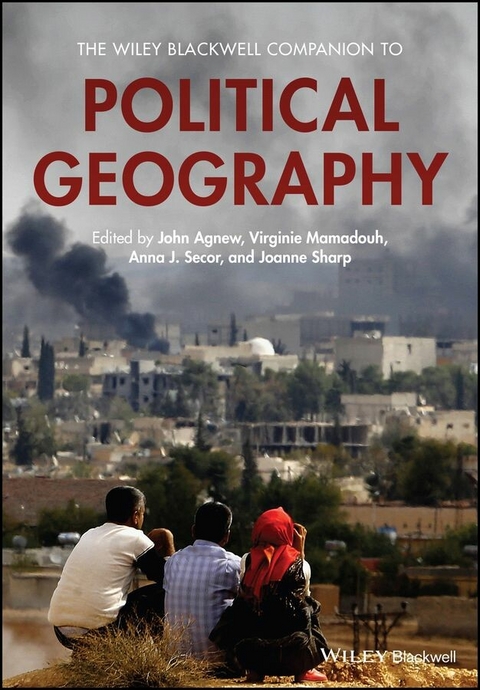
- Discusses the latest developments and places increased emphasis on modes of thinking, contested key concepts, and on geopolitics, climate change and terrorism
- Explores the influence of the practice-based methods in geography and concepts including postcolonialism, feminist geographies, the notion of the Anthropocene, and new understandings of the role of non-human actors in networks of power
- Offers an accessible introduction to political geography for those in allied fields including political science, international relations, and sociology
John Agnew is Distinguished Professor of Geography at the University of California, Los Angeles. He has taught at a number of universities including Syracuse University, the University of Chicago, and the University of Siena. He has authored or co-authored numerous books including Berlusconi's Italy: Mapping Contemporary Italian Politics (2008) and Globalization and Sovereignty (2009). He is co-editor of the Wiley Blackwell Companion to Human Geography (2011).
Virginie Mamadouh is Associate Professor of Political and Cultural Geography at the University of Amsterdam and an editor of the international academic journal Geopolitics. Her research interests are in European geopolitics, new media and multilingualism. She is co-editor of The Theory and Practice of Institutional Transplantation (with Martin de Jong and Kostas Lalenis, 2002), Critical Essays in Human Geography (with J. Agnew, 2008), and Urban Europe: Fifty tales of the city (with A. van Wageningen, 2016).
Anna J. Secor is Professor of Geography at the University of Kentucky and the Hajja Razia Sharif Sheikh Professor of Islamic Studies. Her research focuses on theories of space, politics, and subjectivity. Recently she has developed ideas of topology in geography by engaging the work of Lacan, Deleuze, and Agamben. Her research on Islam, state, and society in Turkey has been funded by the National Science Foundation.
Joanne Sharp is Professor of Geography at the University of Glasgow. Her research interests are in feminist, postcolonial, cultural and political geographies. She is the author of Geographies of Postcolonialism: Spaces of Power and Representation (2009) and editor of The Ashgate Research Companion to Critical Geopolitics (with Klaus Dodds and Merje Kuus, 2013).
The Wiley Blackwell Companion to Political Geography aims to account for the intellectual and worldly developments that have taken place in and around political geography in the last 10 years. Bringing together established names in the field as well as new scholars, it highlights provocative theoretical and conceptual debates on political geography from a range of global perspectives. Discusses the latest developments and places increased emphasis on modes of thinking, contested key concepts, and on geopolitics, climate change and terrorism Explores the influence of the practice-based methods in geography and concepts including postcolonialism, feminist geographies, the notion of the Anthropocene, and new understandings of the role of non-human actors in networks of power Offers an accessible introduction to political geography for those in allied fields including political science, international relations, and sociology
John Agnew is Distinguished Professor of Geography at the University of California, Los Angeles. He has taught at a number of universities including Syracuse University, the University of Chicago, and the University of Siena. He has authored or co-authored numerous books including Berlusconi's Italy: Mapping Contemporary Italian Politics (2008) and Globalization and Sovereignty (2009). He is co-editor of the Wiley Blackwell Companion to Human Geography (2011). Virginie Mamadouh is Associate Professor of Political and Cultural Geography at the University of Amsterdam and an editor of the international academic journal Geopolitics. Her research interests are in European geopolitics, new media and multilingualism. She is co-editor of The Theory and Practice of Institutional Transplantation (with Martin de Jong and Kostas Lalenis, 2002), Critical Essays in Human Geography (with J. Agnew, 2008), and Urban Europe: Fifty tales of the city (with A. van Wageningen, 2016). Anna J. Secor is Professor of Geography at the University of Kentucky and the Hajja Razia Sharif Sheikh Professor of Islamic Studies. Her research focuses on theories of space, politics, and subjectivity. Recently she has developed ideas of topology in geography by engaging the work of Lacan, Deleuze, and Agamben. Her research on Islam, state, and society in Turkey has been funded by the National Science Foundation. Joanne Sharp is Professor of Geography at the University of Glasgow. Her research interests are in feminist, postcolonial, cultural and political geographies. She is the author of Geographies of Postcolonialism: Spaces of Power and Representation (2009) and editor of The Ashgate Research Companion to Critical Geopolitics (with Klaus Dodds and Merje Kuus, 2013).
Notes on Contributors viii
1 Introduction 1
John Agnew, Virginie Mamadouh, Anna J. Secor, and Joanne Sharp
Key Concepts in Political Geography 11
2 Boundaries and Borders 13
Anne?-Laure Amilhat Szary
3 Scale 26
Andrew E.G. Jonas
4 Territory beyond the Anglophone Tradition 35
Cristina Del Biaggio
5 Sovereignty 48
Joshua E. Barkan
6 The State 61
Alex Jeffrey
7 Federalism and Multilevel Governance 73
Herman van der Wusten
8 Geographies of Conflict 86
Clionadh Raleigh
9 Security 100
Lauren Martin
10 Violence 114
James Tyner
11 Justice 127
Farhana Sultana
12 Power 141
Joe Painter
13 Citizenship 152
Patricia Ehrkamp and Malene H. Jacobsen
14 The Biopolitical Imperative 165
Claudio Minca
Theorizing Political Geography 187
15 Spatial Analysis 189
Andrew M. Linke and John O'Loughlin
16 Radical Political Geographies 206
Simon Springer
17 Geopolitics/Critical Geopolitics 220
Sami Moisio
18 Feminist Political Geography 235
Jennifer L. Fluri
19 Postcolonialism 248
Chih Yuan Woon
20 Children's Political Geographies 265
Kirsi Pauliina Kallio and Jouni Häkli
Doing Politics 279
21 Electoral Geography in the Twenty?]First Century 281
Michael Shin
22 Nation and Nationalism 297
Marco Antonsich
23 Regional Institutions 311
Merje Kuus
24 The Banality of Empire 324
Luca Muscarà
25 Social Movements 339
Sara Koopman
26 Religious Movements 352
Tristan Sturm
27 Sexual Politics 366
Catherine J. Nash and Kath Browne
28 The Rise of the BRICS 379
Marcus Power
29 Social Media 393
Paul C. Adams
Material Political Geographies 407
30 More?-Than?-Representational Political Geographies 409
Martin Müller
31 Resources 424
Kathryn Furlong and Emma S. Norman
32 Political Ecologies of the State 438
Katie Meehan and Olivia C. Molden
33 Environment: From Determinism to the Anthropocene 451
Simon Dalby
34 Financial Crises 462
Brett Christophers
35 Migration 478
Michael Samers
36 Everyday Political Geographies 493
Sara Fregonese
Doing Political Geography 507
37 Academic Capitalism and the Geopolitics of Knowledge 509
Anssi Paasi
Index 524
The Wiley Blackwell Companion to Political Geography is a must-have for students and scholars working in this area. This volume shows how long-standing concepts are undergoing rapid change, such as the broadening of agency to include children and the non-human, even as it directs our attention to central concerns that have remained pillars of political geography since its beginning, such as borders and resources. Rarely are so many leading voices gathered in a single volume, and to such effect. This should be the first port of call for any student trying to grasp the whole of the field.
Jason Dittmer, University College London
The Companion to Political Geography is just that, an indispensable volume or companion for any political geographer, whatever the stage of their career; a political geographers "best friend" in the process of learning and doing political geography. It blends historical scope, conceptual depth, theoretical insight, and an impressive empirical range. The Companion balances a reflection upon what has been done, with a call to what needs to be done, while serving as a theoretical and methodological guidebook for how to approach new research. It allows a reader to interpret political geography that has come before and offers meaningful signposts to what may come next. In the process it gives political geographers the ability to reflect on who they are, what they do, and for whom.
Colin Flint, Utah State University
These essays compellingly illustrate how exciting the field has become as they map agendas in political geography...
James D Sidaway, National University of Singapore
Notes on Contributors
Paul C. Adams is Associate Professor of Geography at the University of Texas at Austin, USA. His research addresses place images in the media, the historical geography of communication technologies, geopolitical discourses, and the integration of communication technologies into particular places. He has published articles in the Annals of the AAG, Progress in Human Geography, and Political Geography, among other journals. His books include The Ashgate Research Companion to Media Geography (co-edited with Jim Craine and Jason Dittmer, Ashgate, 2014), Geographies of Media and Communication (Wiley-Blackwell, 2009), Atlantic Reverberations (Ashgate, 2007), The Boundless Self (Syracuse University Press, 2005), and Textures of Place (co-edited with Steven Hoelscher and Karen Till, University of Minnesota Press, 2001). He is the founder of the Communication Geography Specialty Group of the AAG.
John Agnew is Distinguished Professor of Geography at University of California at Los Angeles, USA. He was co-editor of the first edition of the Companion to Political Geography.
Anne-Laure Amilhat Szary, PhD, is a full Professor at Grenoble-Alpes University, France, and a member of the Institut Universitaire de France. A political geographer dedicated to border studies, her latest research concerns the interrelations between art and culture, in and about contested places. She is a founding member of the antiAtlas of borders collective (http://www.antiatlas.net/en/), an art-science project. Her most recent book, Borderities: The Politics of Contemporary Mobile (Palgrave Macmillan 2015) was co-edited with F. Giraut.
Marco Antonsich is a senior lecturer in Human Geography at the Loughborough University, UK. His work lies at the intersection between territory, power, and identity, exploring the production of Western geopolitical discourses; the relationship between territory and identity in the age of globalization at multiple scales; and how togetherness in diversity is theorized and lived within contemporary multicultural societies. Funded by various institutions (US National Science Foundation; NATO and Italian National Research Council; CIMO-Finland; and the European Commission), his work has appeared in leading academic journals: Progress in Human Geography, Political Geography, European Urban and Regional Studies, European Journal of Social Theory, and Annals of the Association of American Geographers, among others. He holds a PhD in Political Geography from the University of Trieste, Italy and a PhD in Geography from the University of Colorado at Boulder, USA.
Joshua E. Barkan is an Associate Professor of Geography at the University of Georgia, USA, where he studies the intersection of law, political economy, and social and political thought. His writing focuses on the relationships between corporations and sovereign, disciplinary, and biopolitical power. He recently published his first book, Corporate Sovereignty: Law and Government under Capitalism (University of Minnesota Press, 2013).
Kath Browne is a Reader in Human Geography at the University of Brighton, UK. Her work exists on the interstices of gender, sexualities, and geographies. Her scholarship includes resistances to LGBT equalities, lesbian, gay, bisexual and trans lives, womyn’s separatist spaces, pride events, and queer, feminist, and participatory methodologies. Her most recent book, Ordinary in Brighton: LGBT, Activisms and the City (Ashgate, 2013), was co-authored with activist researcher Leela Bakshi. Research with Catherine Nash has exposed transnational resistances to LGBT equalities. She is currently working on an Economic and Social Research Council grant that explores what makes life liveable for LGBTQ people.
Brett Christophers is associate professor at the Institute for Housing and Urban Research and the Department of Social and Economic Geography at Uppsala University, Sweden. His research ranges widely across the political and cultural economies of Western capitalism, in both historical and contemporary perspectives. Particular interests include money, finance, and banking; housing and housing policy; urban political economy; markets and pricing; accounting, modeling, and other calculative practices; competition and intellectual property law; and the cultural industries and the discourse of “creativity.”
Simon Dalby is CIGI Chair in the Political Economy of Climate Change at the Balsillie School of International Affairs and Professor of Geography and Environmental Studies at Wilfrid Laurier University, Canada. He is author of Creating the Second Cold War (Pinter/Guilford, 1990), Environmental Security (University of Minnesota Press, 2002) and Security and Environmental Change (Polity, 2009).
Cristina Del Biaggio teaches at the University of Geneva and has been invited researcher at the Institute of European Studies, University of Amsterdam, The Netherlands (2013–2014). She obtained her PhD at the University of Geneva in 2013. In her thesis she studied processes of regional institutionalization through a qualitative analysis of networks of local actors that took form from the 1990s in the Alps. Her current postdoctoral research relates to borders and migrations in Europe.
Patricia Ehrkamp is an Associate Professor in the Department of Geography at the University of Kentucky, USA. She researches contemporary processes of immigration, citizenship, and democracy in the United States and Europe. Her research examines expectations for immigrant assimilation in the context of exclusionary discourses about Islam in Western Europe, attending to the relationship between religion, gender, secularism, and democracy. Most recently, she completed a US National Science Foundation–funded research project, “Places of Worship and the Politics of Citizenship: Immigrants and Communities of Faith in the U.S. South.”
Jennifer L. Fluri is an Associate Professor in the Department of Geography at the University of Colorado-Boulder, USA. Her research examines geopolitics, gender politics, and the geo-economics of international military aid and development interventions in South Asia. Her research appears in several peer-reviewed academic journals. Her forthcoming book, co-authored with Rachel Lehr, explores intimate geopolitics through several different entanglements between Americans and Afghans, and the various currencies from gender to grief that have manifested from discursive framing of 9/11 and the US-led war in Afghanistan. She is currently working on a new project that explores the role of Afghan women’s organizations in Afghanistan’s political and economic transitions.
Sara Fregonese is Birmingham Fellow in the School of Geography, Earth and Environmental Studies and the Institute for Conflict, Cooperation and Security at the University of Birmingham, UK. Her research concerns the mutual influence between geopolitics and the urban environment. She researches and publishes on urban warfare, radicalization and social cohesion, uprising and protest, and has over ten years’ research experience in Beirut, Lebanon. She co-authored The Radicals’ City: Urban Environment, Polarization, Cohesion (Ashgate, 2013).
Kathryn Furlong is an Assistant Professor in Geography at the Université de Montréal, Canada. She holds the Canada Research Chair in Urban, Water and Utility Governance. Her most recent work looks at the shifting nature of public utility corporations in Colombia and The Netherlands.
Jouni Häkli is Professor of Regional Studies at the University of Tampere, Finland. He is Vice Director of the Research Center of Relational and Territorial Politics of Bordering, Identities and Transnationalization (RELATE), and leads the Space and Political Agency Research Group (SPARG). He specializes in spatial and social theory, border studies, transnationalization, and political agency and subjectivity.
Malene H. Jacobsen is a PhD student in the Department of Geography at the University of Kentucky, USA. Her research focuses on the experiences of forced migrants with transnational migration management institutions that straddle the Middle East and Europe, with particular emphasis on Syrian asylum seekers migrating to Denmark.
Alex Jeffrey is a University Lecturer in Human Geography at the University of Cambridge, UK. His research has examined the geographies of state-building after conflict, in particular in the former Yugoslavia. In 2013 he published The Improvised State: Sovereignty, Performance and Agency in Dayton Bosnia (Wiley-Blackwell). He is currently undertaking research exploring the geographical implications of war crimes trials.
Andrew E.G. Jonas is Professor of Human Geography at Hull University, UK. His PhD is from The Ohio State University under the supervision of Kevin R. Cox. His latest book, co-authored with Eugene McCann and Mary Thomas, is Urban Geography: A Critical Introduction (Wiley-Blackwell). His co-edited books include The Urban Growth Machine: Critical Perspectives Two Decades Later (SUNY Press, 1999), Interrogating Alterity (Ashgate, 2010), and Territory, State and Urban Politics (Ashgate, 2012).
Kirsi Pauliina Kallio is Academy Fellow at the University of Tampere, Finland,...
| Erscheint lt. Verlag | 10.8.2015 |
|---|---|
| Reihe/Serie | Blackwell Companions to Geography |
| Blackwell Companions to Geography | Wiley Blackwell Companions to Geography |
| Sprache | englisch |
| Themenwelt | Naturwissenschaften ► Geowissenschaften ► Geografie / Kartografie |
| Sozialwissenschaften ► Politik / Verwaltung ► Europäische / Internationale Politik | |
| Sozialwissenschaften ► Soziologie | |
| Technik | |
| Schlagworte | Al Qaeda • Anthropocene</p> • anti-imperial • Biopolitics • Boundaries • BRICs • China • Citizenship • climate change • colonial present • conflict • Critical geopolitics • democracies • electoral geographies • Environment • Federal • feminist political geographies • Financial Crises • Fundamentalist • Geographie • Geography • Geopolitics • Globalization • Governance • imperial • Internationale Beziehungen • International Relations • Justice • <p>Political geography • Migration • Mobility • Nationalism • Nation-Building • Nature • New Media • Peace • Political Ecology • Political Geography • Political Science • Political Sociology • Politikwissenschaft • Politische Geographie • Politische Soziologie • popular uprisings • Post-colonial • Power • radical political geographies • Recession • regional institutions • Religious • resources • security • sexual politics • Social Media • Social Movements • Sociology • Sovereignty • Soziologie • spatial analysis • State • Territory • Violence • virtual political geographies • war |
| ISBN-13 | 9781118725870 / 9781118725870 |
| Informationen gemäß Produktsicherheitsverordnung (GPSR) | |
| Haben Sie eine Frage zum Produkt? |
 EPUB (Adobe DRM)
Kopierschutz: Adobe-DRM
Adobe-DRM ist ein Kopierschutz, der das eBook vor Mißbrauch schützen soll. Dabei wird das eBook bereits beim Download auf Ihre persönliche Adobe-ID autorisiert. Lesen können Sie das eBook dann nur auf den Geräten, welche ebenfalls auf Ihre Adobe-ID registriert sind.
Details zum Adobe-DRM
Dateiformat: EPUB (Electronic Publication)
EPUB ist ein offener Standard für eBooks und eignet sich besonders zur Darstellung von Belletristik und Sachbüchern. Der Fließtext wird dynamisch an die Display- und Schriftgröße angepasst. Auch für mobile Lesegeräte ist EPUB daher gut geeignet.
Systemvoraussetzungen:
PC/Mac: Mit einem PC oder Mac können Sie dieses eBook lesen. Sie benötigen eine
eReader: Dieses eBook kann mit (fast) allen eBook-Readern gelesen werden. Mit dem amazon-Kindle ist es aber nicht kompatibel.
Smartphone/Tablet: Egal ob Apple oder Android, dieses eBook können Sie lesen. Sie benötigen eine
Geräteliste und zusätzliche Hinweise
Buying eBooks from abroad
For tax law reasons we can sell eBooks just within Germany and Switzerland. Regrettably we cannot fulfill eBook-orders from other countries.
aus dem Bereich